Information: This page contains numerous references to federal, state, regional, and local agencies. Links to websites for these agencies can be found in the References section.
Stormwater programs and permit requirements
This section is intended to serve as guidance to assist stormwater practitioners and the regulated community in identifying and complying with existing federal, state, and local storm and surface water regulations. Several of the major programs implemented at a local level are included in the discussions and summaries in this section. However, local programs can vary considerably and go beyond the scope topics covered in this of this section. Contact the local zoning authority for more specific information on requirements for the project area.
Overview
Many agencies at the federal, state, watershed, and local levels have jurisdiction over surface and ground waters in Minnesota. These jurisdictions can vary and overlap. Multiple agencies involved in managing the same jurisdictional water lead to complex regulations and permitting programs. This complexity is documented in the 2002 report by the Minnesota Planning Department titled: Charting a Course for the Future: Report of the State Water Program Reorganization Project.
This section of the manual focuses solely on those programs and permits that are specifically tied to stormwater management, though many other programs may exist that have an indirect stormwater connection. Examples include federal and state hazardous waste management, aboveground and underground storage tanks, solid waste management, oil handling and spill prevention, pesticide management, and facility planning and construction. (See also File:Issue paper C - stormwater regulatory framework.pdf)
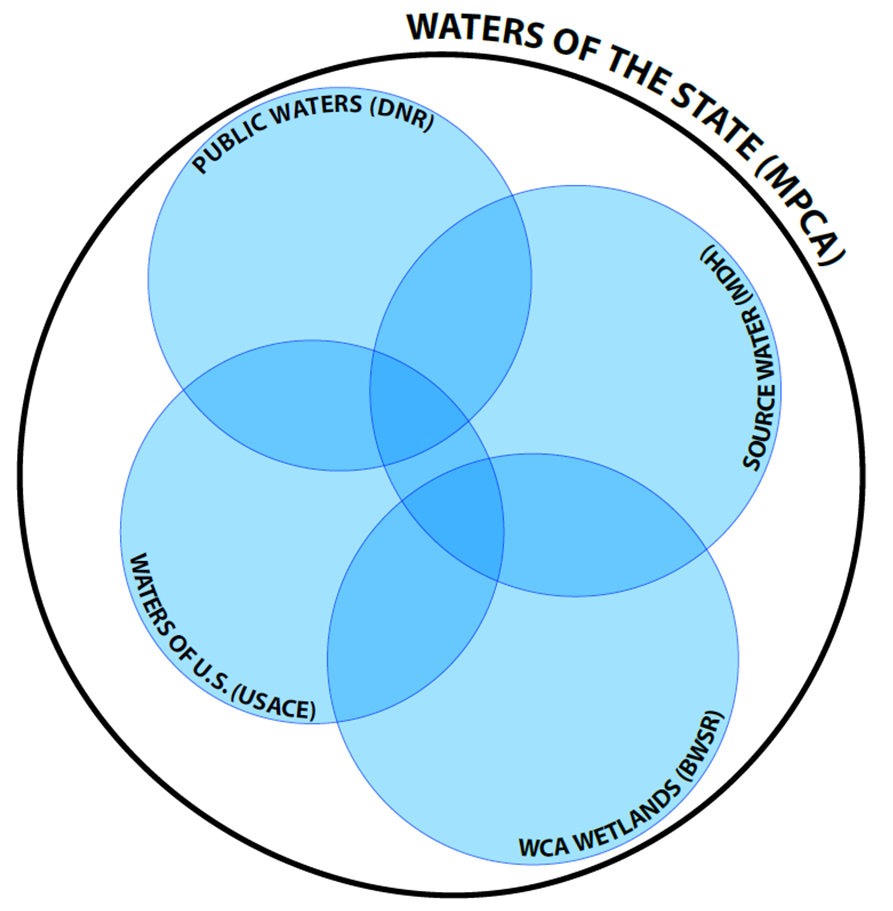
This section further focuses on description/interpretation of programs and permits at the federal and state levels. Most of the decisions about development and land use however are made at the local level. It is also at the local level that the effects of runoff problems become most apparent and the responsibility for implementing and maintaining the stormwater infrastructure and stormwater management resides. Because of this, many of the federal and state regulatory programs have a large impact on stormwater management responsibilities at the local level. Counties, watershed organizations, regional agencies (e.g. Metropolitan Council), municipalities, and townships are all examples of local government groups that may have responsibility for stormwater management.
The implementation vehicle for many local stormwater management programs is through local ordinances. Stormwater management activities may be addressed through specific stormwater ordinances, zoning ordinances or development ordinances and may contain requirements for water quantity, water quality, erosion and sediment control, nonpoint source pollution control, channel protection, and natural area protection.
While the Manual has no regulatory authority in and of itself, it seeks to provide a sound technical basis for stormwater management design and implementation. This can be coordinated on a statewide level through existing laws and regulations.
The table below provides a summary of regulatory authorities for some common stormwater management activities. It outlines the agencies with permitting or review authority and those with the ability to set standards or provide enforcement for those programs.
| Action classes | Federal | State | Locala | ||||||
|---|---|---|---|---|---|---|---|---|---|
| USEPA | USACE | FEMA | MPCA | DNR | BWSR | MDH | Met Council | LGUs | |
| Erosion and sediment control | Conditional | Full | Review | Full | |||||
| Lake, stream, river protection | Conditional | Full | Review | Full | Full | Review | review | Conditional | |
| Wetland protection | Review | Full | review | Full | Full | Review | Review | Full | |
| Groundwater protection | Conditional | Full | Full | Conditional | Conditional | Full | |||
| Surface water quality protection | Conditional | Full | Conditional | Review | Review | Conditional | |||
| Construction stormwater discharge | Conditional | Full | Conditional | Review | Conditional | ||||
| Municipal stormwater discharge | Conditional | Full | Review | Conditional | |||||
| Industrial stormwater discharge | Conditional | Full | Conditional | Conditional | |||||
| Agricultural stormwater discharge | Conditional | Full | Review | Conditional | |||||
| Flood control | Full | Full | Conditional | Review | Conditional | ||||
| aDepending upon location in the state, the local jurisdictions may be administered at the county, watershed organization (if one exists), city/township/village, or tribal level, or a combination of these. contact the local zoning authority for more information on local regulations. USEPA = United States Environmental Protection Agency, USACE = United States Army Corp of Engineers, FEMA = Federal Emergency Management Agency, MPCA = Minnesota Pollution Control Agency, DNR = Minnesota Department of Natural Resources, BWSR = Board of Water and Soil Resources, MDH = Minnesota Department of Health Note: FEMA, BWSR and MDH have no enforcement authority for any of these action classes. Met Council has enforcement authority for industrial stormwater discharges. The remaining agencies have enforcement authority. |
|||||||||