Information: We recently updated this page and will continue to work on information about MS4 stormwater management. Information and resources previously found on the MS4 Toolkit page are now housed on this page.
NOTE: Minnesota uses the term Stormwater Pollution Prevention Program (SWPPP) for MS4 stormwater, while several states and EPA may use the term Stormwater Management Plan (SWMP). These terms refer to the same thing.
Link to MPCA MS4 staff contact information
On this Page
- MS4 Program Background
- What is a municipal separate storm sewer system (MS4)?
- Why is a municipality regulated under the MS4 permit?
The municipal separate storm sewer system (MS4) stormwater program is designed to reduce the amount of sediment and pollution that enters surface and ground water from storm sewer systems. Public entities that own or operate an MS4 play a key role in preventing or reducing the negative impacts stormwater runoff has on our valuable water resources.
Proper stormwater runoff management in urbanized areas is especially important for restoring and protecting surface waters. Urbanized areas are more likely to have activities that contribute pollutants to stormwater runoff, like applying anti/deicing mixtures to roads; fueling vehicles; grease, oil, and other spills; landscaping; and using pesticides and fertilizers. Urbanized areas have a large amount of impervious surfaces, or surfaces that rain and snowmelt cannot pass through, such as streets, driveways, rooftops, parking lots and sidewalks. Stormwater runoff from these surfaces travels faster and in higher amounts, damaging rivers, streams, and wetlands; destroying aquatic habitats; increasing the amount of pollution that enters surface waters; and limiting groundwater recharge and the MS4 program is to help mitigate the impact.
Background Information
Regulated MS4 permittees are required to develop a stormwater pollution prevention program (SWPPP) to reduce the pollutants entering the municipality's storm sewer system. When applying for the MS4 permit, permittees identified measurable goals they intended their SWPPP to reach. Based on these goals, permittees should evaluate the effectiveness of their program and make any necessary changes.
What is a municipal separate storm sewer system (MS4)?
A municipal separate storm sewer system (MS4) is a means of transportation, individually or in a system, (e.g. roads with drainage systems, municipal streets, catch basins, curbs, gutters, ditches, man-made channels, storm drains, etc.) that are:
- owned or operated by a public entity (e.g. cities, townships, counties, military bases, hospitals, prison complexes, highway departments, universities, etc.) with jurisdiction over disposal of sewage, industrial wastes, stormwater, or other wastes. This includes special districts under State law (sewer, flood control, or drainage districts, etc.), an authorized Indian tribal organization, or a designated and approved management agency under section 208 of the Clean Water Act;
- designed or used for collecting or transporting stormwater;
- not a combined sewer; and
- not part of a publicly owned treatment works.
What is an MS4? Watch the video: MS4 Program Overview and Minimum Control Measures (MCM) Descriptions - YouTube Video
Why is a municipality regulated under the MS4 permit?
Only certain MS4s in Minnesota are subject to stormwater regulation under the Clean Water Act and Minnesota Rule 7090. The MPCA regulates the following:
- An MS4 located fully or partially within an urbanized area as determined by the latest Decennial Census and owned or operated by a publicly owned entity that has the potential resident capacity, bed count occupancy, or average daily user population of 1,000 or more. See changes in regulated areas for cities and townships due to 2019 Legislation for more information.
- An MS4 owned or operated by a municipality with a population of 10,000 or more.
- An MS4 owned or operated by a municipality with a population of at least 5,000 and discharges or has the potential to discharge stormwater to one of the following:
- A water identified as an outstanding resource value water as identified in Minn R. 7050.0335.
- A water identified as a trout lake or trout stream as identified in Minn. R. 6264.0050, subparts 2 and 4.
- A water listed as impaired under section 303(d) of the Clean Water Act, 33 U.S.C. § 1313.
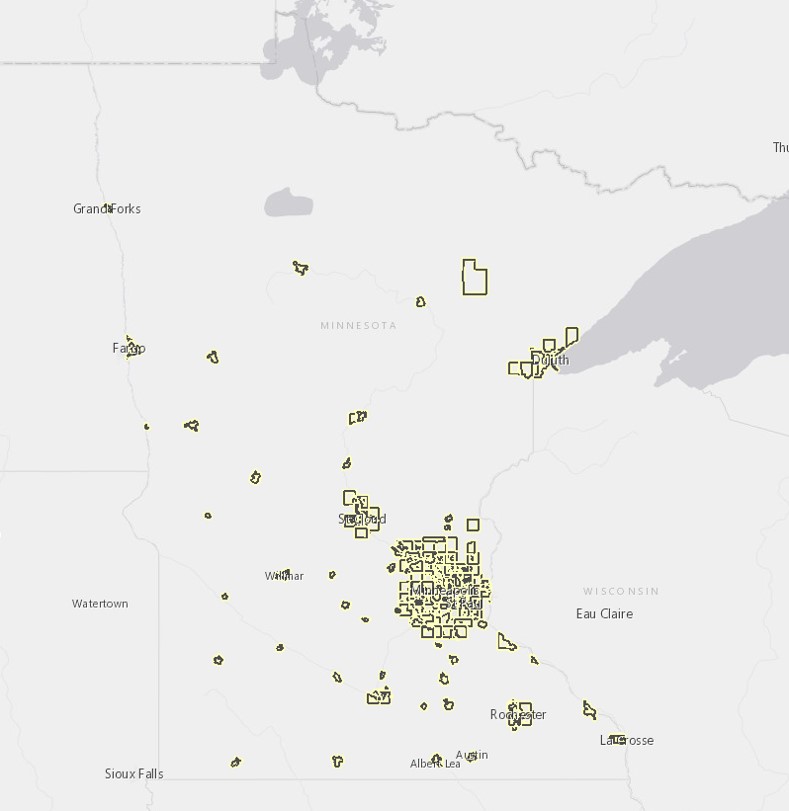
Map of regulated MS4s in Minnesota. Use the MS4 mapping tool for more detail.