| BMP Type and Example | Objective | BMP Examples | Safety Considerations |
|---|---|---|---|
|
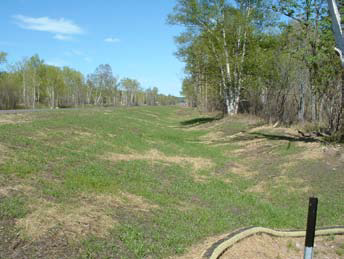
Energy dissipation
|
Diffuse flow energy from concentrated roadway surface before discharging over a slope; reinforce discharge point and slopes; promote sheet flow | Compost sock (see image), bio-slope, outlet reinforcement, spray mulch, compost rip rap matrix (between rocks) | May increase slipperiness of shoulder slope |
|
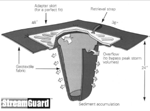
Filtration
|
Filter litter and debris from flow as it enters catch basins; preferably with pollutant sorbents 2 | Catch basin insert (see image); hooded outlet pipe; oil and grease separator | Might become heavy for maintenance crews to lift; must be cleaned to prevent clogging |
|
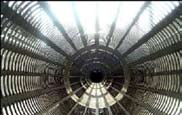
Screening
|
Route runoff through a screen or filter material to remove litter and treat particulate, and the associated nutrients, toxics and hydrocarbons | Gross Solids Removal Device (GSRD) (see image), compost tube inside of rock weep, | Often contained in confined space; maintenance crew will need confined space training |
 |
Diffuse heat from road and parking surfaces prior to discharge to sensitive waters | Geotextile wrapped rip rap thermal tube (see image), infiltration trench | None |
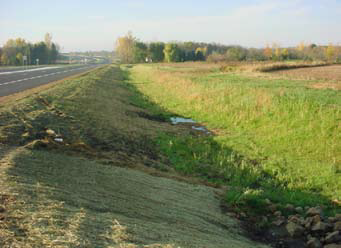 |
Provide vegetated swale drainage systems with low head grade breaks in rural sections | “Living ditch” (see image), check dams (rip rap, bio-weeper, bio-ditch filter) | Can hold water for a time after runoff occurs so need to keep design depths shallow; grade breaks can be obstruction hazard to recreational vehicles using swale |
| Retrofit stored water BMPs with proper outlet and skimmer devices | Particulate skimmer (see image), baffle weir, Faircloth skimmer (proprietary device) | None | |
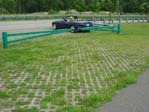 |
Use pervious paving material in areas that will support it | Pervious asphalt and concrete (see image), paving blocks | None for pavement; blocks can pose walking problems if not designed properly; recommendation for minimal salt use could mean ice might be present for short periods |
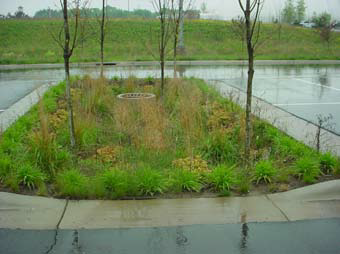 |
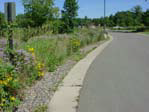
Route water to bioretention, filtration or infiltration areas where conditions appropriate | Rain garden (see image) | Near-road locations could possibly impede vision at intersections if vegetation not kept low; water might collect adjacent to roadway |
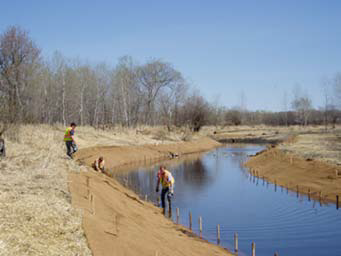 |
Geomorphically stabilize channels | Cross vanes, fish steps, curvilinear channel restoration (see image), reinforced streambank, grade adjustments, revetments, root wads | None |
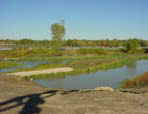 |
Use off-line storage in available floodplain, open space | Off-line pools (see image), enhanced floodplains, wetland restoration/preservation | None if kept away from areas where vehicles expected to travel or go off of the road |
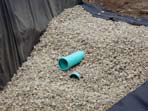 |
Use sub-grade storage with or without perforations to allow for storage and infiltration where drainage determined not to impact road structure | Under street infiltration trenches (see image), vault storage to replace surface ponds, rest areas parking lots | Maintenance crew will need confined-space training |
| 1Use of proprietary devices or images merely for illustrative purposes and does not mean endorsement of a product 2Note that housekeeping practices like street sweeping and chemical use are discussed in the Pollution Prevention section |
|||