This page contains information specific to receiving waters monitoring programs used to meet TMDL permit requirements of the MS4 General Permit.
Contents
Establishing a Monitoring Protocol
The MPCA has specific requirements and protocols related to water quality data collection, laboratory processing of water quality samples, data processing of laboratory results, and final submittal of water quality data to the MPCA for review. Specifically, the MPCA uses a data processing system called EQuIS (Environmental Quality Information System) to store and process water quality data collected from over 17,000 sampling locations across the state, and requires that data be collected and processed in a manner which is compatible with EQuIS.
There are many publicly available Quality Assurance Project Plan (QAPP) and monitoring Standard Operating Procedure (SOP) documents which can be used as a framework for developing a monitoring protocol. The following subsections provide an overview of EQuIS requirements and a summary of lake and stream monitoring QAPP and SOP documents.
EQuIS
The MPCA has developed extensive guidance related to establishing EQuIS projects, and developed tools and guidance to assist monitoring and laboratory staff to process data in an EQuIS-compatible format. The following steps provide a basic overview of the EQuIS data collection and submittal process: establishing an EQuIS project, processing collected water quality data, and submitting collected data to the MPCA for review. Collecting, processing, and submitting EQuIS data requires contact and coordination with an MPCA EQuIS team member.
- Coordinate with an MPCA EQuIS team member and establish an EQuIS project (i.e., submit the EQuIS Project Establishment Form).
- Submit a location establishment form.
- Collect water quality data and submit to a State-certified laboratory.
- Procedures to collect water quality samples and submit to a certified laboratory, including pre- and post-monitoring protocols, quality assurance and quality control (QA/QC), and guidance regarding chain of custody (COC) preparation and documentation are discussed in the next section.
- The MPCA EQuIS team member can be contacted regarding State-certified laboratories.
- Submit EQuIS formatted data to the MPCA for review.
- The EQuIS Data Gathering Engine (EDGE) can be used to generate EQuIS formatted data during field data collection.
- The Lab_MN lab data storage spreadsheet can be used by certified labs to generate EQuIS formatted data of laboratory results.
- If not using EDGE or Lab_MN, data can be manually formatted into the Surface Water Data Template.
Monitoring Quality Assurance Program Plan (QAPP)
The primary objective of a QAPP is to define the data quality assurance (QA) goals and procedures applicable to a monitoring program (MCES, 2003). A lake or stream monitoring QAPP must also provide an overview of program design (e.g., program organization, responsibilities, monitoring parameters, sampling locations, etc.), and must define sampling methods (e.g., sampling locations and monitored variables), analytical procedures, QA procedures, and data review protocols.
For this reason, a QAPP document may also contains monitoring SOP(s), defining sampling procedures, field analysis, laboratory analysis, and data review and QAQC measures.
The following subsections provide a summary of monitoring QAPP documents which can be used as templates for developing a lake or stream monitoring QAPP.
MCES Stream Monitoring QAPP
Met Council's Quality Assurance Program Plan for streams defines the data quality assurance goals and the quality assurance procedures that are applicable to Met Council's stream monitoring program.
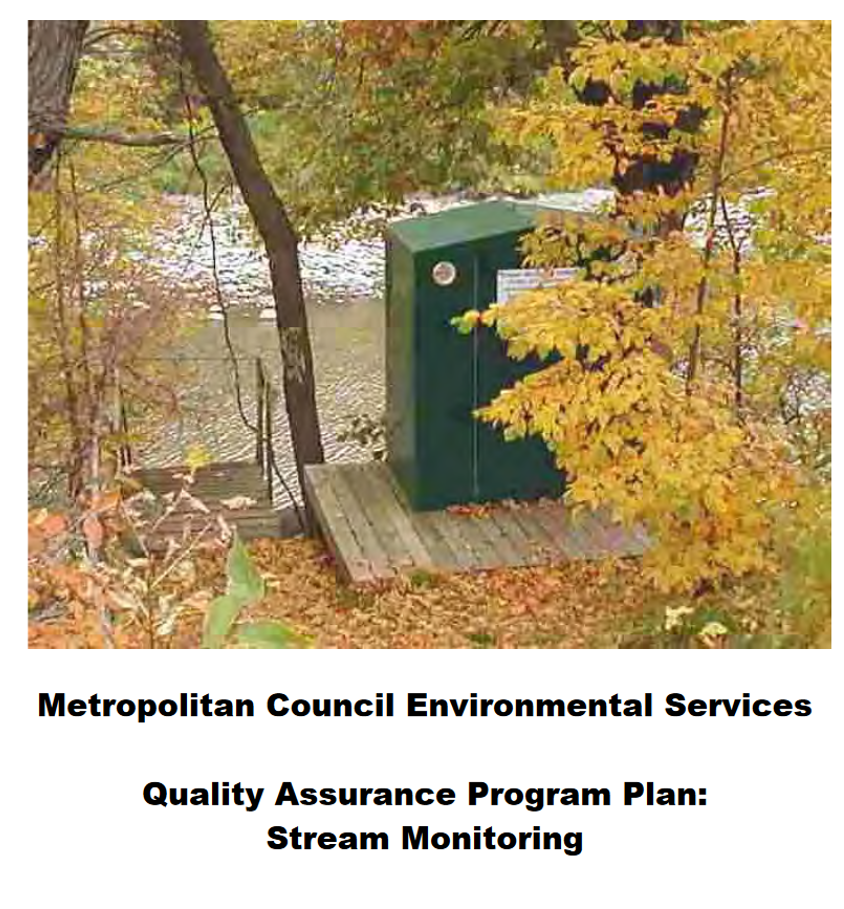
The MCES Quality Assurance Program Plan: Stream Monitoring (MCES, 2003; updated 2011) is a QAPP for the MCES’s Nonpoint Source Pollution Monitoring Program and Watershed Outlet Monitoring Program (WOMP). The QAPP defines goals, objectives, program organization, responsible parties, specific sampling procedures and protocols (e.g. monitoring SOPs, QA procedures, laboratory analytical procedures, etc.), and the monitoring locations, monitored variables, and monitoring frequency for both stream monitoring programs. Specifically, the QAPP is organized into the following sections:
- Introduction: defines the background and purpose of the QAPP, as well as the relationship of the QAPP to other guidance documents (specifically, the monitoring SOPs included as appendices).
- Program Organization and Responsibility: defines the organization of the QAPP, responsible parties, and defines roles and responsibilities for positions and individual staff members.
- Monitoring Program Description: defines the study area, specific monitoring locations, monitored variables (e.g., Total Phosphorus, CBOD 5-day, etc.), and monitoring frequency.
- Quality Assurance Objectives: defines QA objectives related to precision, accuracy, representativeness, completeness, comparability, and analytical sensitivity.
- Sampling Methods: defines procedures and protocols for two forms of sampling: instantaneous grab sampling and flow-weighted composite sampling. Provides and overview of sampling procedures, field equipment, and bottle preparation, etc. and refers reader to the field sampling SOPs included in the QAPP appendices.
- Field and Sample Custody Documentation: defines the field and sample documentation requirements for the MCES stream monitoring programs. Field documentation (e.g., field conditions, time, weather conditions, deviation from written procedures, standardized field documentation sheets) and laboratory chain-of-custody are critical for interpreting results and identifying erroneous samples (e.g., mislabeled samples).
- Field Measurement Procedures: defines field monitoring equipment (e.g., specific models of in situ monitoring equipment), monitoring station layout, maintenance, and operations, and a description of all monitoring parameters. More details related to field procedures are included in the monitoring SOPs included in the QAPP appendices.
- Laboratory Analytical Procedures: defines the laboratory analytical method for each monitored variable and identifies the State-certified laboratory used for sample processing and analysis. Additional information relate to laboratory procedures, processes, and QA program are included in the laboratory QA manual included in the QAPP appendices.
- Quality Assurance Procedures: defines QA procedures relate to data review and validation, QA audits and reporting, and corrective action strategies.
- Data Reporting: defines reporting protocols related to automate electronic data reporting and annual assessment reporting.
The organization of the MCES Stream Monitoring QAPP can be used as template for the development of a stream or lake monitoring QAPP. In addition to defining the organization, goals, and QA procedures for the monitoring programs, the QAPP also includes sampling, field analysis, laboratory analysis, and data review SOPs as appendices to the document. The SOPs outline specific monitoring procedures to be followed in the field (e.g., equipment checklist, grab sample bottle and equipment cleaning, field duplicate collection and labeling, health and safety procedures, etc.). Monitoring SOPs are discussed in more detail below.
Other Monitoring QAPP Resources
The MPCA and United States Environmental Protection Agency (USEPA) have developed many guidance documents related to QA and the development of QAPPs. Specific QAPP guidance documents and QA tools are summarized below:
- MPCA Quality System: aggregated resources related to QA of environmental data. Includes many QAPP development documents and examples of completed QAPPs. Additionally, includes documents related to the development of SOPs, example SOPs (e.g., lake monitoring SOP), and State-certified laboratory guidance and reference documents.
- MPCA QA Project Plan Guidance: guidance document for developing MPCA Remediation Program QAPPs.
- EPA QAPP Development Tool: web-based QAPP development tool. The tool provides step-by-step guidance related to developing a surface water monitoring QAPP, and is partitioned into the following six (6) modules:
- Module 1 – guidance on preparing a QAPP.
- Module 2 – QAPP template.
- Module 3 – Model QAPP: provides and model example of a completed QAPP.
- Module 4 – references and links for technical and QA information to assist in developing a QAPP.
- Module 5 – standard operating procedures (SOPs): contains development guidance and example SOPs related to surface water monitoring.
- Module 6 – selecting an environmental laboratory: provides guidance related to selecting a State-certified laboratory for sample processing.
- EPA Requirements for QAPPs: defines EPA QAPP requirements.
Questions related to QAPP development, QA procedures, or the references listed above can be directed to any of the MPCA QA coordinators listed in the “Contacts” section of the MPCA Quality System webpage.
Monitoring Standard Operation Procedure (SOP)
As discussed above, a monitoring standard operating procedure (SOP) is a critical component of a complete monitoring QAPP. A monitoring SOP defines specific protocols related to field sample collection and laboratory analysis, and often also includes pre-field protocols (e.g., equipment and supply checklist, pre-field bottle preparation and labeling, etc.), post-sampling protocols (e.g., sample preparation and preservation, sample chain of custody, etc.) and other protocols not specifically related to monitoring and sample collection (e.g., boat and canoe preparation, health and safety, inclement weather protocols, etc.).
The following subsections provide a summary of monitoring SOP documents which can be used as templates for developing a lake or stream monitoring SOP. It is recommended that the documents discussed in this section be used in conjunction with specific monitoring guidance outlined in the applicable TMDL when developing a lake or stream monitoring SOP.
NOTE: See example case studies in which monitoring was used to help identify pollutant sources, evaluate the impact of implementation strategies, and ultimately delist a formerly impaired water body.
MPCA Lake and Stream Water Quality Sampling SOPs
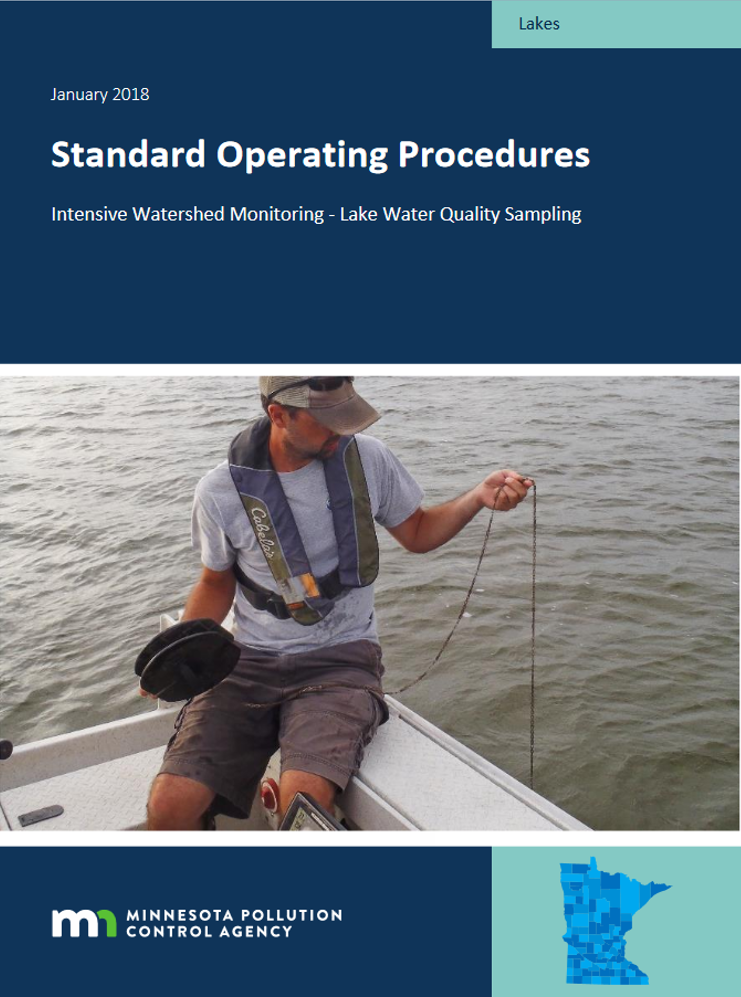
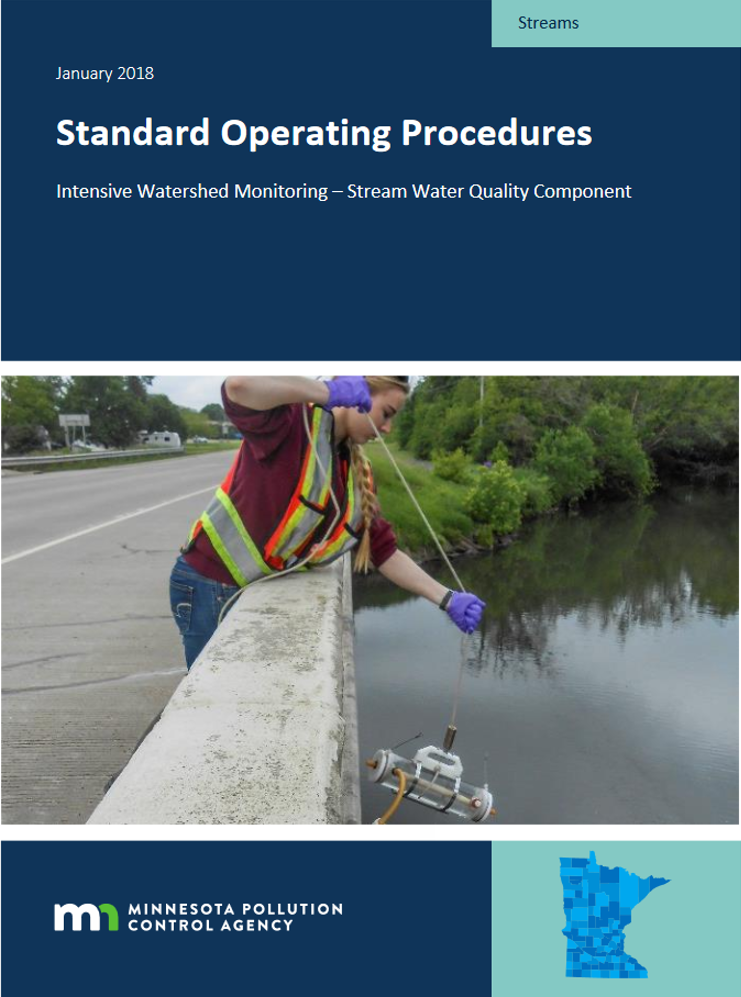
The Standard Operating Procedures: Intensive Watershed Monitoring – Lake Water Quality Sampling and Standard Operation Procedures: Intensive Watershed Monitoring – Stream Water Quality Component are SOPs created by the MPCA for local partners contracted through the MPCA’s Surface Water Assessment Grants Program. The SOP outlines sampling procedures applicable to all Minnesota lakes and streams, including pre-sampling requirements, equipment and supply checklists, on-site sampling procedures, QAQC procedures (e.g., field sample duplicates), post-sampling procedures, and a detailed discussion of health and safety protocols. In addition to pre- and post-sampling procedures, the SOP discusses bottle labeling and the chain of custody (COC) procedures for delivering samples to State-certified laboratories, and final data preparation and submittal to EQuIS.
Other Monitoring SOP Resources
The MPCA, USEPA, and MCES have developed many publicly available guidance documents related to the development of surface water monitoring SOPs. Specific SOP documents which be used as templates to develop a surface water monitoring SOP are summarized below. It is recommended that the documents discussed in this section be used in conjunction with specific monitoring guidance outlined in the applicable TMDL when developing a lake or stream monitoring SOP:
- Chloride Monitoring Guidance for Lakes (MPCA, 2015a) and Chloride Monitoring Guidance for Streams and Storm sewers (MPCA, 2015b): these documents are similar in scope to the MPCA lake and stream monitoring SOPs (MPCA, 2018c; MPCA, 2018d), but include specific guidance related to monitoring chloride, including a detailed winter monitoring SOP. Winter monitoring guidance includes a detailed description of how to predict and monitor winter thaw and rain events, which often produce elevated chloride concentration in streams due to mobilization of deicing salts accumulated over winter deicing operations.
- MCES Quality Assurance Program Plan: Stream Monitoring (MCES, 2003; updated 2011): the stream monitoring QAPP contains sampling, field analysis, laboratory analysis, and data review SOPs as appendices.
- EPA QAPP Development Tool: Module 5 of the web-based tool contains development guidance and example SOPs related to surface water monitoring. SOP documents can requested from the EPA via the EPA contact listed in Module 5.
Questions related to SOP development can be directed to any of the MPCA QA coordinators listed in the “Contacts” section of the MPCA Quality System webpage.
Related pages
- Recommendations and guidance for utilizing lake monitoring to meet TMDL permit requirements
- Recommendations and guidance for utilizing stream monitoring to meet TMDL permit requirements
- Establishing a monitoring protocol for receiving waters
- Recommendations and guidance for utilizing major stormwater outfall monitoring to meet TMDL permit requirements
- Recommendations and guidance for utilizing stormwater best management practice monitoring to meet TMDL permit requirements
- Case studies for monitoring to meet TMDL permit requirements
- Utilizing monitoring to meet TMDL permit requirements overview