Pretreatment reduces maintenance and prolongs the lifespan of structural stormwater BMPs by removing trash, debris, organic materials, coarse sediments, and associated pollutants prior to entering structural stormwater BMPs. Implementing pretreatment devices also improves aesthetics by capturing debris in focused or hidden areas.
To perform efficiently, pretreatment practices must be properly sized. Given the lack of a consistent approach in stormwater pretreatment sizing in the literature, we developed a sizing approach focused on removing a specific fraction of sediment. This approach is dependent on the settling velocity of different sized particles.
For the technical development of this methodology, link here.
Contents
Pretreatment basins
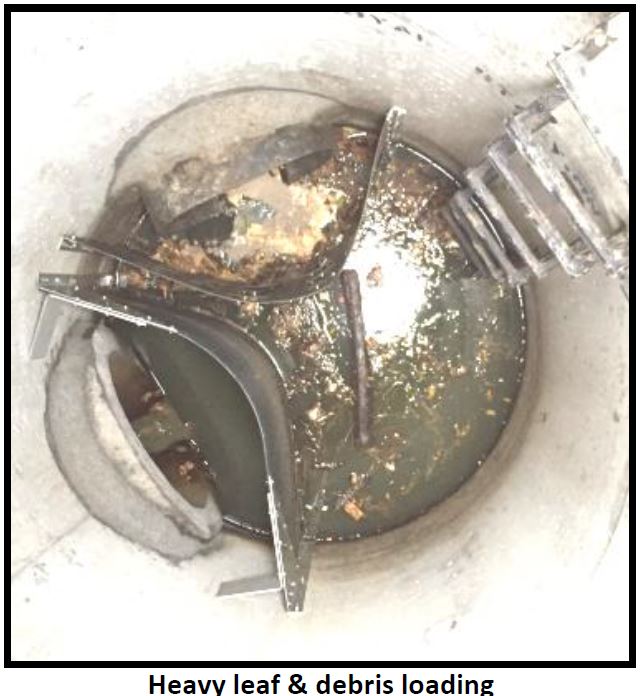
Basins are stormwater best management practices (BMPs) having an engineered pool that promotes settling of solids (e.g., pond forebay, sump, hydrodynamic separator, and catch basin). These pretreatment facilities are typically small (relative to the primary treatment practice) but can be sized to settle gravel and sands, and possibly silts, at low flow conditions. For preliminary sizing purposes, the small size results in a basin that is close to well-mixed, where the concentration of suspended solids is constant with depth to the bottom of the basin and the particles are settling out because of zero velocity at the wall.
Methodology for pretreatment basins
Calculate the area of the pretreatment basin from
AS = (FR * I * A * FR) / (vS * (1 - FR))
For the following calculation, ensure your units are consistent
- Determine, vs, the settling velocity for the particle size targeted (recommend 80 microns for particle size. Determine vs from table on this page)
- Determine FR, the target fraction removal (recommend 0.50-0.70)
- Determine A, the area of directly connected impervious draining to the pretreatment practice
- Determine I, the peak rain intensity (0.5 in/hr for a 1-inch event, Type 2 distribution)
- Calculate the area of the pretreatment basin from AS = (FR * I * A * FR) / (vS * (1 - FR))
- Determine the basin depth as the lesser of sqrt(AS) or 6 feet
Example for pretreatment basin
| Silt and sand Diameter (um) | vs (m/s) | Header text (ft/s) |
|---|---|---|
| Settling velocity according to Equation 8 of various equivalent spherical diameter sand and silt particles at 20°C. | ||
| 10 | 0.000089 | 0.00029 |
| 30 | 0.00078 | 0.0026 |
| 80 | 0.0051 | 0.017 |
| 100 | 0.0075 | 0.025 |
| 150 | 0.015 | 0.049 |
| 200 | 0.023 | 0.075 |
| 500 | 0.071 | 0.23 |
| 1000 | 0.13 | 0.43 |
One of the inlets into a 2-acre pond is draining a directly connected impervious area of 30 acres. The pretreatment basin for the 2-acre pond will be designed to retain 70 percent of the 80 μm fine-sand particles. Using adjacent table, the settling velocity (vS) for 80 μm fine-sand particles is 0.017 feet per second (fps). For this case, the values to be input into the calculation are
FR = 0.7
A = 30 acres * 43,560 ft2/ac = 1,306,800 ft2
I = 0.5 in/hr / 12 in/ft / 3600 s/hr = 1.157 X 10⁻⁵ ft/s
vs = 0.017 ft/s
Plugging the these into the equation AS = (FR * I * A * FR) / (vS * (1 - FR)) yields a value of 1453 ft2 for the area of the forebay. The depth is the lesser of 6 feet or the square root of the forebay area (square root of 1453 = 38.1). The depth is therefore 6 feet.
Pretreatment filter strips
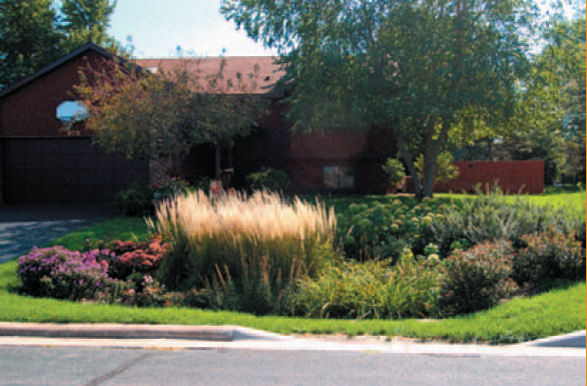
Filter strips are primarily designed to enhance settling; physical filtering of particles in a filter strip is minimal. The filter strip is located at the bottom of a shallow, widely spread, open channel flow to allow for particle settling through the media, which is often grass or rocks. The grass or rocks allow space for the settled particles to collect until cleanout is required.
Methodology for pretreatment filter strips
LW = - ((c * I * A) / (vS) * ln(1 - FR))
Where c = 0.7 for small storms
For the following calculation, ensure your units are consistent
- Determine, vs, the settling velocity for the particle size targeted (recommend 80 microns for particle size. Determine vs from table on this page)
- Determine FR, the target fraction removal (recommend 0.50-0.70)
- Determine A, the area of directly connected impervious draining to the pretreatment practice
- Determine I, the peak rain intensity (0.5 in/hr for a 1-inch event, Type 2 distribution)
- Calculate the area of the filter strip from LW = - ((c * I * A) / (vS) * ln(1 - FR)) where c = 0.7 for small storms
- Determine the length (L) and the width (W) from the above computation
Example for pretreatment filter strip
A directly connected impervious area of 10,000 ft2 drains into a bioretention practice. The area is a sufficient size to install a well-sized filter strip, so the designer chose to settle 80 percent of the 80 um fine-sand particles in the filter strip during the design storm. For this case, the values to be used are
FR = 0.8
A = 10,000 ft2
I = 0.5 in/hr
vS = 0.017 ft/s
c = 0.7
Plugging these values into the equation LW = - ((0.7 * 10000 ft2) * 0.5 in/hr) / 0.017 ft/s) * ln(1-0.8) = 7.6 ft2
Assuming a 3-ft wide inlet, the filter strip would need to be a minimum of 2.5 ft (L = LW/W = 7.6 ft2/3 ft = 2.5 ft) in length by 2.5-ft. To settle 80 percent of the fine sand particles entering this bioretention practice, the filter strip is recommended to be 3 ft wide by 2.5 ft long.
Related pages
- Pretreatment selection tool
- Overview and methods of pretreatment
- Overviews for different types of pretreatment practices
- Information for specific types of pretreatment practices
- Design, construction, operation and maintenance specifications for pretreatment vegetated filter strips
- Pretreatment - Hydrodynamic separation devices
- Pretreatment - Screening and straining devices, including forebays
- Pretreatment - Above ground and below grade storage and settling devices
- Pretreatment - Filtration devices and practices
- Pretreatment - Other pretreatment water quality devices and practices
To see the above pages as a single page, link here
Pretreatment sizing for basins and filters strips
Guidance for managing sediment and wastes collected by pretreatment practices
Tables
- Pretreatment tables - link to tabled information for pretreatment practices
- Hydrodynamic separator tables
- Screening and straining devices tables
- Above ground and below grade storage and settling tables
- Filtration tables
- Other water quality devices tables
Other information and links