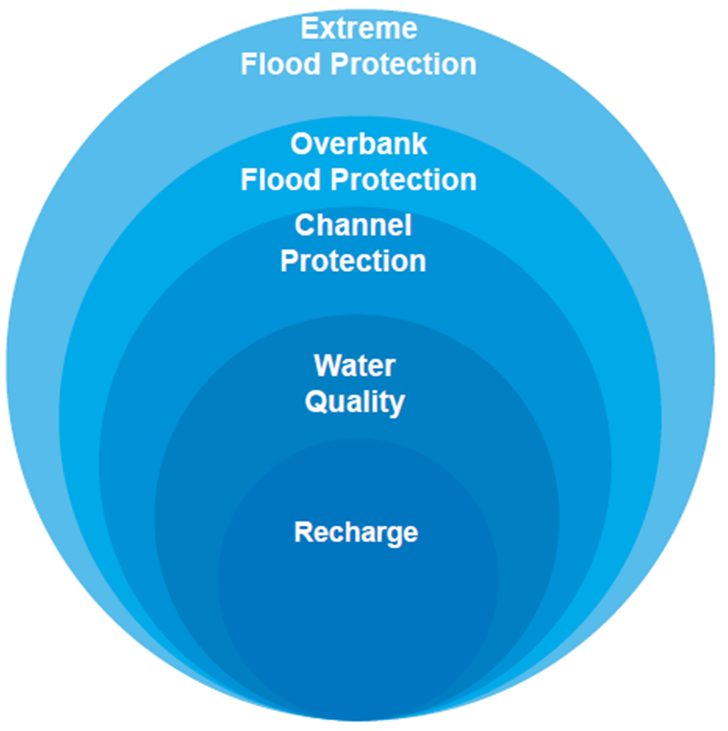
A unified framework is presented for addressing stormwater sizing criteria in the context of the MPCA Construction Stormwater (CSW) General Permit and local stormwater management requirements, if chosen by the local community. The unified approach addresses five different sizing criteria, as shown below.
- Recharge
- Water quality
- Channel protection
- Over bank flooding
- Extreme storms
In addition to these sizing criteria for regular waters, this Manual describes how sizing criteria can be adapted to provide greater protection for special and other sensitive waters of the state. The goal of the unified framework is to develop a consistent approach for sizing stormwater practices that can
- perform effectively: manage enough runoff volume to actually solve the stormwater problem it is intended to address;
- perform efficiently: manage just enough runoff volume to address the problem but not over-control it. More storage is not always better, and can greatly increase construction costs;
- be simple to administer: be understandable, relatively easy to calculate with current hydrologic models, and workable over a range of development conditions and intensities. In addition, criteria should be clear and straightforward to avoid needless disputes between design engineers and plan reviewers when they are applied to development sites, while also eliminating any competitive disadvantages that are created when uniform regulations do not exist;
- promote better site design: be structured in a manner so that property owners have real incentives to reduce storage volumes (and costs) by applying better site design techniques to receive stormwater credits; and
- be flexible to respond to special site and receiving water conditions: be expanded to adequately protect unique receiving waters, and to be reduced or eliminated in certain development situations where they are inappropriate or infeasible.
A unified framework for sizing stormwater practices provides greater consistency and integration among the many city, county, watershed organization, regional and statewide stormwater requirements and ordinances adopted over the years. It also establishes a common framework to address all stormwater problems caused by development sites over the entire spectrum of rainfall events. The unified approach still provides communities with flexibility to develop stormwater criteria adapted for local conditions, within overall context of the 2003 MPCA CSW Permit. The Manual provides more detailed guidance on the appropriate design assumptions for accepted hydrologic models used in design.
Overview of the unified stormwater sizing framework
The terminology and abbreviations associated with various stormwater sizing criteria can be confusing at times, as the state and local reviewing authorities often define or interpret them in a slightly different manner. This terminology is described in the following table.
| Term | Definition |
|---|---|
| Better Site Design (BSD) | Better site design refers to the application of non-structural practices at new development sites to reduce site impervious cover, conserve natural areas, and use pervious areas to more effectively treat stormwater runoff. Also know as low impact development. |
| Channel Protection (VcpVolume) | Refers to the recommended runoff storage volume needed to control post-development bankfull flow velocities so they do not increase erosion in downstream channels. typically, detention and/or extended detention of intermediate sized storms (0.5 to 2.0 inches of rainfall) are used for this purpose. The channel protection volume is denoted as Vcp. |
| Design Storm | An engineering term for a single rainfall event with a defined intensity, duration and statistical recurrence interval commonly ranging from 0.5 to 100 years. These single event storms are based on long-term rainfall data and are used in hydrologic models to predict the peak discharges and runoff volumes associated with each type of storm. Unless otherwise indicated, all design storms discussed in the Manual has a 24-hour duration and a Type II distribution. |
| Detention Time | Various definitions for detention time exist in hydraulic manuals and in help screens on computer models. For this Manual, a simple method of computing detention time is recommended. Detention time is equal to the length of time starting at basin full (for a specific design storm) and ending either when the basin is dry (filtration or infiltration) or the basin has attained normal water level (stormwater ponds or constructed wetlands). |
| Extreme Storm Volume (Vp100) | The greatest runoff storage volume is used to the peak discharges of infrequent but very large storm events to pre-development levels. The 100-year design storm, which has a statistical recurrence interval of occurring once in one hundred years, is used by most communities. Extreme floods can cause catastrophic damage and even loss of life. The storage volume needed to store and detain them is denoted as Vp100. Note that storms more "extreme" than the 100-year event do occur in Minnesota. The extreme term is used relative to other volume terms for perspective. |
| Hydrologic Soil Group (HSG) | HSG is an USDA-NRCS designation given to different soil types to reflect their relative surface permeability and infiltrative capability. Group A soils have low runoff potential and high infiltration rates. Group B soils have moderate infiltration rates. Group C soils have low infiltration rates. Group D soils have high runoff potential with very low infiltration rates and consist chiefly of clay soils (TR-55, 1986). |
| Other Sensitive Receiving Waters |
In addition to special waters defined in the CSW Permit, there are other receiving waters that merit additional management attention because of their sensitivity, as defined by various state and local entities. Recommended stormwater criteria exist for
|
| Overbank Flood Volume (Vp10) | Refers to the runoff storage volume needed to prevent an increased frequency of floods that spill out of the channel and onto the floodplain where they may cause damage to the conveyance systems, property and infrastructure. Overbank flooding is normally controlled by detention of post-development 10-year storm so that pre-development peak discharge rates (as defined by state or local agencies) are maintained, and is denoted by Vp10 (assuming the local review authority requires control of the 10-year storm event). |
| Permanent Pool Volume (Vpp) | The CSW Permit requires that all wet sedimentation basins contain a permanent pool with a volume of 1,800 cubic feet of storage for each acre that drains to the basin. This equates to 1/2 inch of runoff per acre. The permanent pool must reach a minimum depth of three feet, stay below 10 feet and be configured to minimize scour and resuspension of solids. |
| Pre-Development Conditions | The term pre-development conditions can be interpreted in many different ways. The MPCA uses land cover conditions immediately preceding the current development project as the CSW Permit pre-development condition, whereas many other local and watershed managers use a more natural definition, such as meadow or woodlands in good shape (stated in a manner to help in CN selection). Obviously the CSW Permit version will usually result in a smaller net runoff increase for most land that has anything but a natural cover. It is recommended that the CSW Permit definition be used for its intended purpose as part of state permit issuance, but that the more natural pre-development condition be used if a stormwater manager wants to assume a more conservative condition. |
| Recharge Volume (Vre) | Refers to the recommended volume of runoff which should be spread over pervious areas and otherwise infiltrated into the soil to promote groundwater recharge. The recharge volume is denoted as Vre and is normally included as part of the water quality volume. |
| Special Waters |
A list of eight categories of receiving waters are specifically designated as "special waters" in the CSW Permit. Additional BMPs and enhanced runoff controls are required for discharges to the following special waters:
|
| Total Storage Volume (Vts) | For ponds built under the requirements of the CSW Permit, the total storage volume required is the sum of the permanent pool volume (Vpp) plus the water quality volume (Vwq). |
| Water Quality Volume (Vwq) | Generic term for the storage volume used to capture, treat and remove pollutants in stormwater runoff. It is normally expressed as a volume (watershed-inches or acre-feet) and is denoted by Vwq. For ponds and wetlands, the MPCA CSW Permit defines it as the volume of live storage above the permanent pool (above the dead storage) used for water quality. For non-pond BMPs, MPCA defines the water quality volume in the same manner as the general definition above. |
In the course of a year, anywhere from 35 to 50 precipitation events fall on Minnesota. Most events are quite small but a few can be several inches in depth. A rainfall frequency spectrum describes the average frequency of the depth of precipitation events (adjusted for snowfall) that occur during a normal year. Rainfall frequency maps have been developed for Minnesota for several return frequencies. The majority of storms are relatively small but a sharp upward inflection point occurs at about one-inch of rainfall.
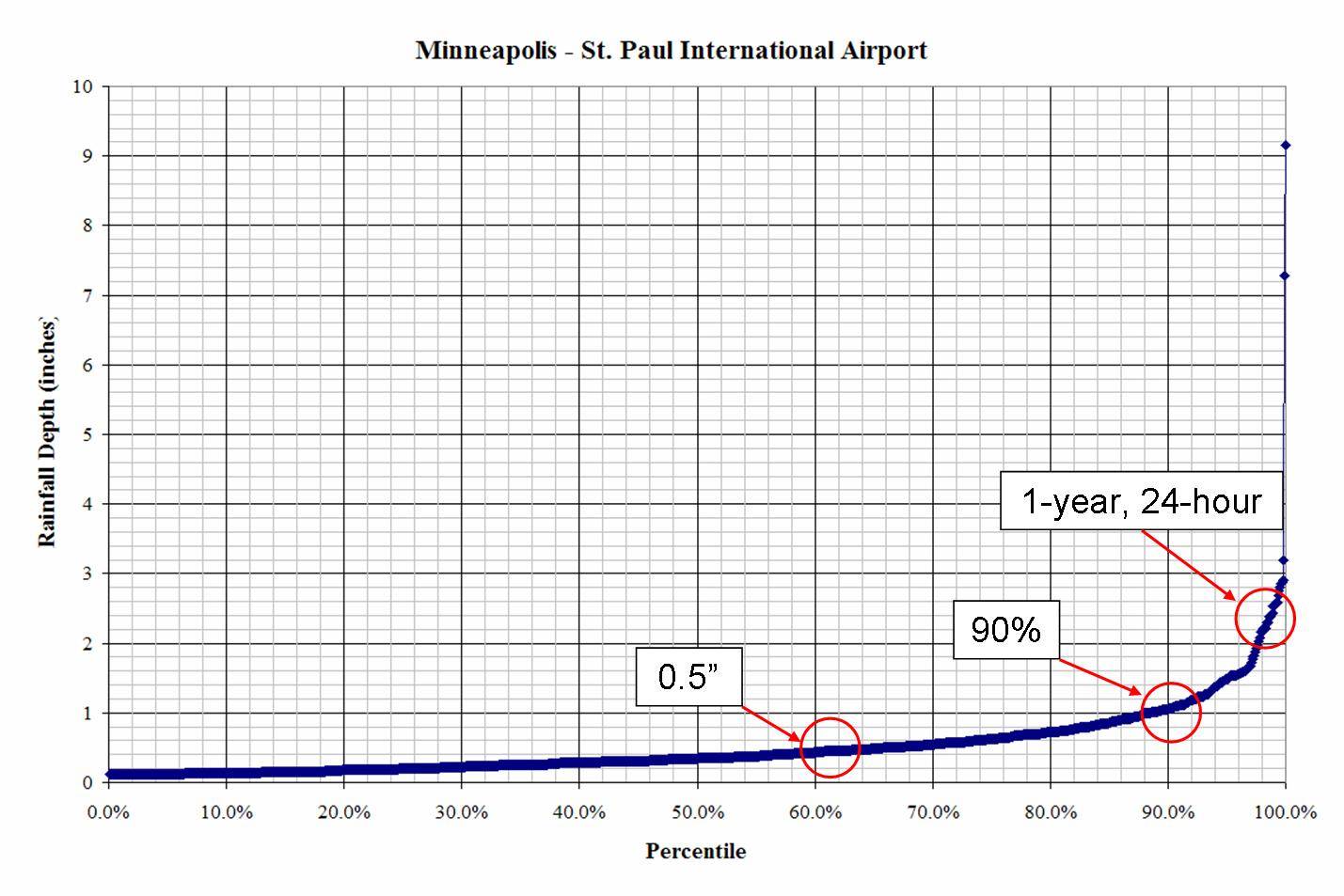
The unified sizing approach seeks to manage the entire frequency of rainfall events that are anticipated at development sites. The runoff frequency spectrum is divided into five management zones, based on their relative frequency, as follows.
- Recharge: targets rainfall events that create little or no runoff but produce much of the annual ground water recharge at the site.
- Water Quality: targets rainfall events that deliver the majority of the stormwater pollutants at the site.
- Channel Protection: targets storms that generate bankfull and sub-bankfull floods in the stream that cause channel enlargement.
- Overbank Floods: targets large and infrequent storm events that spill over to floodplain and cause damage to infrastructure.
- Extreme Storms: controls the largest, most infrequent and most catastrophic floods that threaten property and public safety (e.g., commonly known as the 100-year storm.
The goal of stormwater management is to provide effective control over each management zone in order to produce post-development hydrology that most closely resembles state or locally defined pre-development conditions at the development site. Each criterion defines a unique storage volume that should be managed at the site. They are best understood visually as a layer cake that has progressively larger layers from bottom to top, with recharge volume being the narrowest layer at the bottom and extreme storm control comprising the thickest layer at the top.
The unified approach proposes to standardize the basic approach to stormwater design for regular waters of the state, while also defining certain site conditions or development scenarios where individual stormwater sizing criteria may be relaxed or waived. The unified framework also clearly indicates when sizing criteria need to be enhanced to provide a higher degree of water resource protection for special or other sensitive waters. The table below profiles the recommended or required sizing criteria for each of the five stormwater management zones for both regular and special waters. Each of these management zones is discussed in a separate page in this Manual. Each page describes how the sizing criteria are calculated and the conditions where they may be relaxed or waived. This information is a general guide and designers should always check with their local review authority and the MPCA to determine the appropriate sizing criteria used in their community.
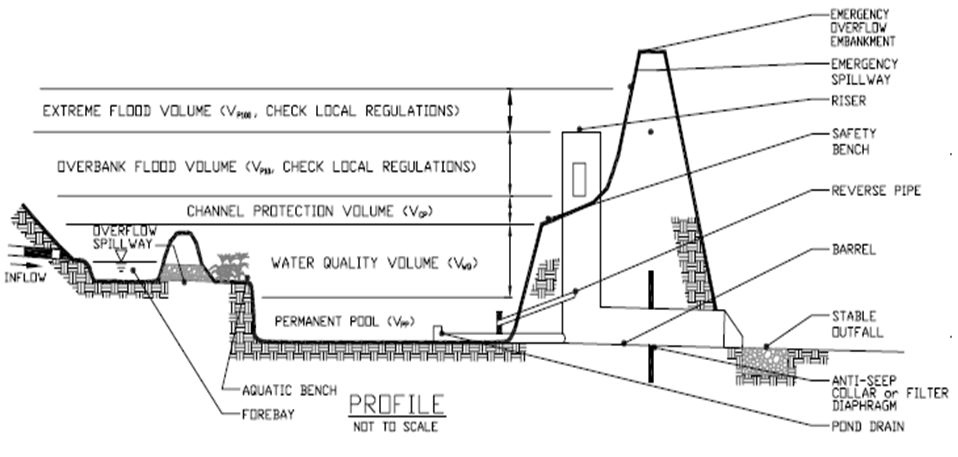
Channel protection outlet: an outlet designed to release Vcp over a period of 24 hours (minimum Vcp detention time is recommended to be 12 hours). The Vcp pool elevation can be read from the pond stage-storage relationship.
Assuming an orifice is also used to release Vcp, the invert of the Vcp orifice may be placed at the Vwq pool elevation (Ewq).
The average release rate for Vcp is computed as
$^Q_{cp,avg} = (V_{cp} - V_{wq} / t_{cp}) - Q_{wq}^$
Where:
tcp = the intended channel protection volume detention time
Qwq= computed (using the above equation for Qwq), with the head value calculated as $^h_{wq} = (E_{wq} + E_{cp} / 2) - E_{PermPool}^$
From the stage-storage table, find the elevation associated with Vcp. The average head on the channel protection outlet can then be calculated as
$^h_{cp,avg} = (E_{cp} - E_{wq}) / 2^$
Again, the required orifice cross sectional area can then be indirectly computed using the orifice equation
$^Q_{cp,avg} = CA_{cp} \sqrt{2gh_{cp,avg}}^$
The diameter of the orifice is then
$^D_{cp} = 2\sqrt{A_{cp} / \pi}^$
The rate of discharge from the channel protection orifice for any head value hcp on the channel protection outlet can then be computed as
$^Q_{cp} = CA_{cp} \sqrt{2gh_{cp}}^$
The combined flow out of the water quality orifice and channel protection orifice at a given water surface elevation can be computed by adding together the discharges from the two structures, for the head values corresponding to the specified water surface elevation.
- Overbank flood control outlet: an outlet (typically a weir) with its invert at the Vcp pool elevation, designed to release Qp10 at pre-development rates (recommended).
- Extreme storm control outlet: an outlet with its invert at or slightly above the Vp10 pool elevation, designed to release Qp100 at pre-development rates (recommended), or at minimum to safely pass the Qp100 with 1 to 2 feet of freeboard below the top of the embankment. Check with local officials to determine whether a principal spillway can be used to manage extreme storm flows, or if an emergency spillway (broad-crested weir or earthen embankment, not susceptible to obstruction) is necessary.