This section of the manual is currently undergoing revision.
Special management of cold weather runoff is usually required because of the extended storage of precipitation and pollutants in catchment snowpack, the processes occurring in snowpack, and the changes in the catchment surface and transport network by snow and ice. The discharges that come from urban meltwater may cause physical, chemical, biological and combined effects in receiving waters and thereby limit their quality, ecosystems and beneficial uses.
For many years the old adage “one size fits all” was tried for the management of all runoff management. Once the effects of this approach were scrutinized, however, it became apparent that applying traditional rainfall runoff BMPs was not working for meltwater in spite of their success with rainfall. The problem is usually not the large volume resulting from a significant event, although serious flooding certainly can occur. Rather, it is that the BMPs are prevented from working as intended because of ice, cold water, highly concentrated pollution and lack of biological activity. Complications encountered in cold climates simply work against many of the commonly used warm weather BMPs, reinforcing the need for the development or adaptation (e.g. revised criteria and specifications) of existing treatment practices to better address melt runoff. Additionally, the usually poorer performance exhibited during cold weather is generally not considered when management approaches are designed because of the perceived uselessness in trying to overcome the challenges to managing runoff in cold climates. The problems cannot be entirely negated, but any improvement in the quantity and quality of runoff will be a step forward.
Typical results of the conditions listed above include flow by-passing and flooding, lack of reaeration in the water column, pond stratification, decreased settling and biological uptake, flushing of previously settled material, and reduced infiltration capacity.
Information: The 5 steps for management
Step 1 - Pollution Prevention
- Pollution prevention is always the best way to manage the quality of runoff from urban and rural surfaces (see next section).
Step 2 - Infiltration
- The highly soluble and perhaps toxic “first flush” should be infiltrated to the extent possible provided the source area is not concentrated in Cl or other toxic pollutants. This can be done on-site in areas with a high degree of pervious surfaces, or perhaps routed to an area where short-term detention and infiltration can occur. For source areas high in Cl and soluble toxics or near drinking water sources, infiltration should be avoided in favor of storage and slow release once sufficient flow occurs in the receiving water to dilute the effects. Note also that snow deposits should not be located directly over a designed infiltration facility because of the possibility of clogging from debris in the snow.
Step 3 - Meltwater Storage
- Excess flow that cannot be infiltrated because of preventive (frozen) or pollution conditions should be collected in a meltwater storage area with excess capacity to hold it for the later influx of water volume and particulates. These particulates can adsorb solubles and settle, thus removing a portion of the more toxic soluble load (see Ponds section).
Step 4 - Filtration
- When fine- and medium-grained solids begin to move, settling BMPs can be incorporated starting with local application, and moving to regional storage as the need dictates. Some adaptations will be needed to incorporate storage around ice layers that might be present.
Step 5 - Housekeeping
- Much of the remaining solids are too heavy to be moved by melt so they remain near the roadside, in gutters, or in the location they were dumped as part of a snow pile, available for wash-off when spring rains come. After the snowpack has totally melted and before the first rainfall (if possible) preventive measures such as street and parking lot sweeping should be pursued. Note that Step 5 could occur after Step 1 for those communities or commercial/industrial facilities that practice cleaning activities during the winter.
The sequence above is an optimal approach and ideal conditions seldom occur. See the “Management Sequence” section for more details.
Management sequence
The manner in which meltwater runs off of different contributing surfaces was previously addressed. This behavior suggests that a sequence be followed to intercept and treat variable quantities and qualities of runoff as they emerge. The following general, idealized approach should be used in planning a strategy for optimizing treatment effectiveness when it is possible to implement. Specific BMP adaptations to account for these strategies will be discussed later on this page.
Pollution prevention
Keeping contaminating materials away from paved surfaces and out of accumulated or dumped snow is the key to minimizing the pollution associated with meltwater runoff. Management approaches that help accomplish this include
- judicious use of de-icing and anti-skid chemicals, which then indirectly control secondary effects like heavy metal speciation and soil character changes from Cl;
- less additives like cyanide (CN) to salt;
- better chemical storage and mixing (covered storage and mix areas, mix only needed amount);
- improved application technology with trucks, such as weather monitoring (RWIS or “road weather information systems”), direct application to roadway, and brine wetting;
- snow removal and meltwater routing to less sensitive receiving waters or treatment facilities;
- design of Cl dilution system to lower its direct impact;
- rapid sweeping as soon as snow gone from paved surfaces;
- litter control;
- erosion control; and
- disconnection of impervious surfaces/reduced pavement (such as narrow roads, fewer parking spaces).
Chloride is the cause of many problems associated with snowmelt runoff. Chloride is a very soluble, conservative chemical that migrates easily through treatment systems and soil. High Cl levels decrease sorption of heavy metals and mobilize them. This leads to release of these polluting materials from storage areas with high Cl levels, as density stratification leads to the build-up of Cl to very high levels if not properly flushed from bottom waters.
Caution: Snow deposits should not be located directly over a designed infiltration facility because of the possibility of clogging from debris in the snow.
Infiltration
Although it can be advantageous to capture and infiltrate as much meltwater as possible, some considerations are essential. After some basic pollution prevention is practiced, the next phase of runoff management should be to soak in as much of the meltwater as possible, provided the source area does not contribute high Cl or soluble toxic pollutants.
The treatment available from infiltrating meltwater through soil (filtration, ion exchange, adsorption, and biological decomposition/transformation) will remove many of the most polluting contaminants typical of low density urban areas. These practices are, therefore, most appropriate for residential and open space areas within a watershed. Local infiltration practices, like bioretention (rain gardens, swales) and dry ponds are a good approach to route water for infiltration or filtration. All flows to infiltration practices should be appropriately pre-treated to remove particulate material that could clog the pore interstices and lead to system failure.
The problems that Cl-laden runoff can cause in both surface water and groundwater were previously discussed. However, in addition to Cl, early runoff can include other soluble pollutants. The degree to which soluble contaminants will be pervasive is a function of the source load and the amount of particulates available to possibly adsorb them. Sansalone and Buchberger (1996) found that when a high level of particulate material is present in meltwater that a fair amount of adsorption occurs, negating some of the mobilization of this otherwise potentially toxic material. More recently, Kakuturu and Clark (2015) have determined that increased Cl levels may lead to premature failure of infiltration and filtration practices and that additional leaching of adsorbed pollutants and nutrients is likely for filtration systems. In addition, sodium-based deicers have been shown to breakdown soil structure and potentially decrease infiltration rates. See this Summary of properties of deicing agents for additional information. For source areas where runoff is a possibility, routing the runoff to a facility where an opportunity exists for this sorption to take place is a management option. Similarly, some sorption from these areas might naturally occur, so routing to a storage facility is again advisable for settling of the particulates and adsorbed material.
It is HIGHLY RECOMMENDED that the approximate amount and type of snowmelt be identified prior to or during the design process of the infiltration practice. As discussed above, low-density residential snowmelt is not likely to cause concern. In areas where large stockpiles of snow are created, such as those within large areas of commercial parking, it is likely that snowmelt will not only contribute an increased level of debris but be sustained over a long period. During the melt period, the slow, consistent inflow of melt water should be monitored. This potentially long period of inundated conditions is likely to occur prior to greening of plants so there is not a concern of planting drowning during this period. In addition to sand, large commercial snow piles are likely to contribute a high amount of trash including floatables that will additionally burden pretreatment structures or move into the BMP.
Routing meltwater into or away from an infiltration system is also an active meltwater management decision that can be made depending upon conditions. For example, highly Cl-laden water can be routed away from an infiltration system that might operate during three seasons, but not the winter. On the other hand, meltwater from a residential area could be routed to an infiltration system to take advantage of early melt infiltration into a dry infiltration basin.
Stormwater ponds
The most commonly used rainfall runoff BMP has been various versions of detention ponding. Difficulties in applying warm weather detention concepts to cold weather meltwater treatment occur with higher runoff volumes and increased pollutant loads, ice layers and frozen/sand-plugged conduits, anaerobic conditions, greatly enriched under-ice accumulation of pollutants, circulation problems and resuspension.
Many processes work to limit the effectiveness of ponding during meltwater events, including
- densimetric stratification caused by accumulation of road salt in runoff;
- anaerobic conditions evolving once ice prevents reaeration and baseflow ceases;
- release of pollutants, once thought to be permanently removed, from both bottom sediment and interstitial waters; and
- displacement and flushing of highly polluted under-ice pond water with the first waves of meltwater that sink below the ice layer in ice-free areas near the inflow.
To better understand the dynamics of sedimentation and resuspension necessary for building better cold climate detention systems in the future, and for retro-fitting the thousands in place already in Minnesota, better data collection will be needed. Such data collection should include meltwater treatment adaptations, such as seasonal detention, variable outlets, under-ice circulation, and first melt diversion into or around a treatment system.
In spite of the fact that detention systems often do not work well under typical designs in cold weather, they play a prominent role in treatment of meltwater. In the areas draining the paved areas and accumulating snow and ice near paved areas, particulate content can become extremely high because of a winter’s accumulation of anti-skid sand and urban debris. Routing this runoff to a detention facility prior to release to a receiving water is a reasonable thing to do. This large mass of particulates near these surfaces also plays an important role in adsorbing soluble pollutants that otherwise might escape further treatment. For both of these reasons, an adapted ponding system is among the list of recommended treatment methods for meltwater management.
Ponds also provide an opportunity to store, mix and slowly release pollutants mobilized during a melt event. Oftentimes, pollutants like Cl in meltwater can rise to toxic levels defined by MPCA water quality standards (Mn. Rules 7050) as beginning to show chronic toxicity at 230 milligrams per liter. If routed into a storage facility and slowly released when sufficient water is, for example, flowing in a receiving stream, the toxic effects can be minimized. Ponds can also be used to accumulate all or a substantial part of the meltwater volume for later release when biological and physical constraints are less apparent.
It is important to recognize the potential pollution problems that Cl and toxic contaminant build-up in a pond can cause when released. A delicate balance needs to be pursued in deciding whether to adjust pond level to pass Cl-laden runoff downstream or retain as much as possible for later release when flows are higher. Retaining polluted water all winter long only to discharge it all at once in the spring is not in the best interest of receiving waters, but this is what can happen in a pond not managed for seasonally changing conditions. In no case should ponds be drained in the spring following a winter’s long accumulation of under-ice contaminants. If lowering is done, it should be done in the late fall before freeze-up.
Wetland and biological-based systems
In Minnesota, wetlands often act as modified detention facilities by virtue of their sheer numbers and the location they occupy in the drainage landscape. Most of the constraints listed above for ponds also apply to the proper operation of wetland treatment systems. In addition, however, is the sparse biological activity during the cold weather season. Vegetative uptake, filtering and microbial activity are all effective mechanisms to reduce pollution related to biological activity during warm weather that are much reduced when the weather is cold. Although sedimentation might continue to play a role in meltwater treatment, provided an ice layer does not prevent it, decomposition, chemical adsorption and biological transformation will all likely be reduced.
The impacts of Cl-laden meltwater on vegetation were previously discussed. Greatly reduced germination and growth of seeds, reduced community biomass, taxa and productivity, and a shift to less desirable species are all the effect of pollution loading to wetlands.
Other biological systems that are commonly used for rainfall runoff also suffer a drop in effectiveness in winter weather. For example, water draining to vegetated swales and bioretention (rain gardens) systems experience a drop in water quality because of reduced pollution removal.
Caution: Many new proprietary management systems are on the market today with promises of year-round effectiveness. Many of these systems are promising, yet most are untested in cold climates.
Even though the pollutant removal effectiveness of biological systems is less during cold weather, these systems certainly have their place in an overall runoff management program. Low-lying wetlands and bioretention areas are the first place that soluble-laden first meltwater will migrate and soak into the ground. Standing vegetation, although not green and vibrant, still provides a measure of filtration as meltwater flows through. Soil microbes still live and consume nutrients even in the dead of winter. Accumulation of Cl is generally not a problem in shallow biological systems, as long as very highly concentrated levels are not routed directly to them. Even when this does occur, salt tolerant vegetation can survive.
Filtration, hydrodynamic structures and treatment trains
Filtration was to some degree addressed in the previous section on wetlands. Filtration also plays a role as part of a treatment train, or sequence of treatment steps designed to remove incrementally greater pollution as runoff water flows through. Filtration through a granular inorganic (sand, perlite) or organic (compost, leaf pellet) medium can be a fairly effective way to treat many of the pollutants associated with meltwater. The organic materials are less attractive in Minnesota because of the potential for phosphorus leaching into our lake dominated receiving waters.
Filtration is usually one of the last stages of a treatment train, typically preceded by processes such as screening, settling, floatable skimming, aeration, and chemical addition. Filtration is usually the final process before system infiltration or discharge to an outflow pipe connected to a storm sewer.
These systems can be particularly effective when placed as a sub-grade unit below the frostline. Sub-grade construction also allows for surface land to be used for other things, such as parking or open space.
Many new proprietary management systems are on the market today with promises of year-round effectiveness. Perhaps the most promising practices for meltwater are the treatment trains that incorporate settling, floatables skimming, and filtration through some kind of organic or synthetic media. Theoretically, these systems should be able to settle the solids associated with anti-skid grit added over the winter, then remove a fair portion of the soluble toxics also washing off in a melt. Unfortunately, conservative elements like Cl will move through these systems unchanged. The Environmental Technology Verification (ETV) program of USEPA has begun to test the claims of many proprietary units.
Other considerations
Alternatives to sodium chloride (NaCl)
Perhaps the most vexing problem facing cold climate water managers today in many parts of the world is the accumulation of Cl from the ever-increasing application of road salt. As a conservative element, Cl moves readily through all commonly used treatment devices and into both ground and surface waters. The only effective means to remove Cl is through reverse osmosis, which does not lend itself to the large volume of runoff associated with a melt runoff event. Other treatments, like evaporation, do not work well during critical cold periods and only serve to concentrate the pollutant for later attention. The treatment approaches that seem to have some likelihood of success are
- wiser and less use (the focus of most transportation managers as long as safety is not compromised);
- dilution (mix high load runoff with low load runoff); and
- detention and slow release to avoid toxic shock.
Alternative chemicals have shown some promise in the past, but each alternative seems to bring associated impacts once scrutinized. Yet, the search for, and evaluation of alternative chemicals or artificial substances for deicing or anti-icing continues. “Smart salting” is the preemptive application of deicer to prevent ice from forming (anti-icing). In Minnesota, the use of liquid magnesium chloride (MgCl2) spray on bridge decks has proven to be an effective way to avoid repeated NaCl application at high doses. Continued data collection on the presence of Cl in receiving waters is essential to the development of a reasonably protective Cl strategy. Other routinely mentioned alternatives to NaCl use are calcium chloride (CaCl2), calcium magnesium acetate (CMA), potassium formate (KFo), potassium acetate (KAc) and urea (used almost exclusively at airports). Until such time as these alternative sources are shown to be effective in controlling ice, environmentally suitable and economically affordable, NaCl will continue to be the chemical of choice by those responsible for keeping roads safe. However, Minnesota (primarily through Mn/DOT programs) will continue to explore alternatives to the use of NaCl and ways to lower the impact of salt on our receiving waters.
Winter construction season
A recent trend in Minnesota as the winters have seemed to be more mild and construction techniques improve is to continue or even initiate building during the winter. Going into a winter building season means all too often that soil and slopes are left bare all winter and exposed to snowmelt and early spring rainfall events with little protection in place. Under the Phase II NPDES permit provisions, a Stormwater Pollution Prevention Plan (SWPPP) must be produced for each construction site over 1 acre, but often the provisions of the SWPPP and local ordinances are ignored during the winter because of the infeasibility, for example, of getting vegetation started or of placing material over a frozen surface and having it blow away. A small amount of planning before cold conditions set in could prevent the serious erosion and pollution problems associated with these sites in the spring.
Following is a list of practices and options to consider before the cold weather construction season. Many of these elements are currently required as part of the NPDES Construction Permit, but unfortunately are often overlooked or considered infeasible during cold weather. Effective implementation of all permit requirements during cold weather is important.
- Terminate activity until warm weather returns, if construction not required over winter.
- Sequence work such that all earth-moving and soil impacting activities occur prior to freeze-up.
- Stabilize all exposed soil surfaces with vegetation, mulch or synthetic cover before the ground surface freezes and sprays become inoperable.
- Seed before October 1st to assure germination and adequate growth before cold conditions prevent growth.
- Establish stable access/egress points and stockpiling some gravel on site to maintain these routes during the winter season.
- Install roads to keep all vehicles off of exposed soil.
- Open limited new soil exposures (if any at all) and stabilize them immediately.
- Establish perimeter controls and inspect them weekly throughout the winter for structural integrity (use surface bags or rolls when posts and staples cannot be driven into the ground).
- Maintain a stockpile of sandbags and other erosion and sedimentation controls (ex. rock bags, erosion blankets) to address problems that need immediate attention.
Snow management
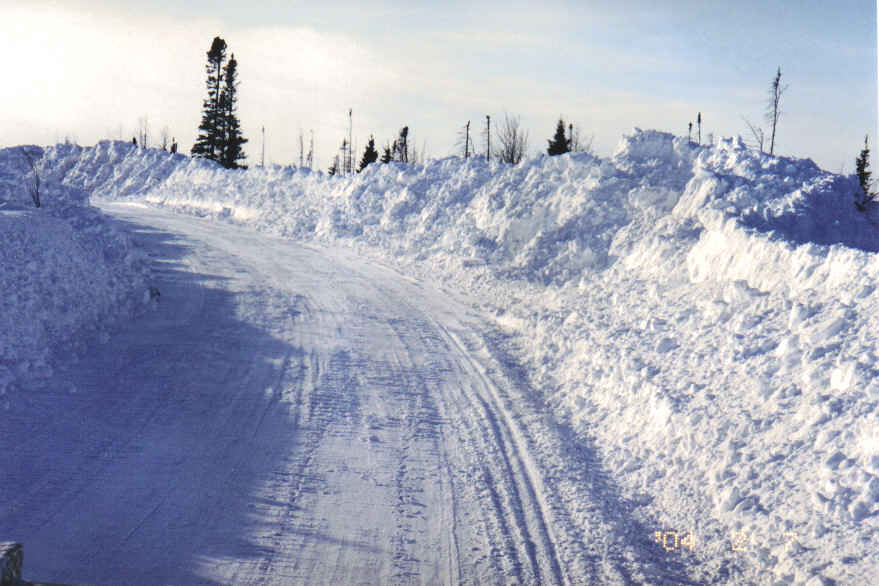
Photo showing snow plowed and piled on road
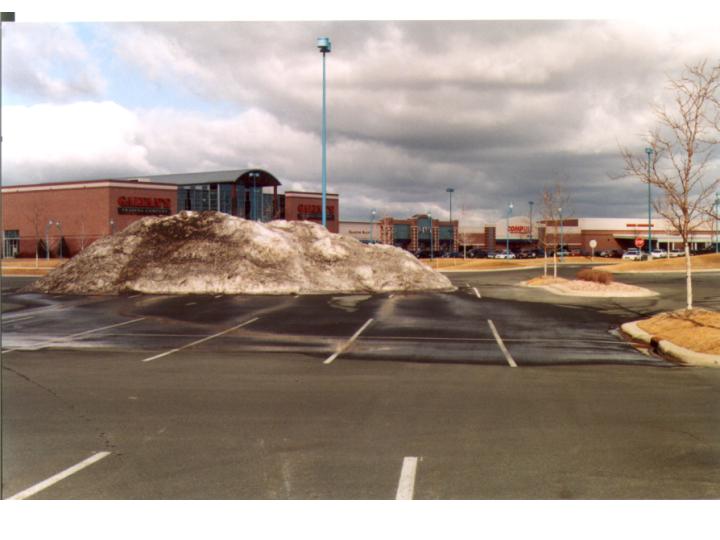
Snow plowed and piled in parking lot. Consideration should be given in locating these "snow dumps", since they will contribute a significant amount of stormwater runoff.
The plowing, relocation and collection of snow presents some very real management questions in need of support data. In most urban areas, a number of approaches are followed depending upon the level of urban density. In residential areas, snow is generally plowed to the side of the road and allowed to accumulate there all winter long. However, in commercial/industrial zones, snow is often plowed to a corner of a parking lot, and in densely-developed urban centers, snow is often removed to a totally different, often remote area, where it is dumped for an entire winter season. Local practices seem to vary considerably based on tradition, expectations and the cost of removal operations. Assuming snow is collected, the design of “snow dumps” must take into account the fact that snow eventually melts and will need somewhere to flow, either off of the land surface or into the ground. Of particular need is data on the impact of these facilities on both ground and surface waters. Until adequate data are available, commonly accepted snow dump guidelines include the following.
- If possible, collect snow on an impervious pad and divert melt for treatment (ex. detention, routing to a wastewater treatment facility).
- If runoff collection and treatment is not an option, locate on a flat slope well away from surface water bodies, outside of the floodplain and well above the ground water table.
- Place the collected snow over well-drained soil to allow filtration, adsorption and microbial activity.
- Clean-up of debris left after the snowmelt and before the first spring rains fall, and restore the soil if needed.
- Monitor the quality of snowmelt and of the receiving water, especially if it is the local ground water system.
- Collecting and treating snow dump meltwater should become more important if a sensitive receiving water is at stake.
Snow Storage and Winter Vegetation Maintenance
Even minor snow storage or piling in or around an infiltration practice can lead to some additional vegetation maintenance considerations. Piles or drifts of snow and ice along the sides of infiltration practices alongside parking lots will likely drop out sediments and trash during the melt season. Also, as piles of snow and ice are pushed or moved with subsequent clearing efforts, significant damage to plants is likely, especially to woody plants such as trees and shrubs. Snowplowing operations can cause scrapping and disturbance to infiltration soils. Areas that have received snow storage should be inspected closely after melt. Any disturbance of the soils should be corrected. Plantings or seedings should be replaced as soon as possible to avoid erosion and open soils that can lead to weed establishment.
Some winter maintenance on plantings should occur over the winter. Trees and shrubs should be pruned in the winter to avoid infections from fungus. When using grasses in planting schemes, the grasses should be left standing through the winter for habitat creation and winter landscaping interest.
Low Impact Development (LID)
The movement in runoff management toward less structural, “low-impact” development techniques shows a great deal of promise for snowmelt management. The effectiveness of this approach to runoff management relies to a great extent on the biological and soil systems within a watershed. The ability of these systems to operate in an acceptable manner could mean they are propelled to common practice or doomed to failure. Much of the discussion in this section stresses the role that low impact approaches can have in meltwater management. Research on this topic will be entered into the BMP design sheets. Practices such as permeable pavement, groundwater recharge by local infiltration, use of grass swales, and road drainage infiltration systems have been found to be effective under cold climate conditions, as long as they are adequately maintained to assure their effective performance.
Planning and education
All of the design and evaluation assistance that will be contained in the Minnesota Manual will be meaningless if the results do not get properly interpreted and distributed, both to the local officials making decisions and to the public that must live with those decisions. For example, a public clamoring for ice-free roads could be in direct conflict with a reduced salt strategy. Local officials also need data and technical assistance to make good decisions on meltwater management. The Minnesota Stormwater Manual is intended to fulfill at least some of this need. Preparation of more of this kind of “on-the-ground” technical information in the hands of everyday managers is essential to improve water management in cold climate areas.