This section of the manual is currently under construction.
There is an increasing reliance on infiltration best management practices (BMPs) to meet water quality goals, meet regulatory requirements, and promote green infrastructure. Infiltration BMPs must be properly designed, constructed, and maintained to perform as intended. Some BMPs, such as permeable pavement, require compaction to provide strength and stability. However, soils are often unintentionally compacted during the construction process. This page addresses unintentional compaction issues at construction sites and presents methods for alleviating compaction.
Contents
- Bulk densities of undisturbed soil
- Causes and effects of compaction at construction sites
- Determining the extent of compaction at a construction site
- Articles and factsheets
- Related pages
Bulk densities of undisturbed soil
Bulk density is the weight of soil divided by its volume. This volume includes the volume of soil particles and the volume of pores among soil particles. Bulk density is typically expressed in grams per cubic centimeter (g/cm3).
The table below illustrates typical bulk densities for undisturbed soil (Schueler, T. 2000. The Compaction of Urban Soils: Technical Note #107 from Watershed Protection Techniques. 3(2): 661-665. Center for Watershed Protection, Ellicott City, MD.). Because bulk density includes volume occupied by air and water, it is always less than the particle density, which isa the density of the solid material. For example, the table includes the density of quartzite, a solid material. The table also includes urban soils (e.g. athletic fields, lawns) that tend to be compacted.
Causes and effects of compaction at construction sites
Soils at construction sites are generally compacted as a result of excavation, mixing, stockpiling, equipment storage, and equipment traffic. In addition, exposed subsoil is susceptible to compaction. Clay soils and wet soils are more susceptible to compaction. Even at sites where selective grading is employed, compaction occurs as a result of construction equipment, stockpiling and vehicle traffic (Randrup, 1998; Lichter and Lindsay, 1994).
When soil is compacted, porosity decreases and bulk density increases. Typical increases in bulk density are shown below, with other compacting activities included for comparison. As a result, permeability of air and water in soil decreases, soil water-holding capacity is reduced, and root growth is impeded. On a watershed scale, soil compaction leads to increased runoff and erosion.
The effects of compaction are difficult to overcome and may persist for decades. Natural processes such as freeze-thaw cycles, animal burrowing, and root growth only slowly diminish compaction. These natural processes are typically limited to the upper foot or two of soil. Even when bulk densities decrease, the original soil structure may not be achieved (Randrup, 1997; Schueler and Holland, 2000).
Information: For information on methods for restoring soil bulk density after compaction see the soil amendment and restoration section of this manual.
Determining the extent of compaction at a construction site
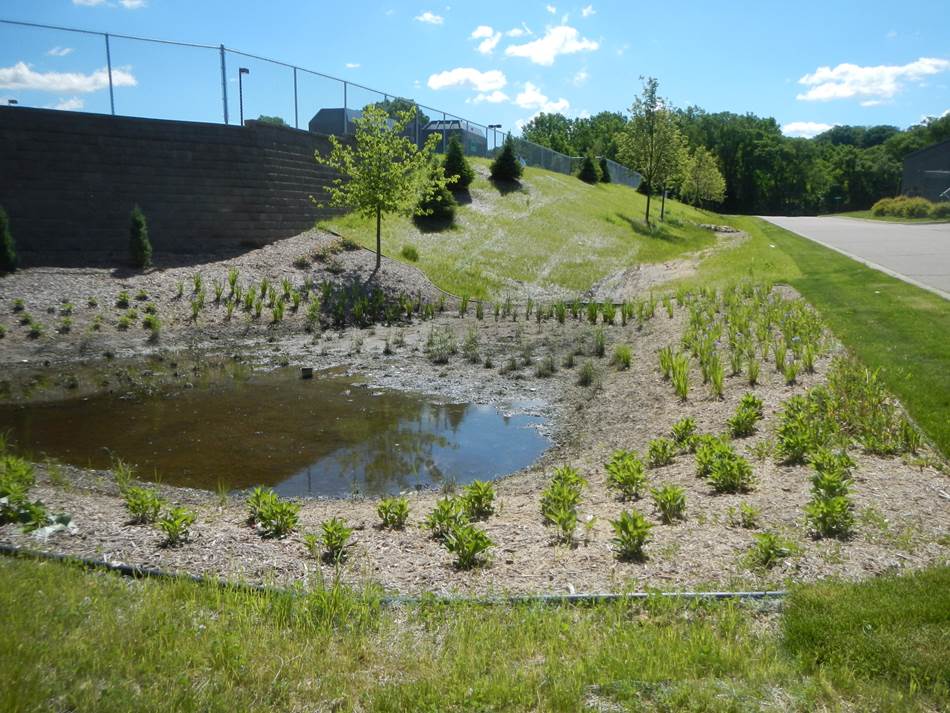
Soil compaction can be evident through field observations, including presence of ponded water, discolored or poor plant growth, and eroded soil. Compaction can be determined through field measurements, including taking bulk density samples, using commercially available cone penetrometers, and using surface nuclear gauges. Other measurements, such as soil infiltration, may be used as indicators of compaction.


It is beyond the scope of this document to present a comprehensive discussion of the various methods for determining soil compaction. A short summary of advantages and disadvantages of common methods is presented below, with links to documents that provide more detailed information.
- Use of bulk density measurements are described by Blake and Hartge (1986), Randrup (1993), and Lichter and Costello (1994). Although taking bulk density measurements is relatively simple and fast, the technique is not suitable for rocky, sandy, dry, or wet soils.
- Use of penetrometers is described by Randrup and Lichter (2001), Gregory et al (2006), NRCS (2012), and Indiana Department of Transportation (2003). Advantages include fast and continuous profiling, reliable and economic equipment free of operator effects, generation of reliable results for soft-earth materials, and well-documented use. Disadvantages include high initial capital cost, need for skilled operators, limitations in gravels or cemented materials, and questionable data in unsaturated soils, particularly clays.
- Use of nuclear gauges is described by Randrup and Lichter (2001), Alberty (1984), and New York Department of Transportation (2015). Nuclear gauges are suitable for measuring compaction in soils with less than 5 percent organic matter at depths up to 6 inches. They are easy to use and provide instant data. Drawbacks include expense, need for licensed personnel, and potential safety concerns.
Articles and fact sheets
- Achieving the Post-construction Soil Standard - provides guidance for preserving and restoring healthy soils on developments.
- Soil Compaction in the Urban Landscape
- Combating Soil Compaction
- Urban Soil Reuse as Planting Soil: Current Science and Lessons Learned
- Resources on soil compaction
Related Pages
Alleviating compaction from construction activities
References
References for this page are included on the page, Alleviating compaction from construction activities.