| Indicator | Function | Type of indicator | Test | Management strategies |
|---|---|---|---|---|
| Compaction/bulk density | Hydrologic; erosion control | Physical | Field and lab | Amend with organic matter; tillage |
Overview
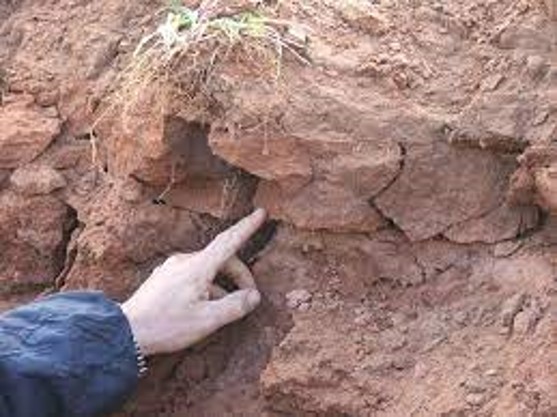
Soil density is related to the mineral and organic composition of a soil and to soil structure. The standard measure of soil density is bulk density, defined as the proportion of the weight of a soil relative to its volume, typically expressed as g/cm3 of soil. Bulk densities in undisturbed soils range from about 1.0 to 1.4 g/cm3, being higher for sands and with increased depth in the soil profile.
Compacted soils exhibit increased bulk density. Several activities result in soil compaction, including but not limited to increased traffic (foot or machinery), turf, lack of soil cover, and use of fill.
Importance
Compacted soils result in restricted water and air transport and loss of habitat for soil biota. Severely compacted soils may also impede root growth. Clay soils and wet soils are more susceptible to compaction.
Assessment
There are multiple methods for measuring bulk density and compaction (resistance). See methods for measuring bulk density and methods for measuring compaction. Recommended methods of assessment include the following.
- Penetrometer - a penetrometer is a portable, easy to use tool. The penetrometer is pushed into a soil and a gauge shows the resistance. Readings greater than 300 psi (pounds per square inch) indicate conditions restrictive to root growth. If more than 50 percent of readings from a field exceed 300 psi, compaction is considered moderate; severe if more than 75 percent of readings exceed 300 psi. Typical cost of a penetrometer is about $200.
- Bulk density - bulk density is a relatively easy to perform measurement but requires determining the soil water (moisture) content (see here). Relationships of bulk density to root growth are shown in the adjacent table.
Management
Information: Recommended reading - See Alleviating compaction from construction activities
The effects of compaction are difficult to overcome and may persist for decades. Natural processes such as freeze-thaw cycles, animal burrowing, and root growth only slowly diminish compaction. These natural processes are typically limited to the upper foot or two of soil. Even when bulk densities decrease, the original soil structure may not be achieved (Randrup, 1997; Schueler and Holland, 2000).
The following table summarizes results for different activities designed to alleviate compaction. The results suggest compost amendment is an effective method for alleviating compaction, while tillage is considerably less effective. Note however, this is an area of on-going research and some recent studies suggest properly conducted tillage can be effective at reducing compaction. For an example, link here.
Recommended reading
- Soil Quality Indicators - Bulk density - USDA-NRCS
- Soil bulk density-mositure/aeration - USDA-NRCS
- Bulk density - Plant and Soil Sciences Library
Below are links to videos demonstrating methods for collecting bulk density samples.
- Bulk density and soil water (moisture) content - a 12 minute video illustrating how to collect the sample in field and measure in the lab using the core method
- Bulk density and soil water (moisture) content - a 10 minute video using the core method
- Bulk density and soil water (moisture) content - this 34 minute video describes the clod method, which is preferred but more time consuming and cannot be used for soils where intact clods cannot be collected
Methods for measuring bulk density are provided in the following document.