Vegetative filters
Vegetative filters provide removal of sediment, nutrients, or pollutants by plant structures
Grass channels
Grass channels are designed to meet a runoff velocity target for a water quality storm as well as the peak discharge from a 2-year design storm. The runoff velocity should not exceed 1.0 feet per second (fps) during the water quality storm. Grass channels can be designed to pass larger storms and serve as conveyance tools. Pre-treatment can be created by placing check dams across the channel below pipe inflows, and at various other points along the channel. Grass channels do not provide adequate pollutant removal benefits to act as a stand-alone BMP.
Dry swales
In dry swales, the entire water quality volume is temporarily retained by check dams during each storm. Unlike the grass channel, the filter bed in the swale is 30 inches of prepared soil. Water is filtered through the sandy loam to underdrains and the swale is quickly dewatered. In the event that surface soils clog, the dry swale has a pea gravel window on the downstream side of each check dam to route water to the underdrain. Dry swales are often preferred in residential areas because they prevent standing water. See Computer-aided design and drafting (CAD/CADD) drawings for design drawing.
Wet swales
Wet swales occur when the water table is located very close to the surface. This wet swale acts as a very long and linear shallow wetland treatment system. Like the dry swale, the entire water quality treatment volume is stored within a series of cells created by check dams. Cells may be planted with emergent wetland plant species to improve pollutant removal.
Filter strips
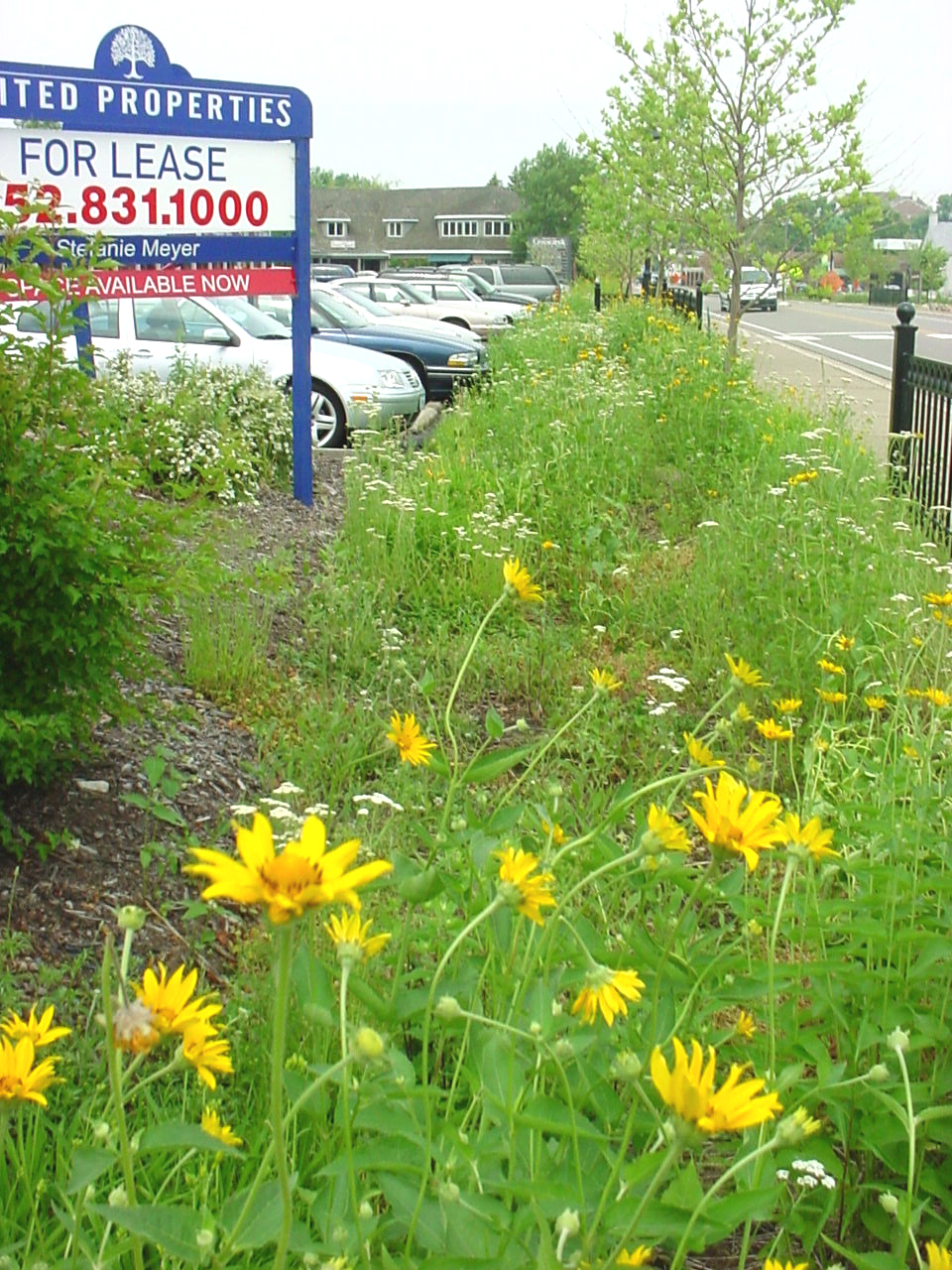
Filter strips rely on the use of vegetation to slow runoff velocities and filter out sediment and other pollutants from urban stormwater.
To be effective, however, filter strips require the presence of sheet flow across the entire strip. Once flow concentrates to form a channel, it effectively short-circuits the filter strip. In the most common design, runoff is directed from a parking lot into a long filtering system composed of a stone trench, a grass strip and a longer naturally vegetative strip. The grass portion of the filter strip provides pre-treatment for the wooded portion. In addition, a stone drop can be located at the edge of the parking lot and the filter strip to prevent sediments from depositing at this critical entry point. The filter strip is typically an on-line practice, so it must be designed to withstand the full range of storm events without eroding. Filter strips do not provide adequate pollutant removal benefits to act as a stand-alone BMP. See Computer-aided design and drafting (CAD/CADD) drawings for design drawing.
Other filters not approved for Minnesota
The following filters are not recommended for use in Minnesota due to high probability of failure under cold climate conditions. They are included here for informational purposes only.
Organic filter
The organic filter functions in much the same way as the surface sand filter, but uses leaf compost or a peat/sand mixture as the filter media instead of sand (compost and peat should not be used when the target pollutant for removal is a dissolved nutrient. The organic material enhances pollutant removal by providing adsorption of heavy metals. In an organic filter, runoff is diverted with a flow splitter into a pre-treatment chamber, from which it passes into one or more filter cells. Each filter bed contains a layer of leaf compost or the peat/sand mixture, followed by a filter fabric and perforated pipe and gravel. Runoff filters through the organic media to the perforated pipe and ultimately to the outlet. The filter bed and subsoils can be separated by an impermeable polyliner to prevent movement into groundwater.
It is HIGHLY RECOMMENDED that the facility be actively managed to keep it dry before it freezes in the late fall.
Pocket filter
Pocket sand filters are intended as an inexpensive variation of a sand filter where sediment loads do not warrant a sedimentation chamber and can suffice with a grass filter strip and a plunge pool. The filter bed is comprised of a shallow basin containing the sand filter medium. The filter surface is a layer of soil and a grass cover. In order to avoid clogging the filter has a pea gravel “window” which directs runoff into the sand and a cleanout and observation well. Typically the filtered runoff is allowed to exfiltrate to ground water, although underdrains may be needed if the soils are not suitably permeable.
Submerged gravel wetland
Submerged gravel filters consist of a series of cells that are filled with crushed rock or gravel. The standpipe from each cell is set at an elevation that keeps the rock or gravel submerged. Wetland plants are rooted in the media, where they can directly take up pollutants. The anaerobic conditions on the bottom of the filter can foster the de-nitrification process. Submerged gravel wetlands are not recommended for stormwater quality in cold climate conditions, although they do have been used in Minnesota for effluent polishing of wastewater.
Related pages
- Overview for filtration
- Design criteria for filtration
- Construction specifications for filtration
- Assessing the performance of swales
- Assessing the performance of sand (media) filters
- Operation and maintenance of filtration
- Calculating credits for sand filter
- Calculating credits for swale
- Cost-benefit considerations for filtration
- References for filtration
- References for dry swale (grass swale)
- References for high-gradient stormwater step-pool swale