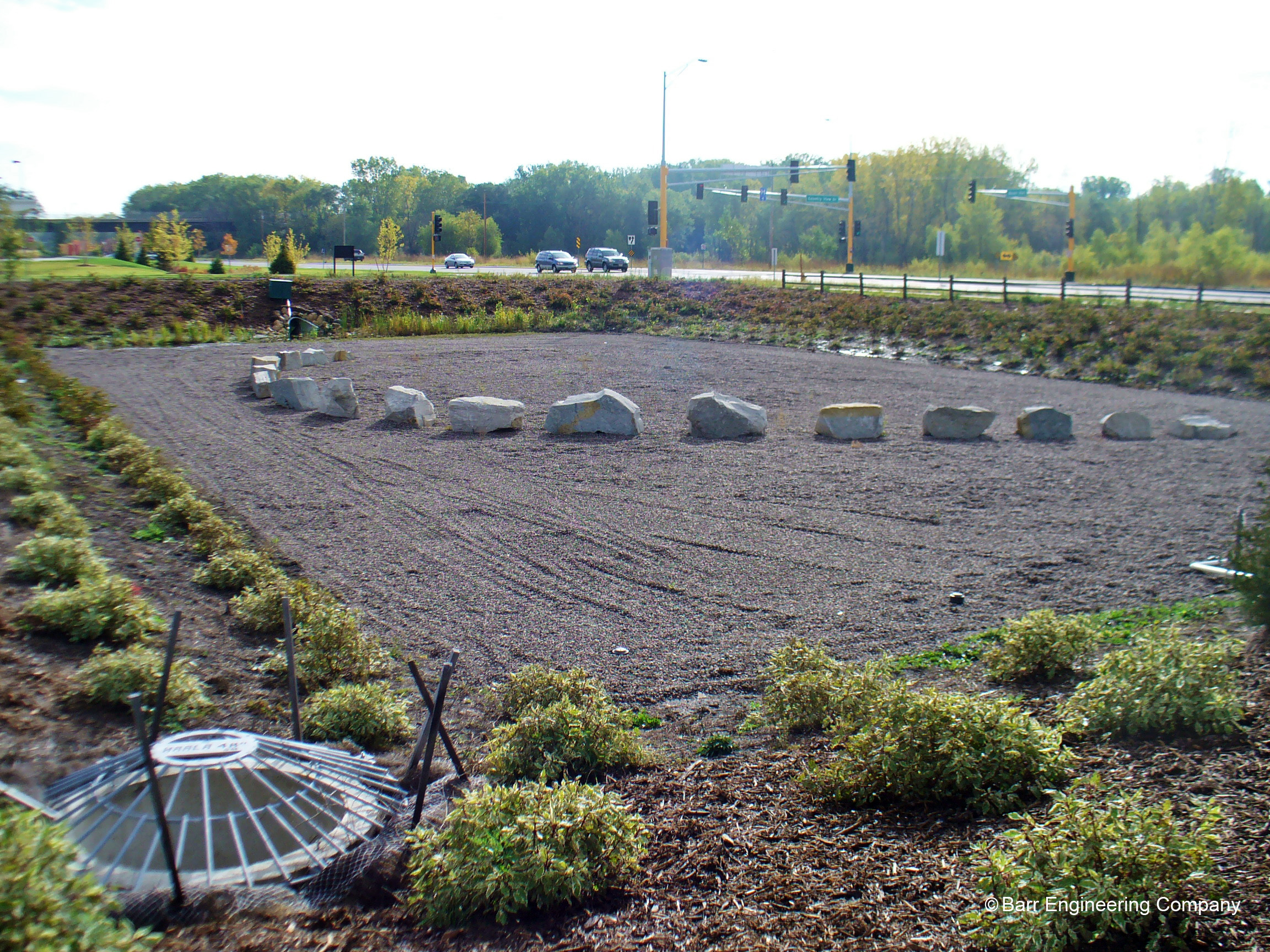
Sand filters, also called media filters or filtration basins, are a stormwater quality treatment system that works by capturing stormwater runoff and allowing this water to percolate through a sand-based filter media. Sand filters are very effective at removing sediment and pollutants attached to sediment. They do not provide reductions in the volume of runoff and have limited effectiveness for dissolved pollutants unless they are modified. They are suitable for all land uses, as long as the contributing drainage areas are limited (e.g., typically less than 5 acres). Media filters are not as aesthetically appealing, which makes them more appropriate for commercial or light industrial land uses or in locations that will not receive significant public exposure. Media filters are particularly well suited for sites with high percentages of impervious cover (e.g., greater than 50%). Media filters are typically designed with an underdrain, which makes them a good option for treating potential stormwater hotspots (PSHs). They can also be installed underground to prevent the consumption of valuable land space (often an important retrofit or redevelopment consideration).
Contents
- Function within stormwater treatment train
- MPCA permit applicability
- Retrofit suitability
- Special receiving waters suitability
- Cold climate suitability
- Water quantity treatment
- Water quality treatment
- Limitations
- Related pages
Function within stormwater treatment train
Sand filters are designed primarily as offline systems for stormwater quality and typically are used in conjunction with other structural controls in the stormwater treatment train.
MPCA permit applicability
One of the goals of this Manual is to facilitate understanding of and compliance with the MPCA Construction Stormwater (CSW) General Permit, which includes design and performance standards for permanent stormwater management systems. These standards must be applied in all projects in which at least 1 acre of new impervious area is being created, and the permit stipulates certain standards for various categories of stormwater management practices.
For regulatory purposes, sand filters are filtration practices that fall under Filtration systems of the MPCA CSW Permit. If used in combination with other practices, credit for combined stormwater treatment can be given. Due to the statewide prevalence of the MPCA permit, design guidance in this section is presented with the assumption that the permit does apply. Also, although it is expected that in many cases the filtration practice will be used in combination with other practices, standards are described for the case in which it is a stand-alone practice.
The following terms are thus used in the text to distinguish various levels of filtration practice design guidance:
- REQUIRED:Indicates design standards stipulated by the MPCA CSW Permit (or other consistently applicable regulations).
- HIGHLY RECOMMENDED: Indicates design guidance that is extremely beneficial or necessary for proper functioning of the filtration practice, but not specifically required by the MPCA CSW Permit.
- RECOMMENDED: Indicates design guidance that is helpful for filtration practice performance but not critical to the design.
Of course, there are situations, particularly retrofit projects, in which a sand filter is constructed without being subject to the conditions of the MPCA permit. While compliance with the permit is not required in these cases, the standards it establishes can provide valuable design guidance to the user. It is also important to note that additional and potentially more stringent design requirements may apply for a particular practice, depending on where it is situated both jurisdictionally and within the surrounding landscape.
Retrofit suitability
The use of sand filters as a retrofit practice primarily depends on existing infrastructure and the compatibility of existing storm drain inverts that need to connect to the filter underdrain outflow. In general, four to six feet of elevation above the existing collection system invert is needed for media filter retrofits (2 to 3 feet is needed for perimeter filters). Underground media filters are excellent for highly urban and ultra-urban environments where space is at a premium.
Special receiving waters suitability
The following table provides guidance regarding the use of filtration practices in areas upstream of special receiving waters.
Cold climate suitability
Various options are available for treating snowmelt runoff. Some of the installations are built below the frost line (trenches, sub-grade proprietary chambers) and do not need further adaptation for the cold. However, some special consideration is HIGHLY RECOMMENDED for surface systems.
The problem with sand filters in cold weather is the ice that forms both over the top of the facility and within the soil interstices. To avoid these problems to the extent possible, it is HIGHLY RECOMMENDED that the practice be actively managed to keep it dry before it freezes in the late fall. This can be done by various methods, including limiting inflow, under-drainage, and surface disking.
Proprietary, sub-grade filtration systems provide an alternative to standard surface based systems. Essentially, these systems provide an insulated location for pre-treated snowmelt to be stored and slowly filtered, or simply filtered and drained away if ground water sensitivity is an issue. The insulating value of these systems adds to their appeal as low land consumption alternatives to ponds and surface infiltration basins.
Water quantity treatment
Sand filters are not a primary practice for providing water quantity control. They are normally either designed offline using a flow diversion or configured to safely pass large storm flows while still protecting the filter bed. In limited cases, filters may be able to accommodate the channel protection volume, Vcp, in either an off- or online configuration, and in general they do provide some (albeit limited) storage volume. Generally, however, to meet site water quantity or peak discharge criteria, it is HIGHLY RECOMMENDED that another structural control (e.g., detention) be used in conjunction with a filter.
Warning: It is REQUIRED that volume reduction practices, such as infiltration basins, are considered before filtration practices
Water quality treatment
Sand filters can be an excellent stormwater treatment practice with the primary pollutant removal mechanism being filtering and settling. Pollutant removal data for select parameters are provided for filtration BMPs in the adjacent table. “Performance” can also be defined as the quality of the water flowing out of a treatment BMP. These outflow concentrations can be used to assess how well a BMP is performing and what its benefit to a down-gradient receiving water will be. The adjacent table contains information on typical expectations for outflow concentration
While it is possible to design sand filters to discharge a portion of the effluent to the groundwater, they are typically designed as enclosed systems (i.e., no “infiltration”).
The benefits associated with filtration BMPs should only be accrued based on the amount of water actually passing through the BMP. Excess runoff beyond that designed for the BMP should not be routed through the system because of the potential for hydraulic and particulate over-loading, both of which will adversely impact the life and operation of the BMP. For example, a filtration device designed to treat the first 0.5 inch of runoff from a fully impervious surface will catch about 30 percent of the volume of runoff in the Twin Cities. This means that 70 percent of the runoff volume should be routed around the filtration system and will not be subject to the removals reflected in the above tables. Attributing removal to all runoff just because a BMP is in place in a drainage system is not a legitimate claim.
Limitations
The following general limitations should be recognized when considering installation of a sand filter.
- Nitrification of water in media filters may occur where aerobic conditions exist.
- Sand filters offer limited water quantity control.
- The potential to create odors exists
It is HIGHLY RECOMMENDED that media filters be equipped with a minimum 8 inches diameter underdrain in a 1 foot gravel bed.
Related pages
- Types of sand (media) filters
- Design criteria for sand (media) filters
- Construction specifications for sand (media) filters
- Assessing the performance of sand (media) filters
- Operation and maintenance of sand (media) filters
- Calculating credits
- Cost-benefit considerations for sand (media) filters
- References for sand (media) filters
- Requirements, recommendations and information for using sand filter as a BMP in the MIDS calculator
- Links to detail images
- Perimeter sand filter details: File:Perimeter Sand Filter PERIMETER SAND FILTER DETAILS (1).pdf
- Surface sand filter: File:SURFACE Sand Filter3 Surface sand filter (1).pdf
- Underground sand filter: File:UNDERGROUND SAND FILTER Layout2 (1).pdf
- Fact sheet for filtration (Includes vegetated filters)