This page provides a discussion of how sand filter practices can achieve stormwater credits.
Information: Calculation of credits for iron enhanced sand filters is covered on another page: Calculating credits for iron enhanced sand filter
| TSS | TP | PP | DP | TN | Metals | Bacteria | Hydrocarbons |
|---|---|---|---|---|---|---|---|
| 85 | 50 | 85 | 0 | 35 | 50 | 80 | 80 |
| TSS=total suspended solids; TP=total phosphorus; PP=particulate phosphorus; DP=dissolved phosphorus; TN=total nitrogen | |||||||
Warning: Models are often selected to calculate credits. The model selected depends on your objectives. For compliance with the Construction Stormwater permit, the model must be based on the assumption that an instantaneous volume is captured by the BMP. For more information on using models to calculate credits see Methods and resources for calculating credits.
Credit refers to the quantity of stormwater or pollutant reduction achieved either by an individual best management practice (BMP) or cumulatively with multiple BMPs. Stormwater credits are a tool for local stormwater authorities who are interested in
- providing incentives to site developers to encourage the preservation of natural areas and the reduction of the volume of stormwater runoff being conveyed to a best management practice (BMP);
- complying with permit requirements, including antidegradation (see Construction permit; Municipal (MS4) permit);
- meeting the MIDS performance goal; or
- meeting or complying with water quality objectives, including total maximum daily load (TMDL) wasteload allocations (WLAs).
Contents
Overview
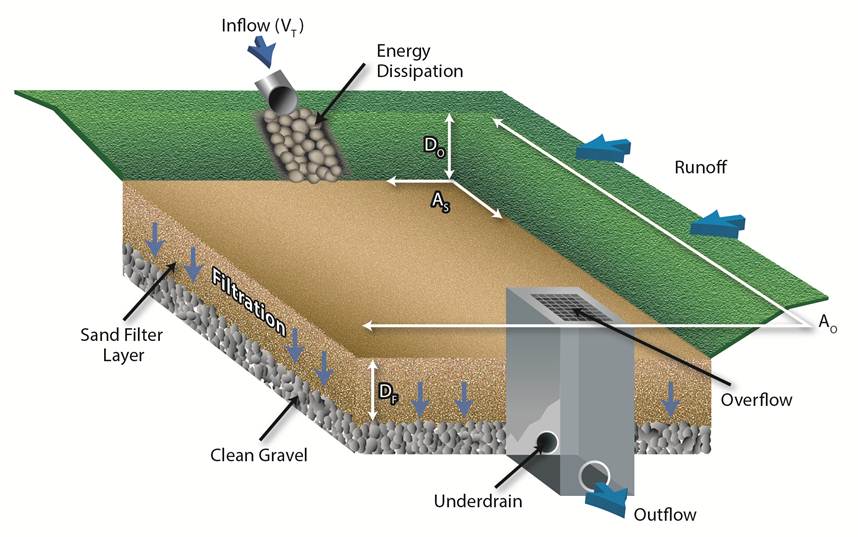
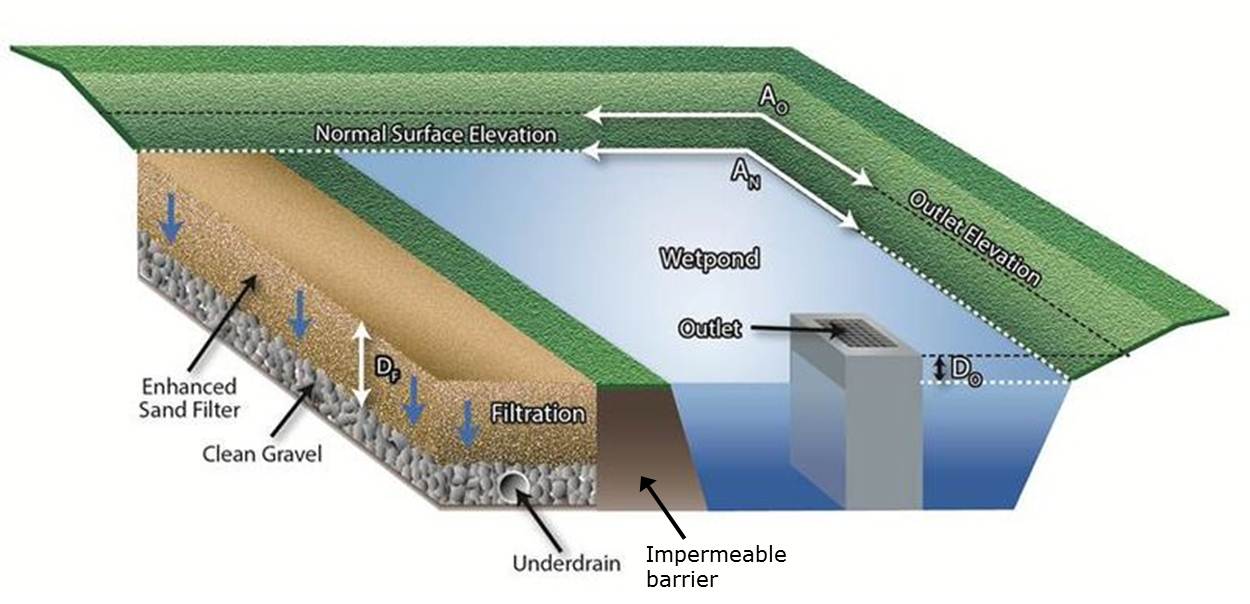
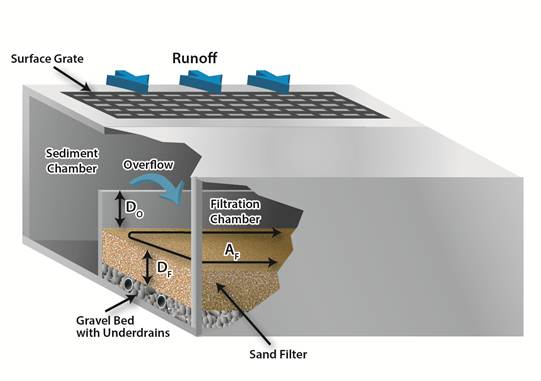
Sand filters are filtration practices that use sand media to filter and remove pollutants from stormwater before entering the downstream stormwater system or BMP. Enhanced sand filters, also known as iron-enhanced sand filters or Minnesota Filters, use iron mixed with the filter media to improve removal of dissolved constituents from the stormwater. Common types of sand filters are perimeter filters, surface filters, or underground filters. Enhanced sand filters are commonly implemented as filtration basins, or as filtration benches for wet ponds. Because sand filters are not designed to infiltrate or store stormwater, all filters require use of an underdrain to convey treated stormwater out of the system.
Pollutant Removal Mechanisms
Sand filters primarily remove pollutants through settling and filtration of solids, whereas enhanced sand filters also remove pollutants through chemical binding. Additionally, surface sand filters that incorporate vegetation into the practice will provide biological removal of nutrients via uptake by the vegetation (WEF, Design of Urban Stormwater Controls). While enhanced sand filters are effective in screening solids, the primary water quality benefits they provide are the removal of dissolved constituents including metals and phosphates. Sand filters and enhanced sand filters are not designed to infiltrate and therefore do not provide stormwater volume reduction benefits. Other pollutants may be addressed by sand filters and enhanced sand filter practices.
Discussion of pollutant removal and credits for enhanced sand filters are discussed in a separate article.
Location in the Treatment Train
Treatment trains are comprised of multiple best management practices (BMPs) that work together to minimize the volume of stormwater runoff, remove pollutants, and reduce the rate of stormwater runoff being discharged to Minnesota wetlands, lakes and streams. Sand filters may be used in a treatment sequence as pretreatment for other structural controls, or as a stand-alone BMP.
Methodology for calculating credits
This section describes the basic concepts and equations used to calculate credits for Total Suspended Solids (TSS) and Total Phosphorus (TP). For specific tools and methods that can be used to calculate credits see Methods and resources for calculating credits. No volume credit can be obtained for sand filters or enhanced sand filters. Enhanced sand filters are effective at reducing concentrations of other pollutants such as metals. This article does not provide information on calculating credits for pollutants other than TSS and phosphorus, but references are provided that may be useful for calculating credits for other pollutants.
Assumptions and approach
In developing the credit calculations, it is assumed the sand filter practice is properly designed, constructed, and maintained in accordance with the Minnesota Stormwater Manual. If any of these assumptions is not valid, the BMP may not qualify for credits or credits should be reduced based on reduced ability of the BMP to achieve pollutant reductions. For guidance on design, construction, and maintenance, see the appropriate article within the sand filter section of the Manual.
Warning: Pretreatment is required for all filtration practices
In the following discussion, the Water Quality Volume (VWQ) is delivered as an instantaneous volume to the BMP. The VWQ is stored as water ponded above the filter media and below the overflow point in the BMP. The VWQ can vary depending on the stormwater management objective(s). For construction stormwater, the water quality volume is 1 inch times the area of new impervious surface. For Minimal Impact Design Standards (MIDS), the VWQ is 1.1 inches times the area of impervious surface.
Volume credit calculations
Sand filters and enhanced sand filters do not provide water quantity control and therefore no volume credit is given.
Total suspended solid (TSS) credits
The water quality credits for sand filters and enhanced sand filters are based on the treatment volume capacity of the BMP. This equates with volume of water filtered through the BMP before reaching the underdrain (VF). The treatment volume is assumed to be the volume of water that can be stored above the filter media. The event-based volume, VF, is given by
$^V_F = 0.5\ D_o\ (A_O + A_S)^$
Where:
Do is the depth of water between overflow outlet structure and the sand filter media surface, in feet;
AO is the surface area of the sand filter at the basin overflow, in square feet; and
AS is the area at the surface of the filter media, in square feet.
For a sand filter bench, in which a permanent pool is maintained in a wet pond, VF is calculated as the depth between the overflow and the normal water level of the wet pond.
In the following discussion, the Water Quality Volume (VWQ) is delivered instantaneously to the BMP. The VWQ is stored as water ponded above the filter media and below the overflow point in the BMP. The VWQ can vary depending on the stormwater management objective(s). For construction stormwater, the water quality volume is 1 inch times the area of new impervious surface. For MIDS, the VWQ is 1.1 inches times the area of impervious surface.
The annual volume filtered can be determined with appropriate modeling tools, including the MIDS calculator. Example values are shown below for a scenario using the MIDS calculator. For example, a sand filter designed to capture 1 inch of runoff from impervious surfaces will capture 89 percent of annual runoff from a site with B (SM) soils.
The event-based TSS credit for sand filters, MTSS in pounds, is given by
$^M_{TSS} = 0.0000624\ R_{TSS}\ EMC_{TSS}\ V_F ^$
where:
RTSS is the TSS removal fraction for sand filters,
EMCTSS is the event mean concentration of TSS in runoff, in milligrams per liter, and
0.0000624 is a conversion factor.
If the sand filter is not the upstream most BMP in the treatment train, EMCTSS should be dependent on the MTSS effluent from the next upstream tributary BMP. Information on EMCs for TSS can be found here. Information on pollutant removal can be found here. The recommended pollutant removal value (RTSS) for sand filters is 0.85.
The annual TSS credit, in pounds, is given by
$^M_{TSS} = 2.72\ R_{TSS}\ EMC_{TSS}\ F\ V_{annual} ^$
where:
F is the fraction of annual runoff treated by the BMP,
Vannual is annual runoff in acre-feet, and
2.72 is a conversion factor.
Example calculation
Assume a 2 acre site with 1 acre of impervious and 1 acre of forested land. Annual rainfall is 31.9 inches and the soil is B (SM) with an infiltration rate of 0.45 inches per hour. The sand filter is designed to treat 1 inch of runoff from the site, or 89 percent of annual runoff (see table above). The TSS EMC is 54.5 milligrams per liter and the removal efficiency of the BMP is 0.85. The MIDS calculator was used to calculate an annual runoff of 2.3446 acre-feet delivered to the BMP. The annual TSS reduction is therefore
2.72 * 0.85 * 54.5 * 0.89 * 2.3446 = 263 pounds
Total phosphorus (TP)
Information: Calculation of credits for iron enhanced sand filters is covered on another page: Calculating credits for iron enhanced sand filter
TP reduction credit is made up of 55 percent particulate phosphorus (PP) and 45 percent dissolved phosphorus (DP) removal through filtered stormwater. The event-based TP removal, MTP in pounds, is given by
$^M_{TP} = 0.0000624\ ((0.55\ R_{PP})\ + (0.45\ R_{DP}))\ EMC_{TP}\ V_F ^$
where:
RPP is the removal fraction for particulate phosphorus,
RDP is the removal fraction for dissolved phosphorus., and
EMCTP is the event mean concentration for total phosphorus in runoff, in milligrams per liter.
Sand filters only receive DP credit if iron is incorporated in the filter media. Information on phosphorus removal fractions (percentages) can be found here. Recommended values are 0.85 for RPP, 0 for RDP when no iron is incorporated into the sand filter, and either 0.40 or 0.60 for RDP when iron is incorporated into the sand filter, depending on the design, construction, and maintenance characteristics of the filter.
Annual TP Credit for sand filters is dependent on the ratio of the fraction of annual runoff volume treated by the BMP. This fraction can be calculated using the Minimal Impact Design Standards (MIDS) calculator or other models (see above). The annual TSS credit, in pounds, is given by
$^M_{TP} = 2.72\ ((0.55\ R_{PP})\ + (0.45\ R_{DP}))\ EMC_{TSS}\ F\ V_{annual} ^$
where:
F is the fraction of annual runoff treated by the BMP,
Vannual is annual runoff in acre-feet, and
2.72 is a conversion factor.
The assumption of 55 percent particulate phosphorus and 45 percent dissolved phosphorus is likely inaccurate for certain land uses, such as industrial, transportation, and some commercial areas. Studies indicate particulate phosphorus comprises a greater percent of total phosphorus in these land uses. It may therefore be appropriate to modify the above equation with locally derived ratios for particulate and dissolved phosphorus. For more information on fractionation of phosphorus in stormwater runoff, link here.
Example calculation
Assume a 2 acre site with 1 acre of impervious and 1 acre of forested land. Annual rainfall is 31.9 inches and the soil is B (SM) with an infiltration rate of 0.45 inches per hour. The sand filter is designed to treat 1 inch of runoff from the site, or 89 percent of annual runoff (see table above). The TP EMC is 0.3 milligrams per liter and the removal efficiency of the BMP is 0.85 for particulate P and 0 for dissolved P. The MIDS calculator was used to calculate an annual runoff of 2.3446 acre-feet delivered to the BMP. The annual TP reduction is therefore
2.72 * ((0.55 * 0.85) + (0.45 * 0)) * 0.3 * 0.89 * 2.3446 = 0.80 pounds
If the sand filter were enhanced with iron, the annual TP reduction would be
2.72 * ((0.55 * 0.85) + (0.45 * 0.6)) * 0.3 * 0.89 * 2.3446 = 1.26 pounds
Other pollutants
In addition to TSS and phosphorus, sand filters can reduce loading of other pollutants. According to the International Stormwater Database, studies have shown that sand filter BMPs are effective at reducing concentrations of pollutants, including metals, and bacteria. A compilation of the pollutant removal capabilities from a review of literature are summarized below.
Related pages
- Methods and resources for calculating credits
- Sand (media) filters