This page provides a discussion of how constructed basins (wet pond and stormwater wetland) can achieve stormwater credits.
Information: The discussion of credits applies only to wet ponds. Dry ponds do not receive credit for volume or pollutant removal
| Design level | TSS | TP | PP | DP | TN | Metals | Bacteria | Hydrocarbons |
|---|---|---|---|---|---|---|---|---|
| 1 | 60 | 34 | 60 | 0 or 401 | 30 | 60 | 70 | 80 |
| 2 | 84 | 50 | 84 | 8 or 481 | 30 | 60 | 70 | 80 |
| 3 | 90 | 60 | 90 | 23 or 631 | 30 | 60 | 70 | 80 |
| TSS=total suspended solids; TP=total phosphorus; PP=particulate phosphorus; DP=dissolved phosphorus; TN=total nitrogen | ||||||||
| 1 If iron or another amendment to retain phosphorus has been incorporated into the design, the dissolved phosphorus removal is 40 percent. With no amendment, removal is 0 percent. Note that only iron enhanced pond benches are discussed in this manual as a mechanism for retaining dissolved phosphorus. | ||||||||
Warning: Models are often selected to calculate credits. The model selected depends on your objectives. For compliance with the Construction Stormwater permit, the model must be based on the assumption that an instantaneous volume is captured by the BMP. For more information on using models to calculate credits see Methods and resources for calculating credits.
Credit refers to the quantity of stormwater or pollutant reduction achieved either by an individual best management practice (BMP) or cumulatively with multiple BMPs. Stormwater credits are a tool for local stormwater authorities who are interested in
- providing incentives to site developers to encourage the preservation of natural areas and the reduction of the volume of stormwater runoff being conveyed to a best management practice (BMP);
- complying with permit requirements, including antidegradation (see Construction stormwater permit; Municipal (MS4) permit);
- meeting the MIDS performance goal; or
- meeting or complying with water quality objectives, including total maximum daily load (TMDL) wasteload allocations (WLAs).
Contents
Overview
Information: The discussion of credits applies only to wet ponds. Dry ponds do not receive credit for volume or pollutant removal
| TSS | TP | PP | DP | TN | Metals | Bacteria | Hydrocarbons |
| 73 | 38 | 69 | 0 | 30 | 60 | 70 | 80 |
| TSS=total suspended solids; TP=total phosphorus; PP=particulate phosphorus; DP=dissolved phosphorus; TN=total nitrogen | |||||||
Stormwater ponds (wet pond) and stormwater wetlands are the most common types of constructed basins. Constructed basins have a permanent pool of water and are built for the purpose of capturing and storing stormwater runoff. These basins are constructed, either temporarily or in a permanent installation, to prevent or mitigate downstream water quantity and/or quality impacts. Several types of constructed basins and wetlands (stormwater basins, constructed stormwater ponds, wet detention ponds, forebays, wet sedimentation basins, wet ponds, constructed wetlands, stormwater wetlands, etc) are included in this general category. Generally, stormwater ponds do not have a significant area of vegetation. Stormwater wetlands do have significant vegetation that enhances the nutrient removal of the basin. Not included in this BMP category are dry basins without a permanent pool. Also not included are pretreatment practices, such as oil/water separators, swirl concentrators, and other manufactured devices, that have a permanent pool of water in the device.
Pollutant Removal Mechanisms
Constructed basins rely on physical, biological, and chemical processes to remove pollutants from incoming stormwater runoff. The primary treatment mechanism is gravitational settling of particulates and their associated pollutants as stormwater runoff resides in the permanent pool. Stormwater wetlands provide an additional mechanism for the removal of nutrient and other pollutants through the uptake by algae and aquatic vegetation. Volatilization and chemical activity can also occur in both ponds and wetlands, breaking down and assimilating a number of other stormwater contaminants such as hydrocarbons (WEF, ASCE/EWRI, 2012).
The longer stormwater runoff remains in the permanent pool, the more settling (and associated pollutant removal) and other treatment will occur. After the particulates settle to the bottom of a pond, a permanent pool provides protection from re-suspension when additional runoff enters the pond during and after a rain event (WEF, ASCE/EWRI, 2012).
Location in the Treatment Train
Stormwater treatment trains are comprised of multiple best management practices (BMPs) that work together to minimize the volume of stormwater runoff, remove pollutants, and reduce the rate of stormwater runoff being discharged to Minnesota wetlands, lakes and streams. Constructed basins are typically located at the end of the stormwater treatment train, capturing all the runoff from the site.
Methodology for calculating credits
This section describes the basic concepts used to calculate credits for volume, total suspended solids (TSS) and total phosphorus (TP). For specific tools and methods that can be used to calculate credits see Methods and resources for calculating credits.
Constructed basins generate credits for TSS and TP. They do not substantially reduce the volume of runoff. Constructed basins are effective at reducing concentrations of other pollutants associated with sediment, including metals and hydrocarbons. This article does not provide information on calculating credits for pollutants other than TSS and TP, but references are provided that may be useful for calculating credits for other pollutants.
Wet pond design levels
Wet ponds have many potential designs. Credits vary with design. Below are minimum requirements for three design levels used to credit constructed wet ponds.
- Design Level 1: must meet the following criteria
- Dead (or permanent) storage of at least 1800 cubic feet per acre (=1/2 inch of impervious area) that drains to the pond
- The pond’s permanent storage volume must reach a minimum depth of at least 3 feet and must have no depth greater than 10 feet. The basin must be configured such that scour or resuspension of solids is minimized.
- Flow path length to pond width ratio less than 1:1 or greater than 10:1 (scouring occurs at ratios greater than 10:1)
- Design Level 2: Meets all of the requirements for Design Levels 1 and 2 (except flow path) and does not meet all design requirements for Design Level 3
- Water Quality Volume (flood pool volume) >= 1 inch of impervious area
- Discharge rate of water quality volume does not exceed 5.66 cubic feet per second per acre of surface area of the pond.
- Flow path length to pond width ratio = 1:1 to 3:1. A ratio of 3:1 is recommended.
- Design Level 3: Must meet all of the following design requirements
- Discharge rate of water quality volume does not exceed 5.66 cubic feet per second per acre of surface area of the pond
- Water quality volume (flood pool volume) > 1.5 inch of impervious area
- Wet extended detention or multi-cell system
- Sediment forebay at all major inflows
- Flow path length to pond width ratio 3:1 to 10:1
Iron-enhanced sand filtration bench in wet ponds
An iron-enhanced sand filtration bench in a wet pond is essentially a wet extended detention pond with a permanent pool and a flood pool. The outlet structure of the pond is designed such that the water in the flood pool during and after a storm event is held above the elevation of the iron-enhanced sand filter bench, thereby allowing water to filter through the bench.
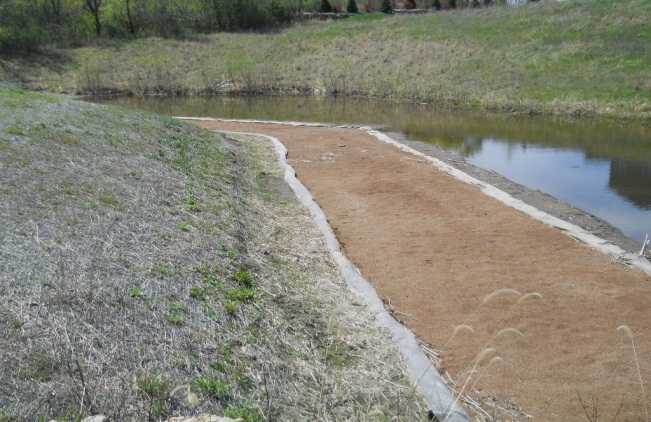
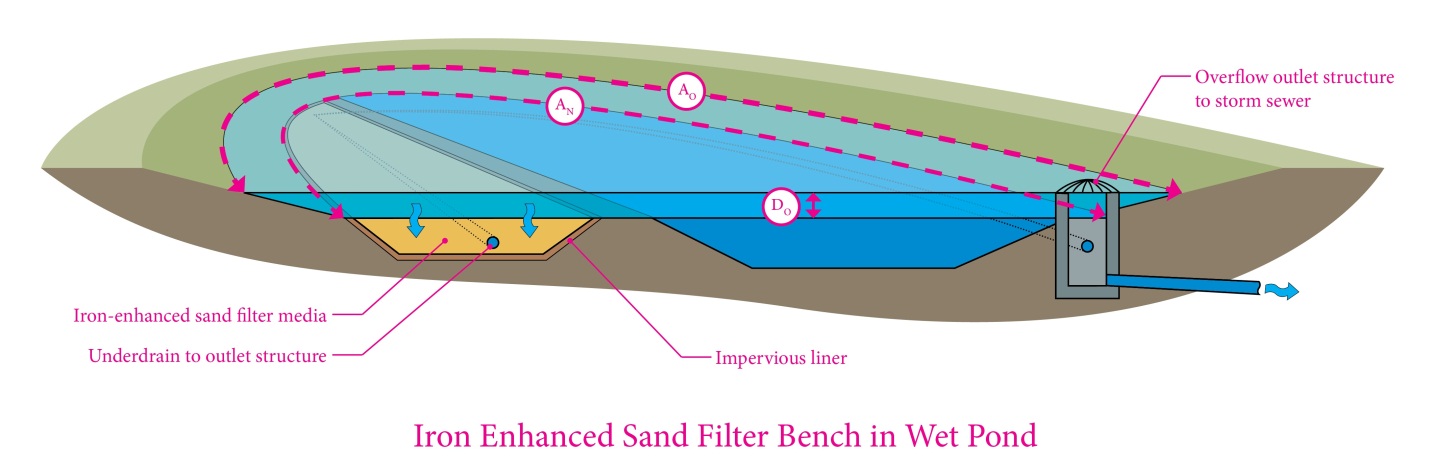
The basic design elements of an iron-enhanced sand filter basin include the following.
- An iron-enhanced sand filter of desired width and length sited along the perimeter of the wet pond (iron-enhanced sands filters should be no less than 5 percent but no greater than 8 percent iron by weight to prevent clogging, see Erickson et al., 2010 and Erickson et al., 2012. The 5 to 8 percent range is based upon iron filing material that is approximately 90 percent elemental iron with a size distribution approximately equal to that of C-33 sand sand.
- An outlet structure that controls the flood pool elevation and can receive the filter bed drain.
- Subsurface drains at the filter bed bottom to drain the bed. The outlet of these subsurface drains should be exposed to the atmosphere and above the downstream high water level to allow the filter to fully drain.
- An impervious barrier (typically geotextile liner, for example HDPE) between the pond and the trench to minimize seepage from the pond into the trench.
- Filter draw down within 48 hours of storm completion to avoid filter fouling and to prepare the filter for next storm event.
- An underdrain that consists of corrugated polyethylene pipe with slits not holes to prevent loss of sand and minimize clogging. If holes are used, the pipe should be covered with pea gravel.
Assumptions and approach
In developing the credit calculations, it is assumed the constructed basin is properly designed, constructed, and maintained in accordance with the Minnesota Stormwater Manual. If any of these assumptions is not valid, the BMP may not qualify for credits or credits should be reduced based on reduced ability of the BMP to achieve pollutant reductions. For guidance on design, construction, and maintenance, see the appropriate article within the Manual (pond design, construction, maintenance; wetland design, construction, maintenance).
Ponds constructed under the Construction Stormwater (CSW) General Permit must meet the following conditions.
- It is REQUIRED in the CSW Permit that the water quality volume (Vwq) is discharged at no more than 5.66 cubic feet per second per acre surface area of the pond.
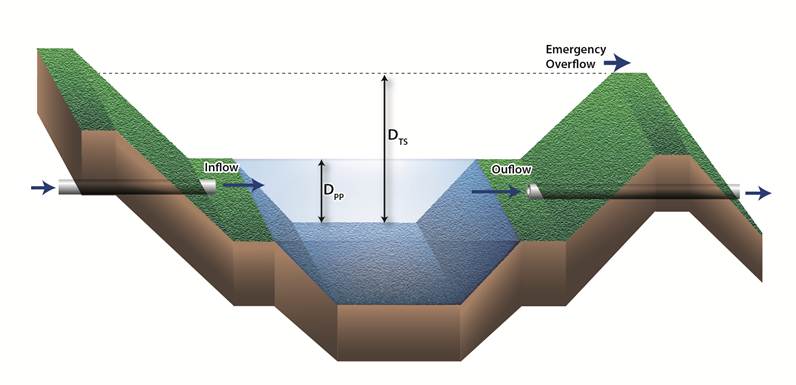
- The REQUIRED total storage volume (Vts) equals the sum of the volume in the permanent pool (Vpp below the outlet elevation) plus live storage allocation for water quality volume (Vwq). Vwq equals 1.0 inch of runoff per impervious acre.
- If the pond is being designed as a wet detention pond for new construction under the MPCA CSW Permit, then a permanent pool volume (Vpp) equal to 1,800 cubic feet for each acre draining to the pond is REQUIRED.
- It is REQUIRED in the CSW Permit that permanent pool depths be a minimum of 3 feet and maximum of 10 feet at the deepest points.
- It is REQUIRED in the CSW Permit that the riser be located so that short-circuiting between inflow points and the riser does not occur.
- The constructed basin must be situated outside of surface waters and any buffer required under Appendix A, Part C.3
If any of these assumptions are not valid, the credit will be reduced.
Volume credit calculations
Constructed basins provide pollutant removal associated with settling of particulates normally present in stormwater runoff and serve the purpose of reducing peak stormwater flows for channel protection and overbank flood control. Pollutant removal is accomplished by the maintenance of a permanent pool of water that serves to both settle and store the particulates. The necessity of the permanent pool negates the ability to infiltrate runoff; therefore no volume credit is obtained for basins and wetlands.
Total suspended solids (TSS) calculations
Constructed basins provide pollutant removal associated with settling of particulates normally present in stormwater runoff. No credits associated with volume reduction are available.
The event-based TSS credit for constructed basins, MTSS in pounds, is given by
$^M_{TSS} = 0.0000624\ R_{TSS}\ EMC_{TSS}\ V_{pp}^$
Where:
RTSS is the TSS removal fraction for the constructed basin;
EMCTSS is the event mean concentration of TSS in runoff, in milligrams per liter;
Vpp is the volume treated by the BMP, in cubic feet; and
0.0000624 is a conversion factor.
TSS removal for constructed ponds and wetlands varies with the design.
Constructed ponds
- Design Level 1 TSS removal = 60%
- Design Level 2 TSS removal = 84%
- Design Level 3 TSS removal = 90%
Design Level 2 is the most common design level, with a median removal of 84 percent
Constructed wetlands: median removal rate of 73 percent.
For a discussion of the principles of sedimentation, see Weiss et al.
The Water Quality Volume (VWQ), which is equivalent to Vpp, is delivered as an instantaneous volume to the BMP. The VWQ can vary depending on the stormwater management objective(s). For construction stormwater, the water quality volume is 1 inch times the new impervious surface area. For MIDS, the VWQ is 1.1 inches times the new impervious surface area.
The annual TSS credit, in pounds, is given by
$^ M_{TSS} = 2.72\ R_{TSS}\ EMC_{TSS}\ F\ V_{annual}^$
Where:
F is the fraction of annual runoff treated by the BMP,
Vannual is annual runoff in acre-feet, and
2.72 is a conversion factor.
For a constructed pond or wetland, the fraction of annual runoff treated by the BMP is assumed to be 1, meaning all runoff from the contributing drainage area passes through and is treated by the BMP.
Example calculation
Assume a constructed pond is designed to treat 5 acres of impervious surface and 5 acres of forested land on B (SM) soils. The TSS concentration in runoff is 54.5 milligrams per liter. Annual runoff, calculated using the MIDS calculator, is 11.72 acre-feet. The annual TSS reduction is 2.72 * 0.84 * 54.5 * 11.72 = 1459 pounds. If the BMP was a constructed wetland instead of a constructed pond, the removal efficiency would be 0.73 instead of 0.84 and the TSS reduction would be 1268 pounds.
Total phosphorus (TP) calculations
Constructed basins provide pollutant removal associated with settling of particulates normally present in stormwater runoff. No credits associated with volume reduction are available.
In the Minimal Impact Design Standards (MIDS) Calculator, phosphorus in runoff is assumed to be 55 percent particulate phosphorus (PP) and 45 percent dissolved phosphorus (DP). Using these values, the event-based TP removal, MTP in pounds, is given by
$^M_{TP} = 0.0000624\ ((0.55\ R_{PP})\ + (0.45\ R_{DP}))\ EMC_{TP}\ V_{pp}^$
Where:
RPP is the removal fraction for particulate phosphorus;
RDP is the removal fraction for dissolved phosphorus; and
EMCTP is the event mean concentration for total phosphorus in runoff, in milligrams per liter.
The assumption of 55 percent particulate phosphorus and 45 percent dissolved phosphorus is likely inaccurate for certain land uses, such as industrial, transportation, and some commercial areas. Studies indicate particulate phosphorus comprises a greater percent of total phosphorus in these land uses. It may therefore be appropriate to modify the above equation with locally derived ratios for particulate and dissolved phosphorus. For more information on fractionation of phosphorus in stormwater runoff, link here.
For wet ponds, removal rates for PP and DP vary with design level. Assuming PP removal is 55% of TP, the removal rates are given below.
- Design Level 1 removal rates: DP = 0%, PP =60%, TP = 34%
- Design Level 2 removal rates: DP = 8%, PP = 84%, TP = 50%
- Design Level 3 removal rates: DP = 23%, PP = 90%, TP = 60%
The MIDS Calculator gives no credit for DP unless an amendment to retain phosphorus is incorporated into the pond design. Data from the International BMP Database indicates constructed basins with no P-retaining amendment typically provide no credit for DP. Information on phosphorus removal fractions (percentages) can be found here. PP removal rates for pond Design Level 2, the most common design, are 0.84 for constructed ponds and 0.69 for constructed wetlands.
Assuming PP is 55 percent of TP, the annual TP credit, in pounds, is given by
$^M_{TP} = 2.72\ ((0.55\ R_{PP})\ + (0.45\ R_{DP}))\ EMC_{TSS}\ F\ V_{annual}^$
Where:
F is the fraction of annual runoff treated by the BMP;
Vannual is annual runoff in acre-feet; and
2.72 is a conversion factor.
For a constructed pond or wetland, the fraction of annual runoff treated by the BMP is assumed to be 1, meaning all runoff from the contributing area passes through and is treated by the BMP.
Example calculation
Assume a 10 acre site with 5 acres of impervious and 5 acres of forested land. Annual rainfall is 31.9 inches and the soil is B (SM) with an infiltration rate of 0.45 inches per hour. The TP EMC is 0.3 milligrams per liter and the removal efficiency of the BMP for particulate phosphorus is 0.85. No dissolved phosphorus is removed. The MIDS calculator was used to calculate an annual runoff of 11.72 acre-feet delivered to the BMP. The annual TP reduction is therefore
2.72 * ((0.55 * 0.84) + (0.45 * 0)) * 0.3 * 11.72 = 4.42 pounds
If the BMP was a constructed wetland the removal efficiency for particulate phosphorus would be 0.68 instead of 0.85 and the total phosphorus removed would be 3.58 pounds.
Other Pollutants
In addition to TSS and phosphorus, constructed basins can reduce loading of other pollutants. According to the International Stormwater Database, studies have shown that constructed basins are effective at reducing concentration of pollutants, including nutrients, metals, bacteria, cyanide, oils and grease, Volatile Organic Compounds (VOC), and Biological Oxygen Demand (BOD). A compilation of the pollutant removal capabilities from a review of literature are summarized below.
Related pages
- Methods and resources for calculating credits
- Constructed stormwater ponds
- Overview for stormwater ponds
- Types of stormwater ponds
- Design criteria for stormwater ponds
- Design considerations for constructed stormwater ponds used for harvest and irrigation use/reuse
- Construction specifications for stormwater ponds
- Assessing the performance of stormwater ponds
- Operation and maintenance of stormwater ponds
- Cost-benefit considerations for stormwater ponds
- Stormwater wet pond fact sheet
- References for stormwater ponds
- Requirements, recommendations and information for using stormwater pond as a BMP in the MIDS calculator