This page provides a discussion of how infiltration practices can achieve stormwater credits. Infiltration practices include infiltration basins, infiltration trenches (including dry wells), and underground infiltration systems. The discussion does not include bioinfiltration and permeable pavement systems, unless specifically mentioned. To view the credit articles for other BMPs, see the Related pages section.
| TSS | TP | PP | DP | TN | Metals | Bacteria | Hydrocarbons |
|---|---|---|---|---|---|---|---|
| Pollutant removal is 100 percent for the volume that is captured and infiltrated | |||||||
| TSS=total suspended solids; TP=total phosphorus; PP=particulate phosphorus; DP=dissolved phosphorus; TN=total nitrogen | |||||||
Warning: Models are often selected to calculate credits. The model selected depends on your objectives. For compliance with the Construction Stormwater permit, the model must be based on the assumption that an instantaneous volume is captured by the BMP.
Green Infrastructure: Infiltration practices can be an important tool for retention and detention of stormwater runoff and treatment of pollutants in stormwater runoff. If the practice utilizes vegetation, additional benefits may include cleaner air, carbon sequestration, improved biological habitat, and aesthetic value.
Credit refers to the quantity of stormwater or pollutant reduction achieved either by an individual best management practice (BMP) or cumulatively with multiple BMPs. Stormwater credits are a tool for local stormwater authorities who are interested in
- providing incentives to site developers to encourage the preservation of natural areas and the reduction of the volume of stormwater runoff being conveyed to a best management practice (BMP);
- complying with permit requirements, including antidegradation (see Construction permit; Municipal (MS4) permit);
- meeting the MIDS performance goal; or
- meeting or complying with water quality objectives, including total maximum daily load (TMDL) wasteload allocations (WLAs).
Contents
- Overview
- Methodology for calculating credits
- 3 Methods for calculating credits
- 4 Other Pollutants
- 6 Related pages
Overview
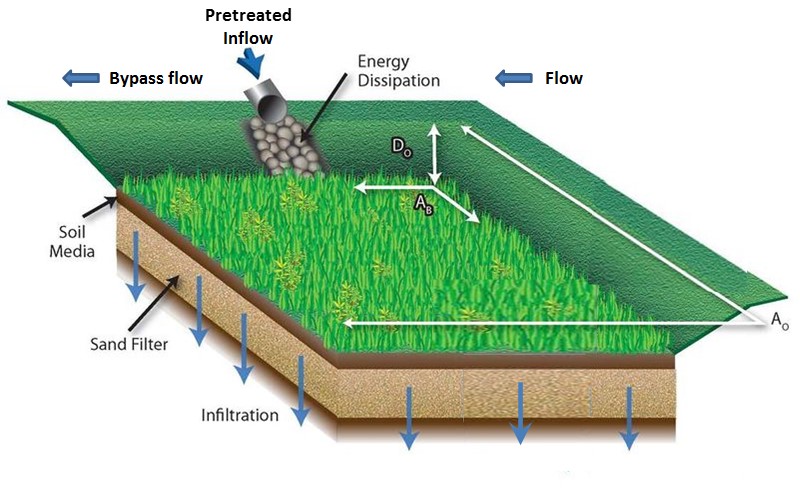
Schematic showing an infiltration basin. Note that inflow into the practice has undergone pretreatment. Once the infiltration basin is filled, water bypasses rather than enters the practice.
Infiltration practices are designed to capture, store, and infiltrate stormwater runoff. They rely on naturally permeable soils to fully infiltrate the designed * Water Quality Volume (VWQ). These are typically off-line practices utilizing an emergency spillway or outlet structure to capture the volume of stormwater runoff for which the practice is designed. Volumes that exceed the rate or volume of the infiltration practice are allowed to bypass the BMP.
Pollutant removal mechanisms
Infiltration practices reduce stormwater volume and pollutant loads through infiltration of the stormwater runoff into the native soil. Infiltration practices also can remove a wide variety of stormwater pollutants through secondary removal mechanisms including filtration, biological uptake, and soil adsorption through plantings and soil media (WEF Design of Urban Stormwater Controls, 2012). See Other Pollutants, for a complete list of other pollutants addressed by infiltration practices.
Location in the treatment train
Stormwater treatment trains are comprised of multiple Best Management Practices that work together to minimize the volume of stormwater runoff, remove pollutants, and reduce the rate of stormwater runoff being discharged to Minnesota wetlands, lakes and streams. Because infiltration practices are designed to be off-line, they may either be located at the end of the treatment train, or used as off-line configurations to divert the water quality volume from the on-line system.
Methodology for calculating credits
This section describes the basic concepts and equations used to calculate credits for volume, Total Suspended Solids (TSS) and Total Phosphorus (TP). Specific methods for calculating credits are discussed later in this article. Infiltration practices are also effective at reducing concentrations of other pollutants including nitrogen, metals, bacteria, and hydrocarbons. This article does not provide information on calculating credits for pollutants other than TSS and TP, but references are provided that may be useful for calculating credits for other pollutants.
Assumptions and approach
In developing the credit calculations, it is assumed the infiltration practice is properly designed, constructed, and maintained in accordance with the Minnesota Stormwater Manual. If any of these assumptions is not valid, the BMP may not qualify for credits or credits should be reduced based on reduced ability of the BMP to achieve volume or pollutant reductions. For guidance on design, construction, and maintenance, see the appropriate article within the infiltration basin or infiltration trench sections of the Manual. Because of their high susceptibility of failure due to clogging, pretreatment is REQUIRED in all infiltration designs.
Warning: Pretreatment is required for all infiltration practices
In the following discussion, the Water Quality Volume (VWQ) is delivered instantaneously to the BMP. VWQ is stored as water ponded above the soil or engineered media and below the overflow elevation. VWQ can vary depending on the stormwater management objective(s). For construction stormwater, VWQ is 1 inch off new impervious surface. For MIDS, VWQ is 1.1 inches.
In reality, some water will infiltrate through the bottom and sidewalls of the BMP as a rain event proceeds. The instantaneous volume method therefore may underestimate actual volume and pollutant losses.
The approach in the following sections is based on the following general design considerations:
- Credit calculations presented in this article are for both event and annual volume and pollutant load removals.
- Stormwater volume credit equates to the volume of runoff that will ultimately be infiltrated into the soil subgrade.
- TSS and TP credits are achieved for the volume of runoff that is infiltrated.
Volume Credit Calculations
Schematic showing terms used in calculating volume credits for an infiltration basin.
Volume credits are calculated based on the capacity of the BMP and its ability to permanently remove stormwater runoff via infiltration into the underlying soil from the existing stormwater collection system. These credits are assumed to be instantaneous values entirely based on the capacity of the BMP to capture, store, and transmit water in any storm event. Because the volume is calculated as an instantaneous volume, the water quality volume (VWQ) is assumed to pond below the overflow elevation and above the bioretention media. This entire volume is assumed to infiltrate through the bottom of the BMP. The volume credit (Vinfb) for infiltration through the bottom of the BMP into the underlying soil, in cubic feet, is given by
$V_{inf_b} = D_o\ (A_O + A_M)\ / 2$
Where:
AO is the overflow surface area of the bioretention system, in square feet;
AM is the area at the surface of the media, in square feet; and
Do is the ponded depth with the BMP, in feet.
If native soils are used rather than engineered media, the term AM may be substituted by AB, as shown in the above schematic and in the schematics for the MIDS calculator. To comply with the Construction Stormwater General Permit, VWQ must infiltrate within 48 hours (24 hours is recommended if discharges are to a trout stream).
Some of the VWQ will be lost to evapotranspiration rather than all being lost to infiltration. In terms of a water quantity credit, this differentiation is unimportant, but it may be important if attempting to calculate actual infiltration into the underlying soil.
The annual volume captured and infiltrated by the BMP can be determined with appropriate modeling tools, including the MIDS calculator. Example values are shown below for a scenario using the MIDS calculator. For example, a permeable pavement system designed to capture 1 inch of runoff from impervious surfaces will capture 89 percent of annual runoff from a site with B (SM) soils.
Total suspended solid (TSS) calculations
Pollutant removal for infiltrated water is assumed to be 100 percent. The mass of pollutant removed through infiltration, MTSSi in pounds, is given by
\( M_{TSS_i} = 0.0000624\ V_{inf_b}\ EMC_{TSS} \)
where
- Vinfb is the volume of water infiltrated, in cubic feet; and
- EMCTSS is the event mean TSS concentration in runoff water entering the BMP (milligrams per liter).
The EMCTSS entering the BMP is a function of the contributing land use and treatment by upstream tributary BMPs. For more information on EMC values for TSS, link here. The above calculation may be applied on an annual basis and is given by
\( M_{TSS_f} = 2.72\ F\ V_{annual}\ EMC_{TSS} \)
where
Vannual is the annual volume treated by the BMP, in acre-feet.
The annual volume captured and infiltrated by the BMP can be determined with appropriate modeling tools, including the MIDS calculator.
Total phosphorus credit calculations
Pollutant removal for infiltrated water is assumed to be 100 percent. The mass of pollutant removed through infiltration, in pounds, is given by
\( M_{TP_i} = 0.0000624\ V_{inf_b}\ EMC_{TP} \)
where
EMCTP is the event mean TP concentration in runoff water entering the BMP (milligrams per liter).
The EMCTP entering the BMP is a function of the contributing land use and treatment by upstream tributary BMPs. The above calculation may be applied on an annual basis and is given by
\( M_{TP_f} = 2.72\ V_{annual}\ EMC_{TP} \)
where
Vannual is the annual volume treated by the BMP, in acre-feet.
Methods for calculating credits
This section provides specific information on generating and calculating credits from infiltration practices for volume, TSS and TP. Stormwater runoff volume and pollution reductions (“credits”) may be calculated using one of the following methods:
- Quantifying volume and pollution reductions based on accepted hydrologic/hydraulic models
- The Simple Method and MPCA Estimator
- MIDS Calculator
- Quantifying volume and pollution reductions based on values reported in literature
- Quantifying volume and pollution reductions based on field monitoring
Credits based on models
Warning: The model selected depends on your objectives. For compliance with the Construction Stormwater permit, the model must be based on the assumption that an instantaneous volume is captured by the BMP.
Users may opt to use a water quality model or calculator to compute volume, TSS and/or TP pollutant removal for the purpose of determining credits for infiltration practices. The available models described in the following sections are commonly used by water resource professionals, but are not explicitly endorsed or required by the Minnesota Pollution Control Agency. Furthermore, many of the models listed below cannot be used to determine compliance with the Construction Stormwater General permit since the permit requires the water quality volume to be calculated as an instantaneous volume.
Use of models or calculators for the purpose of computing pollutant removal credits should be supported by detailed documentation, including:
- Model name and version
- Date of analysis
- Person or organization conducting analysis
- Detailed summary of input data
- Calibration and verification information
- Detailed summary of output data
The following table lists water quantity and water quality models that are commonly used by water resource professionals to predict the hydrologic, hydraulic, and/or pollutant removal capabilities of a single or multiple stormwater BMPs. The table can be used to guide a user in selecting the most appropriate model for computing volume, TSS, and/or TP removal for biofiltration BMPs. Sort the table by Infiltrator BMPs to identify BMPs that may include infiltration practices.
Comparison of stormwater models and calculators. Additional information and descriptions for some of the models listed in this table can be found at this link. Note that the Construction Stormwater General Permit requires the water quality volume to be calculated as an instantaneous volume, meaning several of these models cannot be used to determine compliance with the permit.
The Simple Method and MPCA Estimator
The Simple Method is a technique used for estimating storm pollutant export delivered from urban development sites. Pollutant loads are estimated as the product of event mean concentration and runoff depths over specified periods of time (usually annual or seasonal). The method was developed to provide an easy yet reasonably accurate means of predicting the change in pollutant loadings in response to development. Ohrel (2000) states: "In general, the Simple Method is most appropriate for small watersheds (<640 acres) and when quick and reasonable stormwater pollutant load estimates are required". Rainfall data, land use (runoff coefficients), land area, and pollutant concentration are needed to use the Simple Method. For more information on the Simple Method, see The Simple method to Calculate Urban Stormwater Loads or The Simple Method for estimating phosphorus export.
Some simple stormwater calculators utilize the Simple Method (EPA STEPL, Watershed Treatment Model). The MPCA developed a simple calculator for estimating load reductions for TSS, total phosphorus, and bacteria. Called the MPCA Estimator, this tool was developed specifically for complying with the MS4 General Permit TMDL annual reporting requirement. The MPCA Estimator provides default values for pollutant concentration, runoff coefficients for different land uses, and precipitation, although the user can modify these and is encouraged to do so when local data exist. The user is required to enter area for different land uses and area treated by BMPs within each of the land uses. BMPs include infiltrators (e.g. bioinfiltration, infiltration basin, tree trench, permeable pavement, etc.), filters (biofiltration, sand filter, green roof), constructed ponds and wetlands, and swales/filters. The MPCA Estimator includes standard removal efficiencies for these BMPs, but the user can modify those values if better data are available. Output from the calculator is given as a load reduction (percent, mass, or number of bacteria) from the original estimated load.
Caution: The MPCA Estimator should not be used for modeling a stormwater system or selecting BMPs.
Because the MPCA Estimator does not consider BMPs in series, makes simplifying assumptions about runoff and pollutant removal processes, and uses generalized default information, it should only be used for estimating pollutant reductions from an estimated load. It is not intended as a decision-making tool.
MIDS Calculator
Download the MIDS Calculator
The Minimal Impact Design Standards (MIDS) best management practice (BMP) calculator is a tool used to determine stormwater runoff volume and pollutant reduction capabilities of various low impact development (LID) BMPs. The MIDS calculator estimates the stormwater runoff volume reductions for various BMPs and annual pollutant load reductions for total phosphorus (including a breakdown between particulate and dissolved phosphorus) and total suspended solids (TSS). The calculator was intended for use on individual development sites, though capable modelers could modify its use for larger applications.
The MIDS calculator is designed in Microsoft Excel with a graphical user interface (GUI), packaged as a windows application, used to organize input parameters. The Excel spreadsheet conducts the calculations and stores parameters, while the GUI provides a platform that allows the user to enter data and presents results in a user-friendly manner.
Detailed guidance has been developed for all BMPs in the calculator, including infiltration practices. An overview of individual input parameters and workflows is presented in the MIDS Calculator User Documentation.
Credits based on reported literature values
A simplified approach to computing a credit would be to apply a reduction value found in literature to the pollutant mass load or concentration (EMC) of the infiltrationtion device. Concentration reductions resulting from treatment can be converted to mass reductions if the volume of stormwater treated is known.
Designers may use the pollutant reduction values reported in this manual or may research values from other databases and published literature. Designers who opt for this approach should
- select the median value from pollutant reduction databases that report a range of reductions, such as from the International BMP Database;
- select a pollutant removal reduction from literature that studied an infiltration device with site characteristics and climate similar to the device being considered for credits;
- review the article to determine that the design principles of the studied infiltration are close to the design recommendations for Minnesota, as described in this manual and/or by a local permitting agency; and
- give preference to literature that has been published in a peer-reviewed publication.
The following references summarize pollutant reduction values from multiple studies or sources that could be used to determine credits. Users should note that there is a wide range of monitored pollutant removal effectiveness in the literature. Before selecting a literature value, users should compare the characteristics of the monitored site in the literature against the characteristics of the proposed infiltration device, considering such conditions as watershed characteristics, infiltration sizing, soil infiltration rates, and climate factors.
- International Stormwater Best Management Practices (BMP) Database
- Compilation of BMP performance studies
- Provides values for TSS, Bacteria, Nutrients, and Metals
- Applicable to grass strips, bioretention, bioswales, detention basins, green roofs, manufactured devices, media filters, porous pavements, wetland basins, and wetland channels
- Updated BMP Removal Efficiencies from the National Pollutant Removal Database (2007) & Acceptable BMP Table for Virginia
- Provides data for several structural and non-structural BMP performance evaluations
- The Illinois Green Infrastructure Study
- Figure ES-1 summarizes BMP effectiveness
- Provides values for TN, TSS, peak flows / runoff volumes
- Applicable to permeable pavements, constructed wetlands, infiltration, detention, filtration, and green roofs
- New Hampshire Stormwater Manual
- Volume 2, Appendix B summarizes BMP effectiveness
- Provides values for TSS, TN, and TP removal
- Applicable to basins and wetlands, stormwater wetlands, infiltration practices, filtering practices, treatment swales, vegetated buffers, and pre-treatment practices
- Design Guidelines for Stormwater Bioretention Facilities. University of Wisconsin, Madison
- Table 2-1 summarizes typical removal rates
- Provides values for TSS, metals, TP, TKN, ammonium, organics, and bacteria
- Applicable for bioretention
- BMP Performance Analysis. Prepared for US EPA Region 1, Boston MA.
- Appendix B provides pollutant removal performance curves
- Provides values for TP, TSS, and zinc
- Pollutant removal broken down according to land use
- Applicable to infiltration trench, infiltration basin, bioretention, grass swale, wet pond, and porous pavement
- Weiss, P.T., J.S. Gulliver and A.J. Erickson. 2005. The Cost and Effectiveness of Stormwater Management Practices: Final Report
- Table 8 and Appendix B provides pollutant removal efficiencies for TSS and P
- Applicable to wet basins, stormwater wetlands, bioretention filter, sand filter, infiltration trench, and filter strips/grass swales
Credits based on field monitoring
Field monitoring may be made in lieu of desktop calculations or models/calculators as described. Careful planning is HIGHLY RECOMMENDED before commencing a program to monitor the performance of a BMP. The general steps involved in planning and implementing BMP monitoring include the following.
- Establish the objectives and goals of the monitoring. When monitoring BMP performance, typical objectives may include the following.
- Which pollutants will be measured?
- Will the monitoring study the performance of a single BMP or multiple BMPs?
- Are there any variables that will affect the BMP performance? Variables could include design approaches, maintenance activities, rainfall events, rainfall intensity, etc.
- Will the results be compared to other BMP performance studies?
- What should be the duration of the monitoring period? Is there a need to look at the annual performance vs the performance during a single rain event? Is there a need to assess the seasonal variation of BMP performance?
- Plan the field activities. Field considerations include
- equipment selection and placement;
- sampling protocols including selection, storage, and delivery to the laboratory;
- laboratory services;
- health and Safety plans for field personnel;
- record keeping protocols and forms; and
- quality control and quality assurance protocols
- Execute the field monitoring
- Analyze the results
This manual contains the following guidance for monitoring.
- Recommendations and guidance for utilizing monitoring to meet TMDL permit requirements
- Recommendations and guidance for utilizing lake monitoring to meet TMDL permit requirements
- Recommendations and guidance for utilizing stream monitoring to meet TMDL permit requirements
- Recommendations and guidance for utilizing major stormwater outfall monitoring to meet TMDL permit requirements
- Recommendations and guidance for utilizing stormwater best management practice monitoring to meet TMDL permit requirements
The following guidance manuals have been developed to assist BMP owners and operators on how to plan and implement BMP performance monitoring.
Urban Stormwater BMP Performance Monitoring
Geosyntec Consultants and Wright Water Engineers prepared this guide in 2009 with support from the USEPA, Water Environment Research Foundation, Federal Highway Administration, and the Environment and Water Resource Institute of the American Society of Civil Engineers. This guide was developed to improve and standardize the protocols for all BMP monitoring and to provide additional guidance for Low Impact Development (LID) BMP monitoring. Highlighted chapters in this manual include:
- Chapter 2: Developing a monitoring plan. Describes a seven-step approach for developing a monitoring plan for collection of data to evaluate BMP effectiveness.
- Chapter 3: Methods and Equipment for hydrologic and hydraulic monitoring
- Chapter 4: Methods and equipment for water quality monitoring
- Chapters 5 (Implementation) and 6 (Data Management, Evaluation and Reporting)
- Chapter 7: BMP Performance Analysis
- Chapters 8 (LID Monitoring), 9 (LID data interpretation]), and 10 (Case studies).
Evaluation of Best Management Practices for Highway Runoff Control (NCHRP Report 565)
AASHTO (American Association of State Highway and Transportation Officials) and the FHWA (Federal Highway Administration) sponsored this 2006 research report, which was authored by Oregon State University, Geosyntec Consultants, the University of Florida, and the Low Impact Development Center. The primary purpose of this report is to advise on the selection and design of BMPs that are best suited for highway runoff. The document includes chapters on performance monitoring that may be a useful reference for BMP performance monitoring, especially for the performance assessment of a highway BMP.
- Chapter 4: Stormwater Characterization
- 4.2: General Characteristics and Pollutant Sources
- 4.3: Sources of Stormwater Quality data
- Chapter 8: Performance Evaluation
- 8.1: Methodology Options
- 8.5: Evaluation of Quality Performance for Individual BMPs
- 8.6: Overall Hydrologic and Water Quality Performance Evaluation
- Chapter 10: Hydrologic Evaluation
- 10.5: Performance Verification and Design Optimization
- In 2014 the Water Environment Federation released this White Paper that investigates the feasibility of a national program for the testing of stormwater products and practices. The report does not include any specific guidance on the monitoring of a BMP, but it does include a summary of the existing technical evaluation programs that could be consulted for testing results for specific products (see Table 1 on page 8).
Caltrans Stormwater Monitoring Guidance Manual (Document No. CTSW-OT-13-999.43.01)
The most current version of this manual was released by the State of California, Department of Transportation in November 2013. As with the other monitoring manuals described, this manual does include guidance on planning a stormwater monitoring program. However, this manual is among the most thorough for field activities. Relevant chapters include.
- Chapter 4: Monitoring Methods and Equipment
- Chapter 5: Analytical Methods and Laboratory Selection
- Chapter 6: Monitoring Site Selection
- Chapter 8: Equipment Installation and Maintenance
- Chapter 10: Pre-Storm Preparation
- Chapter 11: Sample Collection and Handling
- Chapter 12: Quality Assurance / Quality Control
- Chapter 13: Laboratory Reports and Data Review
- Chapter 15: Gross Solids Monitoring
Optimizing Stormwater Treatment Practices: A Handbook of Assessment and Maintenance
This online manual was developed in 2010 by Andrew Erickson, Peter Weiss, and John Gulliver from the University of Minnesota and St. Anthony Falls Hydraulic Laboratory with funding provided by the Minnesota Pollution Control Agency. The manual advises on a four-level process to assess the performance of a Best Management Practice.
- Level 1: Visual Inspection
- Level 2: Capacity Testing
- Level 3: Synthetic Runoff Testing
- Level 4: Monitoring
Level 1 activities do not produce numerical performance data that could be used to obtain a stormwater management credit. BMP owners and operators who are interested in using data obtained from Levels 2 and 3 should consult with the MPCA or other regulatory agency to determine if the results are appropriate for credit calculations. Level 4, Monitoring, is the method most frequently used for assessment of the performance of a BMP.
Use these links to obtain detailed information on the following topics related to BMP performance monitoring:
Other Pollutants
In addition to TSS and phosphorus, infiltration practices can reduce loading of other pollutants. According to the International Stormwater Database, studies have shown that infiltration practices are effective at reducing concentration of pollutants, including nutrients, metals, bacteria, cyanide, oils and grease, Volatile Organic Compounds (VOC), and Biological Oxygen Demand (BOD). A compilation of the pollutant removal capabilities from a review of literature are summarized below.
Relative pollutant reduction from infiltration systems for metals, nitrogen, bacteria, and organics.
Link to this table
| Pollutant Category | Constituent |
Treatment Capabilities (Low = < 30%; Medium = 30-65%; High = 65 -100%) |
|---|---|---|
| Metals1 | Cr, Cu, Zn | High2 |
| Ni, Pb | ||
| Nutrients | Total Nitrogen, TKN | Medium/High |
| Bacteria | Fecal Coliform, E. coli | High |
| Organics | High |
1 Results are for total metals only
2 Treatment capabilities are based mainly on information from sources that referenced only metals as a category and did not provide individual efficiency for specific metals
Related pages
- Infiltration portal
- Overview for infiltration
- Types of infiltration
- Design criteria for infiltration
- Construction specifications for infiltration
- Operation and maintenance of stormwater infiltration practices
- Assessing the performance of infiltration
- Calculating credits for infiltration
- Cost-benefit considerations for infiltration
- Case studies for infiltration
- External resources for infiltration
- References for infiltration
- Requirements, recommendations and information for using infiltration basin/underground infiltration BMPs in the MIDS calculator
- Understanding and interpreting soils and soil boring reports for infiltration BMPs
- Determining soil infiltration rates
- Cold climate considerations for infiltration practices - See [1], [2]
