This page provides a discussion of how harvest and use/reuse practices can achieve stormwater credits. It is assumed that captured water is applied as irrigation and that all irrigation water infiltrates. To view the credit articles for other BMPs, see the Related pages section.
| TSS | TP | PP | DP | TN | Metals | Bacteria | Hydrocarbons |
|---|---|---|---|---|---|---|---|
| Pollutant removal is 100 percent for the volume that is captured and infiltrated. If captured water is routed to a non-infiltrating bmp, removal is determined by that bmp. | |||||||
| TSS=total suspended solids; TP=total phosphorus; PP=particulate phosphorus; DP=dissolved phosphorus; TN=total nitrogen | |||||||
Green Infrastructure: Stormwater and rainwater harvest and use systems can improve or maintain watershed hydrology, reduce pollutant loading to receiving waters, increase water conservation, reduce stress on existing infrastructure, and reduce energy consumption
Information: This manual currently does not contain information on models and calculators developed specifically for rainwater/stormwater harvest and use/reuse systems. Once that information is developed it will be incorporated into this page. For more information on using models to calculate credits see Methods and resources for calculating credits.
Credit refers to the quantity of stormwater or pollutant reduction achieved either by an individual best management practice (BMP) or cumulatively with multiple BMPs. Stormwater credits are a tool for local stormwater authorities who are interested in
- providing incentives to site developers to encourage the preservation of natural areas and the reduction of the volume of stormwater runoff being conveyed to a best management practice (BMP);
- complying with permit requirements, including antidegradation (see Construction permit; Municipal (MS4) permit);
- meeting the MIDS performance goal; or
- meeting or complying with water quality objectives, including total maximum daily load (TMDL) wasteload allocations (WLAs).
Contents
Overview
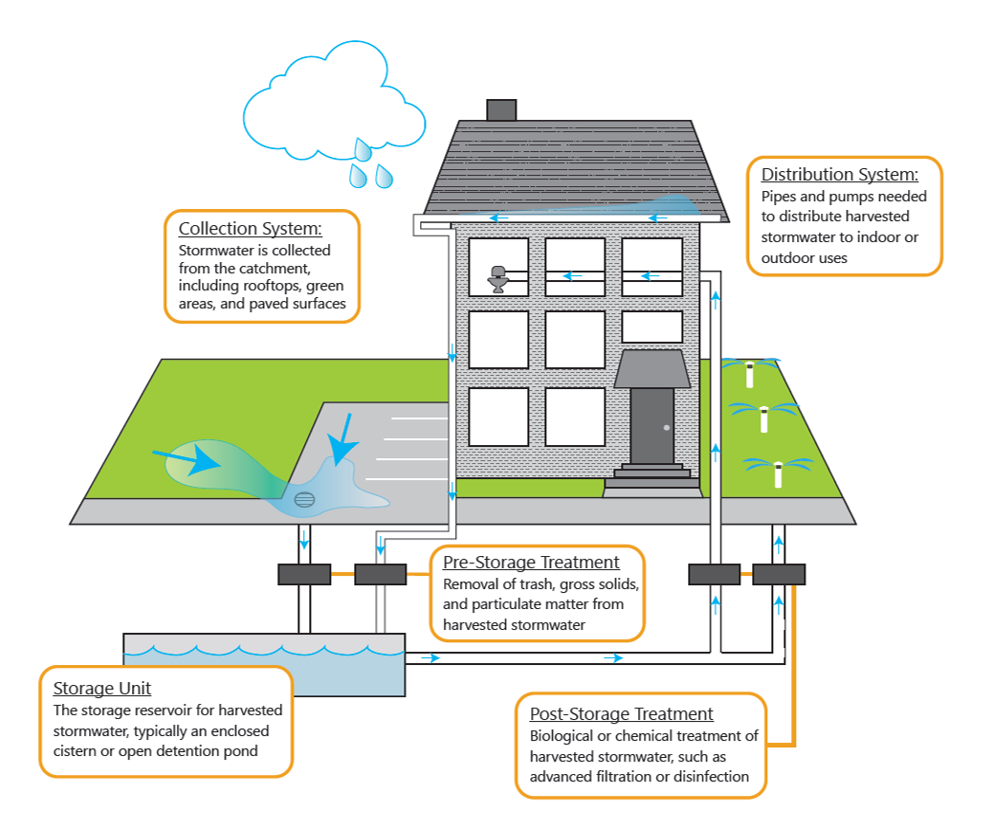
Stormwater and rainwater harvest and use/reuse systems capture and store runoff. The stored water is typically utilized for irrigation. This water is assumed to infiltrate. Credits for these BMPs are therefore similar to credits for other infiltration practices in that all water applied for irrigation and pollutants in that water are credited. The methodology differs, however, in that the water is captured instantaneously, but use of the water is dependent on the irrigation rate rather than the soil infiltration rate, as is the case with infiltration best management practice (BMPs). The period of use is also during the growing season, meaning the generated credits only apply at that time. If harvested water is used indoors, it may be discharged to a sewer system, to a septic drainfield, or to another stormwater BMP. Credits for these vary and are discussed below.
Pollutant removal mechanisms
Harvest and use/reuse practices reduce stormwater volume and pollutant loads through infiltration of the captured and stored stormwater runoff into the native soil. All pollutants in infiltrated water are considered to be removed from the stormwater conveyance system. Because infiltration typically occurs on turf or other vegetated media, a wide variety of stormwater pollutants will be retained through secondary removal mechanisms including filtration, biological uptake, and soil adsorption through plantings and soil media (WEF Design of Urban Stormwater Controls, 2012). See Other Pollutants, for a complete list of other pollutants retained by filtration practices.
Location in the treatment train
Stormwater treatment trains are comprised of multiple Best Management Practices that work together to minimize the volume of stormwater runoff, remove pollutants, and reduce the rate of stormwater runoff being discharged to Minnesota wetlands, lakes and streams. The position of a harvest and use/reuse system in a treatment train is a function of the surface from which the water is being collected. Rainwater harvest systems, which are designed to collect water from rooftops, will generally be located near the beginning of the treatment train, while systems that store water in ponds will be located near the end of treatment trains.
Methodology for calculating credits
This section describes the basic concepts and equations used to calculate credits for volume, Total Suspended Solids (TSS) and Total Phosphorus (TP). For specific tools and methods that can be used to calculate credits see Methods and resources for calculating credits. If harvest water is being infiltrated, this practice is also effective at reducing concentrations of other pollutants including nitrogen, metals, bacteria, and hydrocarbons. This article does not provide information on calculating credits for pollutants other than TSS and TP, but references are provided that may be useful for calculating credits for other pollutants.
Assumptions and approach
In developing the credit calculations, it is assumed the harvest and use/reuse system is properly designed, constructed, and maintained in accordance with the Minnesota Stormwater Manual. If any of these assumptions is not valid, the BMP may not qualify for credits or credits should be reduced based on reduced ability of the BMP to achieve volume or pollutant reductions. For guidance on design, construction, and maintenance, see Stormwater and rainwater harvest and use/reuse
Warning: Pretreatment is required for all infiltration practices
In the following discussion, the Water Quality Volume (VWQ) is delivered as an instantaneous volume to the BMP. VWQ is stored in a cistern or a pond. VWQ can vary depending on the stormwater management objective(s). For construction stormwater, VWQ is 1 inch off new impervious surface. For MIDS, VWQ is 1.1 inches.
The approach in the following sections is based on the following general design considerations.
- Credit calculations presented in this article are for both event and annual volume and pollutant load removals.
- Stormwater volume credit equates to the volume of runoff that will ultimately be infiltrated into the soil.
- TSS and TP credits are achieved for the volume of runoff that is infiltrated.
Volume Credit Calculations
Volume credits are calculated based on the capacity of the BMP and its ability to permanently remove stormwater runoff via infiltration into the underlying soil from the existing stormwater collection system. These credits are assumed to be instantaneous values. However, unlike other stormwater infiltration practices, for an irrigation system, the volume credit is a function of both the water available for storage, the rate at which water is applied, and the area over which the water is applied.
If we assume that on average there are 3 days between rain events, the volume reduction capacity of the BMP (V) that counts toward a performance goal is equal to either the storage capacity of the storage device or the amount of water that is used for irrigation and non-irrigation over a three day period, whichever value is lowest.
$^V=min[S; A_I * R_I * 1556 + V_{nonirrigation}]^$
Where:
S is the storage volume of the storage container in ft3;
AI is the irrigation application area in acres;
RI is the calculated average achieved weekly irrigation rate May-August (inches per week);
1556 is a conversion factor; and
Vnonirrigation is the volume used for non-irrigation purposes, in cubic feet.
This credit can only be applied during the time of year when the irrigation system is in practice. To determine compliance with a performance goal throughout the year, we need to know the annual volume of runoff and the volume of water applied as irrigation. The annual volume captured and infiltrated by the BMP can be determined with appropriate modeling tools, including the MIDS calculator and the Simple Method. Example values are shown below for a scenario using the MIDS calculator. For example, if a harvest and use/reuse system captures and uses 68 percent of the annual runoff volume on B soils, the system is capturing the equivalent of 0.5 inches of runoff annually, even though it may be capturing considerably more during the time of year when the system is operating.
The above calculations may include nonirrigated uses. The nonirrigated uses will need to be translated into the correct units.
Total phosphorus credit calculations
Pollutant removal for infiltrated water is assumed to be 100 percent. The mass of pollutant removed through infiltration (MTP,i), in pounds, is given by
$^M_{TP,i} = 0.0000624\ V_{inf,b}\ EMC_{TP} ^$
Where:
Vinf,b is the volume of water infiltrated (cubic feet), and
EMCTP is the event mean TP concentration in runoff water entering the BMP (milligrams per liter).
The EMCTP entering the BMP is a function of the contributing land use and treatment by upstream tributary BMPs. For more information on TP emcs link here. The above calculation may be applied on an annual basis and is given by
$^M_{TP_f} = 2.72\ V_{annual}\ EMC_{TP}^$
Where:
Vannual is the annual volume treated by the BMP (acre-feet).
Total suspended solid (TSS) calculations
Pollutant removal for infiltrated water is assumed to be 100 percent. The mass of pollutant removed through infiltration (MTSS, i) in pounds, is given by
$^M_{TSS,i} = 0.0000624\ V_{inf,b}\ EMC_{TSS} ^$
Where:
Vinf,b is the volume of water infiltrated (cubic feet), and
EMCTSS is the event mean TSS concentration in runoff water entering the BMP (milligrams per liter).
The EMCTSS entering the BMP is a function of the contributing land use and treatment by upstream tributary BMPs. For more information on EMC values for TSS, link here. The above calculation may be applied on an annual basis and is given by
$^M_{TSS_f} = 2.72\ F\ V_{annual}\ EMC_{TSS}^$
Where:
Vannual is the annual volume treated by the BMP, in acre-feet.
The annual volume captured and infiltrated by the BMP can be determined with appropriate modeling tools, including the MIDS calculator.
Other Pollutants
In addition to TSS and phosphorus, infiltration practices can reduce loading of other pollutants. According to the International Stormwater Database, studies have shown that infiltration practices are effective at reducing concentration of pollutants, including nutrients, metals, bacteria, cyanide, oils and grease, Volatile Organic Compounds (VOC), and Biological Oxygen Demand (BOD). A compilation of the pollutant removal capabilities from a review of literature are summarized below.
| Pollutant Category | Constituent |
Treatment Capabilities (Low = < 30%; Medium = 30-65%; High = 65 -100%) |
|---|---|---|
| Metals1 | Cr, Cu, Zn | High2 |
| Ni, Pb | ||
| Nutrients | Total Nitrogen, TKN | Medium/High |
| Bacteria | Fecal Coliform, E. coli | High |
| Organics | High | |
| 1 Results are for total metals only 2 Treatment capabilities are based mainly on information from sources that referenced only metals as a category and did not provide individual efficiency for specific metals |
||
References and suggested reading
- Bureau of Environmental Services. 2006. Effectiveness Evaluation of Best Management Practices for Stormwater Management in Portland, Oregon. Bureau of Environmental Services, Portland, Oregon.
- California Stormwater Quality Association. 2003. California Stormwater BMP Handbook-New Development and Redevelopment. California Stormwater Quality Association, Menlo Park, CA.
- Caltrans. 2004. BMP Retrofit Pilot Program Final Report, Report No. CTSW-RT-01-050. Division of Environmental Analysis. California Dept. of Transportation, Sacramento, CA.
- CDM Smith. 2012. Omaha Regional Stormwater Design Manual. Chapter 8 Stormwater Best Management Practices. Kansas City, MO.
- Caraco, Deborah, and Richard A. Claytor. 1997. Stormwater BMP Design: Supplement for Cold Climates. US Environmental Protection Agency.
- Denr, N. 2007. Stormwater Best Management Practices Manual. North Carolina Department of Environment and Natural Resources, Raleigh, North Carolina.
- Dorman, M. E., H. Hartigan, F. Johnson, and B. Maestri. 1988. Retention, detention, and overland flow for pollutant removal from highway stormwater runoff: interim guidelines for management measures. Final report, September 1985-June 1987. No. PB-89-133292/XAB. Versar, Inc., Springfield, VA (USA).
- Geosyntec Consultants and Wright Water Engineers. 2009. Urban Stormwater BMP Performance Monitoring. Prepared under Support from U.S. Environmental Protection Agency, Water Environment Research Foundation, Federal Highway Administration, Environmental and Water Resource Institute of the American Society of Civil Engineers.
- Gulliver, J. S., A. J. Erickson, and P.T. Weiss. 2010. Stormwater treatment: Assessment and maintenance. University of Minnesota, St. Anthony Falls Laboratory. Minneapolis, MN.
- Hathaway, J. M., W. F. Hunt, and S. Jadlocki. 2009. Indicator bacteria removal in storm-water best management practices in Charlotte, North Carolina. Journal of Environmental Engineering 135, no. 12: 1275-1285.
- Jaffe, et. al. 2010. The Illinois Green Infrastructure Study. Prepared by the University of Illinois at Chicago, Chicago Metropolitan Agency for Planning. Center for Neighborhood Technology, Illinois-Indiana Sea Grant College Program.
- Jurries, Dennis. 2003. Biofilters (Bioswales, Vegetative Buffers, & Constructed Wetlands) for Storm Water Discharge Pollution Removal. Quality, State of Oregon, Department of Environmental Quality (Ed.).
- Kurz, Raymond C. 1998. Removal of microbial indicators from stormwater using sand filtration, wet detention, and alum treatment: best management practices. PhD diss., University of South Florida.
- Leisenring, M., J. Clary, and P. Hobson. 2012. International Stormwater Best Management Practices (BMP) Database Pollutant Category Summary Statistical Addendum: TSS, Bacteria, Nutrients, and Metals.
- Muthukrishnan, Swarna. 2010. Treatment Of Heavy Metals In Stormwater Runoff Using Wet Pond And Wetland Mesocosms. In Proceedings of the Annual International Conference on Soils, Sediments, Water and Energy, vol. 11, no. 1, p.9.
- New Hampshire Department of Environmental Services. 2008. New Hampshire Stormwater Manual. Volume 2 Appendix B. Concord, NH.
- Schueler, T.R., Kumble, P.A., and Heraty, M.A. 1992. A Current Assessment of Urban Best Management Practices: Techniques for Reducing Non-Point Source Pollution in the Coastal Zone. Metropolitan Washington Council of Governments, Washington, D.C.
- Schueler, Thomas R. 1987. Controlling urban runoff: A practical manual for planning and designing urban BMPs. Washington, DC: Metropolitan Washington Council of Governments.
- State of California, Department of Transportation. 2013. Caltrans Stormwater Monitoring Guidance Manual. Sacramento, CA.
- TetraTech. 2008. BMP Performance Analysis. Prepared for US EPA Region 1, Boston, MA.
- Transportation Research Board. 2006. Evaluation of Best Management Practices for Highway Runoff Control. National Cooperative Highway Research program. Report No. 565.
- Water Environment Federation. 2014. Investigation into the Feasibility of a National Testing and Evaluation Program for Stormwater Products and Practices. A White Paper by the National Stormwater Testing and Evaluation of Products and Practices (STEPP) Workgroup Steering Committee.
- WEF, ASCE/EWRI. 2012. Design of Urban Stormwater Controls. WEF Manual of Practice No. 23, ASCE/EWRI Manuals and Reports on Engineering Practice No. 87. Prepared by the Design of Urban Stormwater Controls Task Forces of the Water Environment Federation and the American Society of Civil Engineers/Environmental & Water Resources Institute.
- Weiss, Peter T., John S. Gulliver, and Andrew J. Erickson. 2005. The Cost and Effectiveness of Stormwater Management Practices Final Report.. Published by: Minnesota Department of Transportation .
- Wossink, G. A. A., and Bill Hunt. 2003. The economics of structural stormwater BMPs in North Carolina. Water Resources Research Institute of the University of North Carolina.
Related pages
- Methods and resources for calculating credits
- Stormwater and rainwater harvest and use
- Overview for stormwater and rainwater harvest and use/reuse
- Design criteria for stormwater and rainwater harvest and use/reuse
- Construction specifications for stormwater and rainwater harvest and use/reuse
- Operation and maintenance for stormwater and rainwater harvest and use/reuse
- Water quality considerations for stormwater and rainwater harvest and use/reuse
- Environmental concerns for stormwater and rainwater harvest and use/reuse
- Cost-benefit considerations for stormwater and rainwater harvest and use/reuse
- Case studies for stormwater and rainwater harvest and use/reuse
- Definitions for stormwater and rainwater harvest and use/reuse
- Requirements, recommendations and information for using Harvest and re-use/cistern as a BMP in the MIDS calculator
- Links for stormwater and rainwater harvest and use/reuse
- References for stormwater and rainwater harvest and use/reuse
- Technical support for stormwater and rainwater harvest and use/reuse