This page provides a discussion of how infiltration practices can achieve stormwater credits. Infiltration practices include infiltration basins, infiltration trenches (including dry wells), and underground infiltration systems. The discussion does not include bioinfiltration and permeable pavement systems, unless specifically mentioned.
| TSS | TP | PP | DP | TN | Metals | Bacteria | Hydrocarbons |
|---|---|---|---|---|---|---|---|
| Pollutant removal is 100 percent for the volume that is captured and infiltrated | |||||||
| TSS=total suspended solids; TP=total phosphorus; PP=particulate phosphorus; DP=dissolved phosphorus; TN=total nitrogen | |||||||
Warning: Models are often selected to calculate credits. The model selected depends on your objectives. For compliance with the Construction Stormwater permit, the model must be based on the assumption that an instantaneous volume is captured by the BMP. For more information on using models to calculate credits see Methods and resources for calculating credits.
Green Infrastructure: Infiltration practices can be an important tool for retention and detention of stormwater runoff and treatment of pollutants in stormwater runoff. If the practice utilizes vegetation, additional benefits may include cleaner air, carbon sequestration, improved biological habitat, and aesthetic value.
Credit refers to the quantity of stormwater or pollutant reduction achieved either by an individual best management practice (BMP) or cumulatively with multiple BMPs. Stormwater credits are a tool for local stormwater authorities who are interested in
- providing incentives to site developers to encourage the preservation of natural areas and the reduction of the volume of stormwater runoff being conveyed to a best management practice (BMP);
- complying with permit requirements, including antidegradation (see Construction permit; Municipal (MS4) permit);
- meeting the MIDS performance goal; or
- meeting or complying with water quality objectives, including total maximum daily load (TMDL) wasteload allocations (WLAs).
Contents
Overview
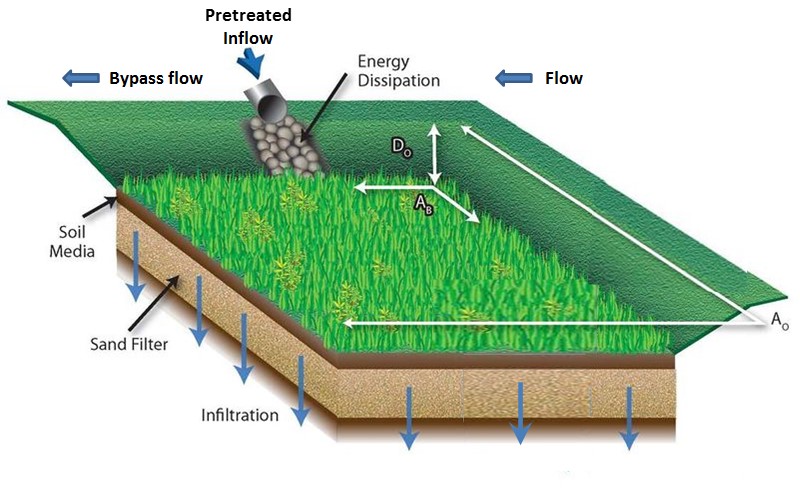
Infiltration practices are designed to capture, store, and infiltrate stormwater runoff. They rely on naturally permeable soils to fully infiltrate the designed Water Quality Volume (VWQ). These are typically off-line practices utilizing an emergency spillway or outlet structure to capture the volume of stormwater runoff for which the practice is designed. Volumes that exceed the rate or volume of the infiltration practice are allowed to bypass the BMP.
Pollutant removal mechanisms
Infiltration practices reduce stormwater volume and pollutant loads through infiltration of the stormwater runoff into the native soil. Infiltration practices also can remove a wide variety of stormwater pollutants through secondary removal mechanisms including filtration, biological uptake, and soil adsorption through plantings and soil media (WEF Design of Urban Stormwater Controls, 2012). See Other Pollutants, for a complete list of other pollutants addressed by infiltration practices.
Location in the treatment train
Stormwater treatment trains are comprised of multiple Best Management Practices that work together to minimize the volume of stormwater runoff, remove pollutants, and reduce the rate of stormwater runoff being discharged to Minnesota wetlands, lakes and streams. Because infiltration practices are designed to be off-line, they may either be located at the end of the treatment train, or used as off-line configurations to divert the water quality volume from the on-line system.
Methodology for calculating credits
This section describes the basic concepts and equations used to calculate credits for volume, Total Suspended Solids (TSS) and Total Phosphorus (TP). For specific tools and methods that can be used to calculate credits see Methods and resources for calculating credits. Infiltration practices are also effective at reducing concentrations of other pollutants including nitrogen, metals, bacteria, and hydrocarbons. This article does not provide information on calculating credits for pollutants other than TSS and TP, but references are provided that may be useful for calculating credits for other pollutants.
Assumptions and approach
In developing the credit calculations, it is assumed the infiltration practice is properly designed, constructed, and maintained in accordance with the Minnesota Stormwater Manual. If any of these assumptions is not valid, the BMP may not qualify for credits or credits should be reduced based on reduced ability of the BMP to achieve volume or pollutant reductions. For guidance on design, construction, and maintenance, see the appropriate article within the infiltration basin or infiltration trench sections of the Manual. Because of their high susceptibility of failure due to clogging, pretreatment is REQUIRED in all infiltration designs.
Warning: Pretreatment is required for all infiltration practices
In the following discussion, the Water Quality Volume (VWQ) is delivered instantaneously to the BMP. VWQ is stored as water ponded above the soil or engineered media and below the overflow elevation. VWQ can vary depending on the stormwater management objective(s). For construction stormwater, VWQ is 1 inch off new impervious surface. For MIDS, VWQ is 1.1 inches.
In reality, some water will infiltrate through the bottom and sidewalls of the BMP as a rain event proceeds. The instantaneous volume method therefore may underestimate actual volume and pollutant losses.
The approach in the following sections is based on the following general design considerations:
- Credit calculations presented in this article are for both event and annual volume and pollutant load removals.
- Stormwater volume credit equates to the volume of runoff that will ultimately be infiltrated into the soil subgrade.
- TSS and TP credits are achieved for the volume of runoff that is infiltrated.
Volume Credit Calculations
Volume credits are calculated based on the capacity of the BMP and its ability to permanently remove stormwater runoff via infiltration into the underlying soil from the existing stormwater collection system. These credits are assumed to be instantaneous values entirely based on the capacity of the BMP to capture, store, and transmit water in any storm event. Because the volume is calculated as an instantaneous volume, the water quality volume (VWQ) is assumed to pond below the overflow elevation and above the bioretention media. This entire volume is assumed to infiltrate through the bottom of the BMP. The volume credit (Vinfb) for infiltration through the bottom of the BMP into the underlying soil, in cubic feet, is given by
$^V_{inf_b} = D_o\ (A_O + A_M)\ / 2^$
Where:
AO is the overflow surface area of the bioretention system, in square feet;
AM is the area at the surface of the media, in square feet; and
Do is the ponded depth with the BMP, in feet.
If native soils are used rather than engineered media, the term AM may be substituted by AB, as shown in the above schematic and in the schematics for the MIDS calculator. To comply with the Construction Stormwater General Permit, VWQ must infiltrate within 48 hours (24 hours is recommended if discharges are to a trout stream).
Some of the VWQ will be lost to evapotranspiration rather than all being lost to infiltration. In terms of a water quantity credit, this differentiation is unimportant, but it may be important if attempting to calculate actual infiltration into the underlying soil.
The annual volume captured and infiltrated by the BMP can be determined with appropriate modeling tools, including the MIDS calculator. Example values are shown below for a scenario using the MIDS calculator. For example, a permeable pavement system designed to capture 1 inch of runoff from impervious surfaces will capture 89 percent of annual runoff from a site with B (SM) soils.
Total suspended solid (TSS) calculations
Pollutant removal for infiltrated water is assumed to be 100 percent. The mass of pollutant removed through infiltration, MTSSi in pounds, is given by
$^M_{TSS_i} = 0.0000624\ V_{inf_b}\ EMC_{TSS} ^$
Where:
Vinfb is the volume of water infiltrated, in cubic feet; and
EMCTSS is the event mean TSS concentration in runoff water entering the BMP (milligrams per liter).
The EMCTSS entering the BMP is a function of the contributing land use and treatment by upstream tributary BMPs. For more information on EMC values for TSS, link here. The above calculation may be applied on an annual basis and is given by
$^ M_{TSS_f} = 2.72\ F\ V_{annual}\ EMC_{TSS} ^$
Where
Vannual is the annual volume treated by the BMP, in acre-feet.
The annual volume captured and infiltrated by the BMP can be determined with appropriate modeling tools, including the MIDS calculator.
Total phosphorus credit calculations
Pollutant removal for infiltrated water is assumed to be 100 percent. The mass of pollutant removed through infiltration, in pounds, is given by
$^M_{TP_i} = 0.0000624\ V_{inf_b}\ EMC_{TP} ^$
Where:
EMCTP is the event mean TP concentration in runoff water entering the BMP (milligrams per liter).
The EMCTP entering the BMP is a function of the contributing land use and treatment by upstream tributary BMPs. The above calculation may be applied on an annual basis and is given by
$^ M_{TP_f} = 2.72\ V_{annual}\ EMC_{TP}^$
Where:
Vannual is the annual volume treated by the BMP, in acre-feet.
Other Pollutants
In addition to TSS and phosphorus, infiltration practices can reduce loading of other pollutants. According to the International Stormwater Database, studies have shown that infiltration practices are effective at reducing concentration of pollutants, including nutrients, metals, bacteria, cyanide, oils and grease, Volatile Organic Compounds (VOC), and Biological Oxygen Demand (BOD). A compilation of the pollutant removal capabilities from a review of literature are summarized below.
| Pollutant Category | Constituent |
Treatment Capabilities (Low = < 30%; Medium = 30-65%; High = 65 -100%) |
|---|---|---|
| Metals1 | Cr, Cu, Zn | High2 |
| Ni, Pb | ||
| Nutrients | Total Nitrogen, TKN | Medium/High |
| Bacteria | Fecal Coliform, E. coli | High |
| Organics | High | |
| 1 Results are for total metals only 2 Treatment capabilities are based mainly on information from sources that referenced only metals as a category and did not provide individual efficiency for specific metals |
||
Related pages
- Methods and resources for calculating credits
- Infiltration
- Overview for infiltration
- Types of infiltration
- Design criteria for infiltration
- Construction specifications for infiltration
- Operation and maintenance of stormwater infiltration practices
- Assessing the performance of infiltration
- Cost-benefit considerations for infiltration
- Case studies for infiltration
- References for infiltration
- Requirements, recommendations and information for using infiltration basin/underground infiltration BMPs in the MIDS calculator
- Understanding and interpreting soils and soil boring reports for infiltration BMPs
- Determining soil infiltration rates
- Cold climate considerations for infiltration practices - See [1], [2]