Green Infrastructure: Swales can be an important tool for retention and detention of stormwater runoff. Depending on design and construction, swales may provide additional benefits, including cleaner air, carbon sequestration, improved biological habitat, and aesthetic value. See the section Green Stormwater Infrastructure (GSI) and sustainable stormwater management.
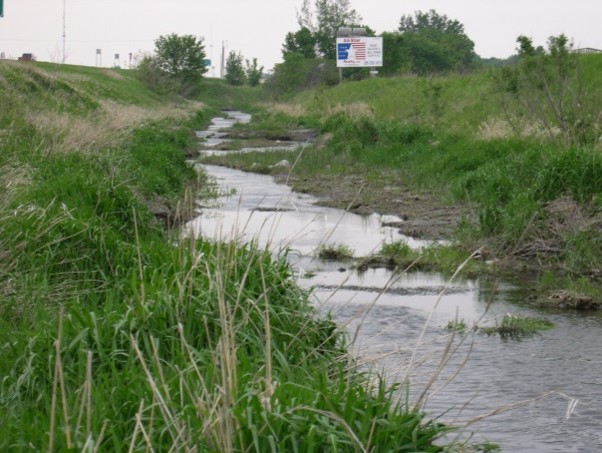
Wet swales occur when the water table is located very close to the surface or water does not readily drain out of the swale. A wet swale acts as a very long and linear shallow biofiltration or linear wetland treatment system. Wet swales do not provide volume reduction and have limited treatment capability. Incorporation of check dams into the design allows treatment of a portion or all of the water quality volume within a series of cells created by the check dams. Wet swales planted with emergent wetland plant species provide improved pollutant removal. Wet swales may be used as pretreatment practices. Wet swales are commonly used for drainage areas less than 5 acres in size.
Wet swale (wetland channel) articles
- Terminology for swales
- Overview for wet swale (wetland channel)
- Types of filtration
- Design criteria for wet swale (wetland channel)
- Construction specifications for wet swale (wetland channel)
- Operation and maintenance (O&M) of swales
- Operation and maintenance of swales - supplemental information
- Operation and maintenance of wet swale (wetland channel) - recommend using the above two links
- Assessing the performance of wet swale (wetland channel)
- Plants for swales
- Check dams for stormwater swales
- Calculating credits for wet swale (wetland channel)
- Cost considerations
- Case studies for wet swale
- Supporting material for swales
- External resources for wet swale (wetland channel)
- References for wet swale (wetland channel)
- Requirements, recommendations and information for using wet swale in the MIDS calculator
- Requirements, recommendations and information for using swale side slope as a BMP in the MIDS calculator