Green Infrastructure: Swales can be an important tool for retention and detention of stormwater runoff. Because they utilize vegetation, swales provide additional benefits, including cleaner air, carbon sequestration, improved biological habitat, and aesthetic value.
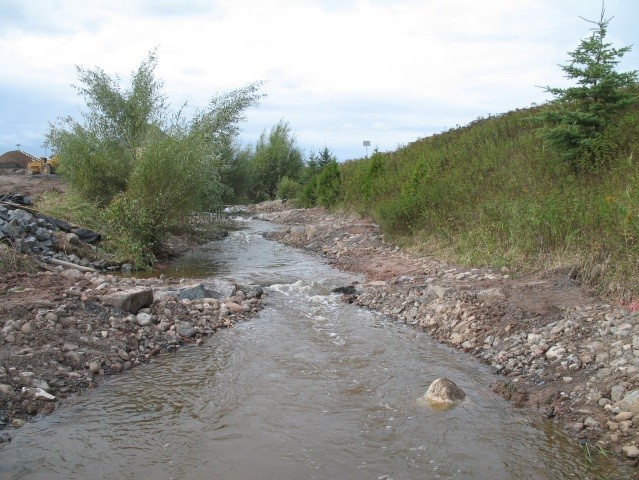
Swales retain solids and associated pollutants by settling and filtering. A typical method for assessing the performance of of BMPs with underdrains is therefore measuring and comparing pollutant concentrations at the influent and effluent. If the swale is designed for infiltration, see Assessing the performance of bioretention.
Additional information on designing a monitoring network and performing field monitoring are found under Calculating credits based on field monitoring.
Related pages
- Terminology for high-gradient stormwater step-pool swale
- Overview for high-gradient stormwater step-pool swale
- Types of infiltration
- Types of filtration
- Design criteria for high-gradient stormwater step-pool swale
- Construction specifications for high-gradient stormwater step-pool swale
- Operation and maintenance of high-gradient stormwater step-pool swale
- Check dams for stormwater swales
- Plants for swales
- Calculating credits for high-gradient stormwater step-pool swale
- Cost considerations
- External resources for high-gradient stormwater step-pool swale
- References for high-gradient stormwater step-pool swale
Stormwater step pools are currently not included as a BMP in the MIDS calculator. The swale main channel BMP can be used, but the maximum allowable slope is 4 percent. To dtermine volume retention for slopes greater than 4 percent, you will need to develop a relationship between the slope and volume retained. To do this, determine volume retention at 0.5 percent slope increments for your site at slopes ranging from 0.5 to 4 percent. Determine the appropriate regression for volume retention and slope and calculate the volume retained at the slope for your site. The relationship is not linear. Links to MIDS calculator information are provided below.
- Requirements, recommendations and information for using dry swale (grass swale) without an underdrain in the MIDS calculator
- Requirements, recommendations and information for using dry swale (grass swale) with an underdrain in the MIDS calculator
- Requirements, recommendations and information for using swale side slope as a BMP in the MIDS calculator