This page provides sources and lists of plants for stormwater BMPs, salt tolerance, green roofs, and trees.
Contents
- Blue Thumb Plant Finder
- Plants for Stormwater Design
- Seeding and seed mixes
- Trees for stormwater
- Salt tolerance
- Green roofs
- Links and References
The Blue Thumb Plant Finder
New in 2024! The Blue Thumb Plant Finder tool helps select Minnesota native plants that are generally commercially available. The tool has a number of filters to identify appropriate plants for a project’s unique site characteristics and design criteria, including rain gardens, engineered soils, salt tolerance, flooding tolerance, and more.
Plants for Stormwater Design
Originally published in 2003 and updated in 2024, Plants for Stormwater Design (authored by Shaw and Schmidt) is applicable to a wide variety of vegetated BMPs. The 2003 version is still available for reference, linked below.
- Section 1: Table of contents; acknowledgements; intro; using guide; environmental influences on plants; plant considerations and species for stormwater management practices; stormwater management practices; literature cited.
- Section 2: Table of plant species included in guide; range of applicability map; plant species descriptions, genera A–E.
- Section 3: Plant species descriptions, genera F-S.
- Section 4: Plant species descriptions, genera T-Z; plant descriptions bibliography; appendix 1: planting and maintenance recommendations; appendix 2: vegetation and hydrology data for 3 Twin Cities stormwater projects.
Seeding and seed mixes for general applications
- Minnesota Board of Water and Soil Resources - State seed mixes by region and application, including stormwater projects, wetland restorations, woodlands, and more
- Minnesota Department of Transportation - Seed and vegetation establishment information for roadside projects
Trees for stormwater
The Tree species table.xlsx lists some trees that are suitable for stormwater BMPs. Many common trees are included, but the list of trees does not include all suitable trees. The following information is include in this table:
- General information:
- native or non-native
- street tree or landscape only
- deciduous, coniferous, or deciduous coniferous
- sun requirements
- position in forest structure (e.g. understory, etc.)
- relative growth rate to maturity
- Morphology: tree height, canopy diameter, relative tree size, and relative growth rate
- Tolerance to stress
- Minimum zone hardiness
- Tolerance to urban stresses
- Tolerance to soil texture conditions
- Salt tolerance
- Stress tolerance
- pH and moisture ranges: acceptable pH and moisture ranges for different tree species
- Tolerance to inundation: Tolerance to inundtable providing information on tree tolerance to inundation with water. Note that information exists for a limited number of tree species.
- Additional benefits of trees: table providing a list of non-stormwater benefits for several tree species
- Notes: table providing additional information for select species, such as susceptibility to specific stresses, preferred choice of cultivar, etc.
- Suitable for CU structural soil: table providing a list of tree species suitable for use with Cornell University (CU) structural soil
Salt tolerance
Vegetated stormwater BMPs that receive frequent winter snowmelt or salt spray, high volumes of runoff, or have contributing areas with high salt use will need to consider salt tolerance in the selection of plant species. Common areas of concern include roadside swales and collection basins. Salt tolerance is less of a concern for stormwater BMPs with small contributing areas or from non- or lightly-salted areas.
Coastal regions naturally have more salt tolerant plant species because these plants have evolved with salt in their environment. Finding salt-tolerant, locally-adapted and appropriate species for Minnesota can be challenging. Even when native plant ranges of coastal plants extend into Minnesota, the local populations are not necessarily salt tolerant. Furthermore, some species that can tolerate the Minnesota climate and high salt exposure are not appropriate due to their aggressive or invasive nature. For instance, common buckthorn and purple loosestrife, common invasive species in Minnesota, have high salt tolerances but should not be used because of their invasive status. Boxelder, a native colonizing tree, has high tolerance but may not be suitable because it aggressively reseeds. Vegetated stromwater BMPs that receive high salt inputs can be susceptible to invasive and aggressive species.
The salt tolerance of select plants were developed from various studies and are summarized in the table below. The referenced studies include research, regional evaluations, and results from specialized salinity testing laboratories, many of which from agriculture applications. Salt tolerance ratings may not compare directly because investigators, applications, and locations vary. Therefore, application of this information to Minnesota applications may warrant interpretation.
| Plant Material | Soil Moisture | Salt Tolerance in Soil | Growth Form | Notes on Use |
|---|---|---|---|---|
| Meadow foxtail (Alopecurus pratensis) | Frequently Saturated | Low | Herbaceous-grass | |
| Rugosa Rose | Mostly Drained | Low | Shrub | Eurasian species, can be invasive |
| American elm (Ulmus Americana) | Always/Frequently Wet | Medium/Low1 | Tree | |
| Green ash (Fraxinus pennsylvanica) | Always Wet | Medium1 | Tree | |
| Canada wild rye (Elymus canadensis) | Frequently Saturated | Medium | Herbaceous-grass | |
| Poplars (Populus spp.) | Frequently Saturated/ Mostly Drained | Medium1 | Tree | Including aspen, cottonwood, black and silver-leaved poplar; fast growing; also provide good streambank stabilization |
| Hackberry (Celtis occidentalis) | Frequently Saturated/Mostly Drained | Medium | Tree | |
| Smooth sumac (Rhus glabra) | Mostly Drained | Medium | Shrub | Colonizes and spreads in high sun |
| Perennial ryegrass (Lolium perenne) | Mostly Drained | Medium | Herbaceous - grass | |
| Seed Mix: MNDOT western tall grass prairie | Undrained | Medium | Herbaceous - grass | |
| Karl Foerster reed grass (Calamogrostis acutifolia ‘Karl Foerster’) | Frequently Saturated/ Mostly Drained | High | Herbaceous-grass | Non-native plant commonly used in landscaping |
| White ash (Fraxinus Americana) | Frequently Saturated/ Mostly Drained | High1 | Tree | |
| Jack pine (Pinus banksiana) | Mostly Drained | High1 | Tree | |
| Staghorn sumac (Rhus typhina) | Mostly Drained | High | Shrub | |
| Cutleaf sumac (Rhus trilobata) | Mostly Drained | High | Shrub | |
| Blue grama grass (Bouteloua hirsuta) | Mostly Drained | High | Herbaceous - grass | U of M selecting for salt-tolerant varieties |
| Little bluestem (Schizachyrium scoparium) | Mostly Drained | High | Herbaceous - grass | |
| Alkali grass (Puccinellia distans) | Mostly Drained | High | Herbaceous - grass | Eurasian species |
| Tall wheatgrass (Agropyron elongatum) | Mostly Drained | High | Herbaceous - grass | |
| Western wheat grass (Elytrigia smithii) | Mostly Drained | High | Herbaceous - grass | |
| Seed Mix: MNDOT urban prairie | Mostly Drained | High | Herbaceous - grass | |
| 1trees with some tolerance to spray | ||||
Salt tolerant forbs
Little information is available on the salt tolerance of native forbs (herbaceous plants that are not grasses). The following genus or species may have slight salt tolerance (Tober et al, 2007).
- blanket flower (Gaillardia)
- yarrow (Achillea millefolium)
- yellow coneflower (Ratibida pinnata)
- fringed sagewort (Artemisia frigida)
- purple prairie clover (Dalea purpurea)
- primrose (Primula vulgaris)
- stiff sunflower (Helianthus pauciflorus)
- Maximilian sunflower (Helianthus maximiliani)
- Lewis flax (Linum lewisii)
- Canada milkvetch (Astragalus canadensis)
- two-grooved milkvetch (Astragalus bisulcatus)
- scarlet globemallow (Sphaeralcea coccinea)
Salt intolerant species
Some common Midwest species are known to be intolerant of high salt soil concentrations. Avoid planting these species or seed mixes when high salt loads are expected.
- Grey dogwood (Cornus racemosa)
- Red-osier dogwood (Cornus stolonifera)
- Silver maple (Acer saccharinum)
- Sugar maple (Acer saccharum)
- Basswood (Tilia Americana)
Green roofs
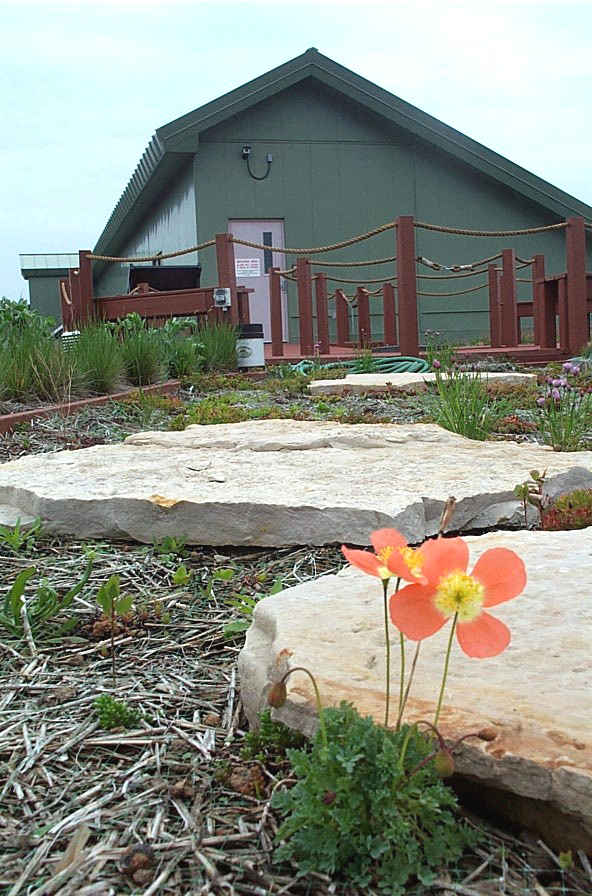
Green roofs require different plants compared to on-the-ground BMPs because of the constrained growing conditions and roof structure. The first consideration for plant material selection is the green roof design type. Extensive green roofs (EGRs, green roof that use shallow media) commonly use xeriscape (drought tolerant) plants. Intensive green roofs (IGRs, green roofs that use deeper media) can include a wider range of plants including shrubs and trees. The following two tables provide native and non-native species that have worked on ERGs.
The plant material selection, through biological processes and nutrient cycling, may effect whether the BMP exacerbates or mitigates the function of nutrient storage. Research to date comparing EGRs and control (nongreen) roofs shows that green roofs are a poor BMP for nutrient storage and removal from precipitation. In evidence from both southern and northern climates, total phosphorus concentrations are higher in runoff leaving a green roof compared to control roofs, although the mass loading is the same as the control (Moran et al, 2004). Nitrogen losses from a green roof do not differ significantly from control roofs. So for nutrient loading and design of removal systems, other BMP tools should be located further down the runoff path from the rooftop BMP to trap runoff from green roofs. It is unclear how the IGRs function for nutrient storage.
Extensive green roofs are a reliable BMP for reducing peak runoff rates. This has been demonstrated in several controlled studies in both southern and northern climates. Intensive green roofs provide the same function. It is not clear if the plant material plays a significant role in this or whether it is related to the design of the planting medium and underlying roof runoff system. To date it has always been assumed that the overall design should support plant materials that are tolerant of drought conditions and not prolonged saturated soil.
There is plenty of opportunity for experimentation on green roof plant material. Most controlled experiments have been limited in the kinds of plant material tested. The Genus Sedum has been widely used in extensive green roof plantings. It is unknown whether plantings dominated by other and widely different plant groups will yield the same results. As such, the function of a green roof as a stormwater BMP may vary: nutrient storage may not be an issue with some plant materials. Until further case studies and experiments are conducted on the nutrient storage function of this BMP, it is wise to assume that all plant material selections will yield added nutrient runoff, particularly if the plants are fertilized. Thus, the green roof system should be designed in series with other BMPs which are expected to function in this respect.
The variety of choices of EGR plant material for warm and cold climates is generally limited in the following ways:
- Water and nutrients from precipitation
- Substrate - often at least partially synthetic and droughty
- Limited organic matter build up – isolated from organic debris, leaf build-up, sediment laden runoff
- Shallow rooting zone – less than one foot
Plant selection is restricted to materials which will be successful in very shallow substrates, perhaps 6 inches, up to 12 inches deep. Long-lived, perennial drought tolerant species commonly display deep taproot growth or deep fibrous root systems. This is the main reason that the Genus Sedum is so commonly relied upon. In contrast, many of the prairie forbs and grasses valued for infiltration BMPs may not be appropriate for green roofs.
The plant material selection for any one specific green roof is also dependent on the substrate content and depth. Intensive and extensive systems were already defined, and will significantly effect the substrate choices. The plant material selections provided here have been limited to those for EGRs. Even within an extensive system, in which the substrate is in general droughty, the specific design of each system will significantly effect plant productivity. Experiments in which the same plant material was grown on several different substrates demonstrates the importance of this. As such, one of the main criteria for selecting EGR plants is the substrate design. And often, this is limited by the structural integrity of the building, particularly for retrofit designs.
For EGRs, irrespective of the specific design, one general consideration applies to establishing plant material. The material will usually be introduced as young plants, and to reduce transplant shock and provide an enriched environment for further growth, an organic substrate such as compost should be used as the immediate transplant medium.
Links and references
Other pages in this manual that address plants
- Plants for swales is a page in this manual providing extensive information, links, and photos of plants that can be used under a variety of conditions in swales.
- Pollinator friendly Best Management Practices for stormwater management
- Bioretention
- Trees
References and resources on salt tolerance
- Colorado State University Cooperative Extension Tri River Area. 2003. Salt Tolerance of Various Temperate Zone Ornamental Plants. Curtis E. Swift.
- Johnson, Gary R. and Ed Sucoff. 2000. Minimizing De-Icing Salt Injury to Trees. University of Minnesota Extension Service.
- Minnesota Department of Transportation. 2024. Seeding Manual. Office of Environmental Services, Erosion Control Unit.
- Niu, G., and D. S. Rodriguez. 2006. Relative salt tolerance of selected herbaceous perennials and groundcovers. Scientia Horticulturae. Volume 110, Issue 4, 27. Pages 352–358.
- Niu, G., and D. S. Rodriguez. 2006. Relative Salt Tolerance of Five Herbaceous Perennials. Hort. Science. 41(6):1493–1497.
- Ogle, D., L. St. John. 2010. Plants for Saline to Sodic Soil Conditions. USDA - Natural Resources Conservation Service Boise, Idaho – Salt Lake City, Utah. TN Plant Materials NO. 9.A
- Tober, D., W. Duckwitz, and S. Sieler. 2007. Plant Materials for Salt-Affected Sites in the Northern Great Plains. United States Department of Agriculture. Natural Resources Conservation Service. Plant Materials Center, Bismarck, North Dakota.
- University of California, Riverside. George E Brown Jr Salinity Laboratory.
- University of Wiscsonsin-Extension. 1999. Salt Injury to Landscape Plants. Delahaut, K.A. and E.R. Hasseljus. Cooperative Extension Publishing.
- Zollinger, N., R. Koenig, T. Cerny-Koenig, R. Kjelgren. 2007. Relative Salinity Tolerance of Intermountain Western United States Native Herbaceous Perennials. HortScience. Vol. 42, No. 3. 529-534.
References for green roof plant material selection
- Bengtsson, L. 2004. Hydrological Response of Sedum-Moss Roof. American Geophysical Union. Fall Meeting 2004. abstract #H41A-0285.
- DeNardo, J.C., A.R. Jarrett, H.B. Manbeck, D.J. Beattie, and R.D. Berghage. 2003. Stormwater Detention and Retention Abilities of Green Roofs. World Water and Environmental Resources Congress. 2003. Paul Bizier, Paul DeBarry - Editors, June 23–26, 2003, Philadelphia, Pennsylvania, USA.
- Federal Energy Management Program. September 2004. Green Roofs. DOE/EE-0298.
- Moran, Amy, Bill Hunt, Greg Jennings. 2004. Greenroof Research of Stormwater Runoff Quantity and Quality in North Carolina. NCSU Water Quality Group Newsletter August 2004.
- Shooting Star Native Seeds. 2005. Mn/DOT 2005 Seed Mixes.
- Uhl, M, Schiedt, L, Mann, G, Henneberg, M. 2003. Long-term study of rainfall runoff from green roofs. Wasser und Boden. Vol. 55, no. 3, pp. 28-36. Mar. 2003.