On this page we discuss available tools that may help practitioners consider potential issues with blowing and drifting snow and incorporate design strategies described under the strategy, Outsmart the wind.
Design tools University of Minnesota/MnDOT
Design tool The University of Minnesota Center for Transportation Studies, with funding from MnDOT, developed a Blowing Snow Control Tools website that includes tools for designing snow fences, and road design that promotes deposition of snow in roadside ditches rather than on the road. Link: Design Tool | Blowing Snow Control Tools.
The Minnesota Drift-Free Roads Design Tool can be used to design a snow fence for a specific site. After entering a location on a map, the tool provides the following calculations (some are based on data within the tool and others are site specific entries) and leads to snow fence design.
- Snowfall data
- Mean snowfall accumulation- used in mean seasonal transport calculation
- Mean snow water equivalent ratio- used in mean seasonal transport calculation
- Relocation Coefficient- used in mean seasonal transport calculation
- Site Conditions
- Wind direction of greatest snow transport- needed to help determine the attack angle
- Fetch distance- used in mean seasonal transport calculation to find ideal snow fence setback
- Mean snow transport- used to determine height and setback of snow fence
- Fence design
- Porosity- porosity of structural or living fence type (examples provided)
- Fence height- calculates minimum fence height needed to capture the calculated snow transport Attack angle- the angle between the prevailing snow transport wind direction and alignment of the road or site.
- Attack angle is used to determine fence setback. Fence setback- calculated from fence porosity, height and attack angle.
- Fence extension- fence length needed to account for variations in wind direction and the end effect. To avoid creating dangerous transitions:
- Tie fence into natural features
- Fill in gaps between fence systems
- Taper out protection by reducing fence height or increasing porosity near the ends.
Wind rose

The prevailing winter wind direction should be documented for your project site. Focus on winter wind direction, not a composite of 12 months. See summaries at this link: https://www.dnr.state.mn.us/climate/summaries_and_publications/wind.html.
How to read a wind rose: The largest bars are the most frequent winds. The design site location is in the circle center of these charts. Imagine that the wind is blowing towards the center of the chart from the largest of the sectors. This is the force you need to control in design.
Wind rose examples
These wind roses for Minneapolis show the prevailing January wind will come from the northwest, but August shows a different trend.
Wind modeling software
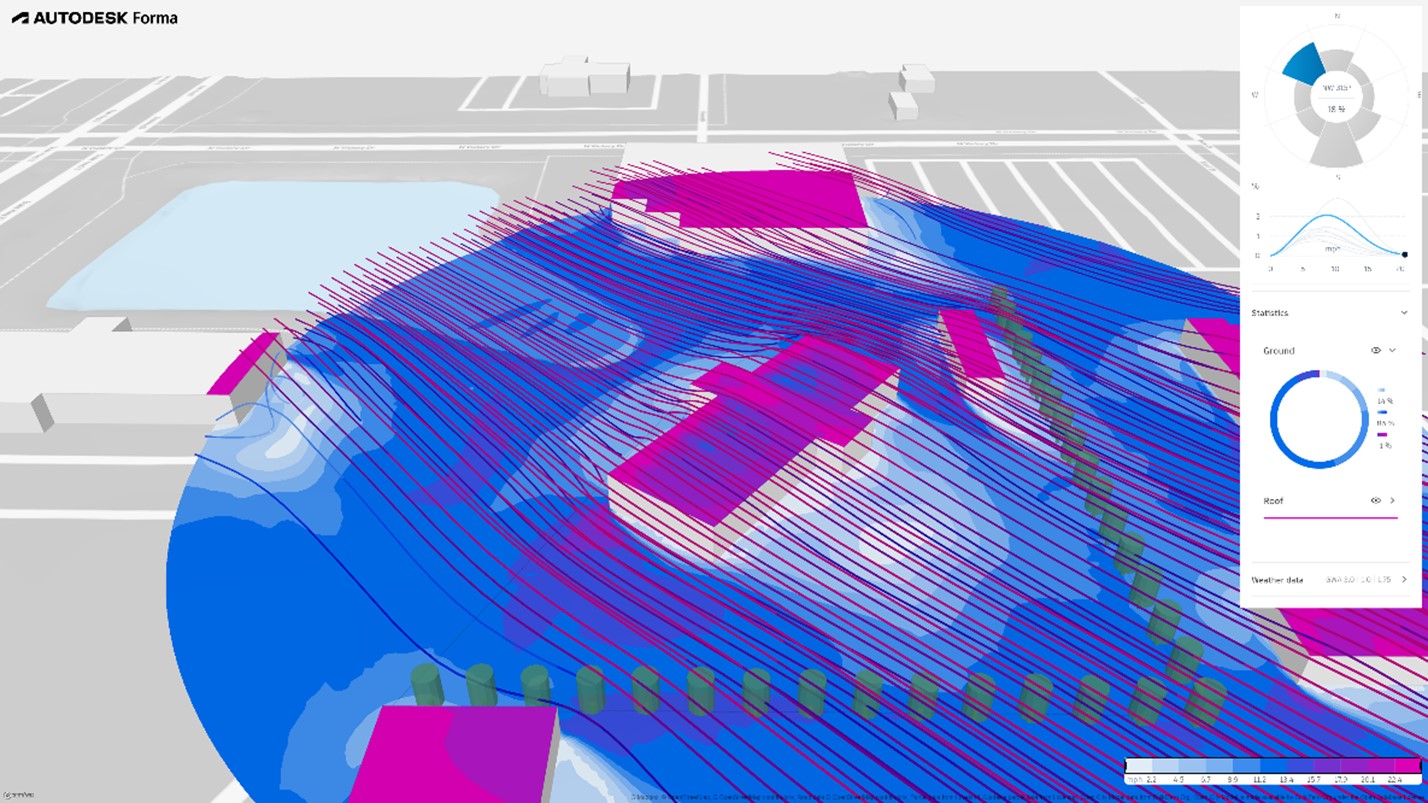
Wind modeling software tools are available for some computer-aided drafting programs. In this example, the lighter colors and white areas indicate lower velocity areas where snow deposition is anticipated.
If you are designing within a part of the state with frequent strong winter winds, prioritize consideration of blowing and drifting snow in your design.