This section of the manual is currently under construction.
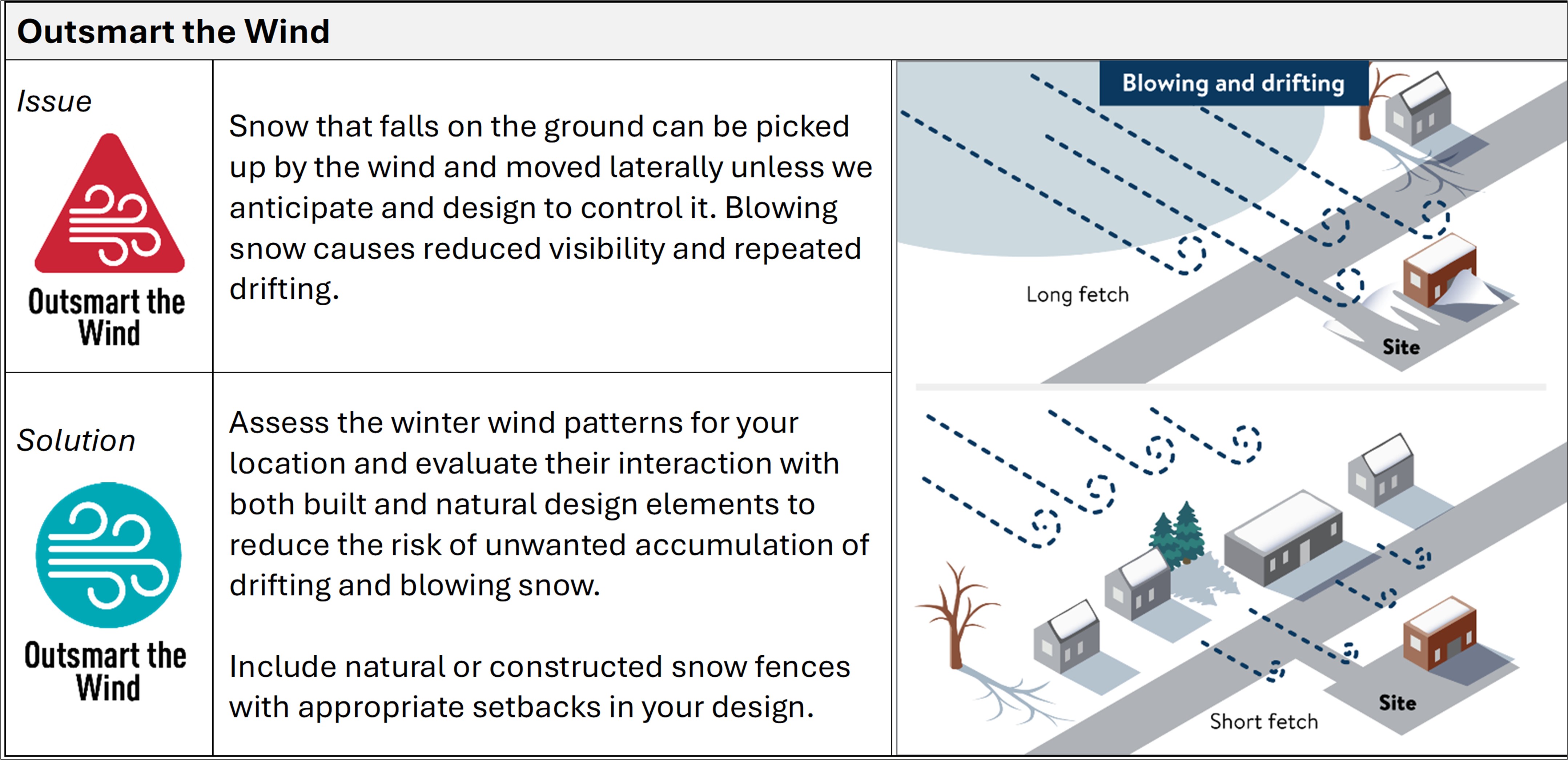
Blowing and drifting snow can create hazardous conditions on roads and other saltable surfaces. With proper design and placement, a variety of snow fence types can be used to create a snow drop area that is not on a critical paved surface and prevent blowing and drifting on roads. Likewise, placement of berm structures and vegetation without consideration of wind effects on snow drop can create unintentional snow drop areas and create hazardous conditions that require a lot of maintenance and use of deicers.
Applicability
Most blowing snow control tools use the language of road corridors, but the concepts apply across different land use categories. Blowing/drifting snow decreases public safety. The Outsmart the Wind strategy can be applied broadly to minimize the potential for blowing/drifting snow accumulations on public walkways and rights-of-way areas. If you are designing within a part of the state with frequent strong winter winds or where maintaining visibility is a critical safety concern, prioritize consideration of blowing and drifting snow in your design.
To implement this strategy, consider the three approaches described under Design criteria and considerations.
Benefits and limitations
The University of Minnesota, with funding from the Minnesota Department of Transportation, developed a cost-benefit tool to estimate return on investment for implementing blowing snow control practices. MnDOT found that snow fencing provides a return on investment of $14 for every $1 spent (Current, 2017).
Design criteria and considerations
There are three approaches to the 'Outsmart the wind' design strategy.
Install snow fences
Snow fences are traditionally associated with corridor protection but offers equal benefits for site protection.
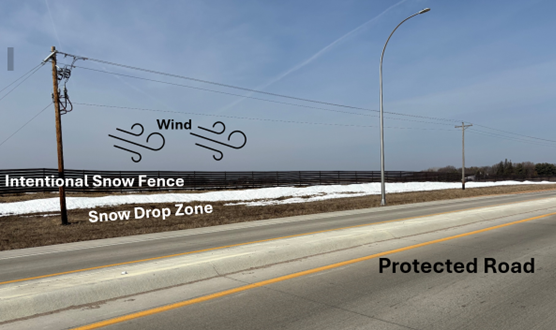
Snow fencing can be a built structure such as a snow fence or berm, or a living structure such as a wall of vegetation, standing row crops, or a row of large hay bales. The angle, porosity, height and setback from the saltable surface are key to success.
MnDOT and the University of Minnesota have tools and instructional videos to help with this design.
Understanding basic snow fence dynamics is important. Realize the snow drop happens as the wind crosses over the snow fence (and loses speed) and deposits snow after (not before) it hits the fence: Proper set back allows for snow drop before the saltable surface.
Remove unintentional snow fences
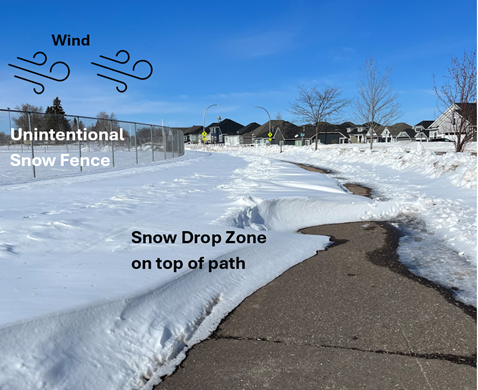
An unintentional snow fence is anything that is placed in the path of the winter wind that causes a reduction in wind speed resulting in a snow drop. This could be park benches, landscaping, decorative fencing, sports field fencing, and other structures.
Drift free road and ditch design
Drift free road and ditch design considers road elevation compared to windward elevation, ditch shape and geometry to store and manage snow before it becomes a problem on the roadway, http://www.dot.state.mn.us/project-development/subject-guidance/snow-blowing-drifting-control/process.html.
Retrofit suitability
High: Intentional and unintentional snow fences
- May require adjustments on adjacent property.
- Structural or living snow fences can be added to a site if there is enough space. If not, it may require working with adjacent properties.
- When implementing living or constructed snow fence lines, required sightlines must be maintained along roadways and at intersections.
- For roadways, the right-of-way is often not enough space to implement an appropriate snow fence. MnDOT has been successful in working with and providing payment to farmers and other landowners to leave corn rows or hay bales in place through the winter, plant living snow fences, or allow MnDOT to install structural snow fences.
- Urban and suburban sites may pose greater complexity for outsmarting the wind.
Permits and regulations
Coordinating the installation of snow fences along roadways involves cooperation with local agencies and property owners. If private property owners are involved, payment, contracts, and easements may be needed.
Potential conflicts
One of the best ways to outsmart the wind is the installation of snow fences. These must be set back from the saltable surface to create a drop zone not on a saltable surface without disrupting required sightline distances. Depending on the size of the site, this may involve working with property owners adjacent to the site you are developing or managing.
Research needed
Research needs for the Outsmart the Wind strategy include:
- Considerations for linear playground or decorative structures that can also serve as snow fences for sites in open areas such highway rest stops or in/near parks, sport fields, lakes, golf courses, and prairies.
- Design options for temporary snow fencing (e.g., for construction sites).
- Verification of low velocity wind models and snow drop locations.
- Case studies on implementation of snow fences and outsmart the wind strategies, especially land uses other than transportation.
References and additional resources
- Current, D., G. Wyatt, D. Zamora, K. Eckman, M. Butler, K. Carroll, M. Danielson, D. Gullickson. 2017. Expanding the Adoption on Private Lands: Blowing-and-Drifting Snow Control Treatments and the Cost Effectiveness of Permanent versus Non-Permanent Treatment Options. Research Project Final Report. MN/RC 2017-42. Minnesota Department of Transportation and University of Minnesota.
- Minnesota Department of Natural Resources. Accessed March 2025. Wind. Minnesota Department of Natural Resources. Retrieved from Wind | Minnesota DNR
- Minnesota Department of Transportation. Accessed March 2025. Cost Benefit - Living Snow Fences: Control blowing and drifting snow. Retrieved from Cost Benefit - Living Snow Fences.
- Minnesota Department of Transportation. Accessed February 2025. Blowing and Drifting Snow Control Process. Minnesota Department of Transportation. Retrieved from Blowing Snow Process - Project Development - MnDOT
- Yang, Mijia, Yao Yu, Dong Cao. 2021. Harnessing Solar Energy Through Noise Barriers and Structural Snow Fencing. Corporate Creator(s): North Dakota State University. Department of Civil and Environmental Engineering. Corporate Contributor(s): Minnesota. Department of Transportation. Office of Research & Innovation. Published Date: 2021-07-01. Report Number: MN 2021-20, https://rosap.ntl.bts.gov/view/dot/57603. Video: https://www.youtube.com/watch?v=i8BbH2-yA1g
- Tabler, R.D. 2023. Controlling Blowing and Drifting Snow with Snow Fences and Road Design, Final Report. National Cooperative Highway Research Program, Transportation Research Board of the National Academies.
- University of Minnesota. Accessed February 2025. Cost Benefit Tool. Blowing Snow Control Tools. Retrieved from Cost Benefit Tool | Blowing Snow Control Tools.
University of Minnesota. Accessed April 2025. Minnesota Drift-Free Roads Design Tool. - Wyatt, G., Zamora, D., Smith, D., Schroder, S., Paudel, D., Knight, J., Kilberg, D., Current, D., Gullickson, D., and Taff, S. (2012). Research and Assess the Farmer and MnDOT Economic and Environmental Costs and Benefits of Living Snow-fences, Including Carbon Impacts. Minnesota Department of Transportation. St. Paul, MN. Link: https://cinram.umn.edu/sites/cinram.umn.edu/files/2021-08/mndot_lsf.final_.report.revised.jan_30.2012.pdf
- Wyatt, G., Zamora, D., Smith, D., Current, D., and Gullickson, D. (2015). Snow-control Tools Webinar. December 2, 2015. University of Minnesota. Retrieved from: http://snowcontroltools.umn.edu/videos/index.html