This section of the manual is currently under construction.
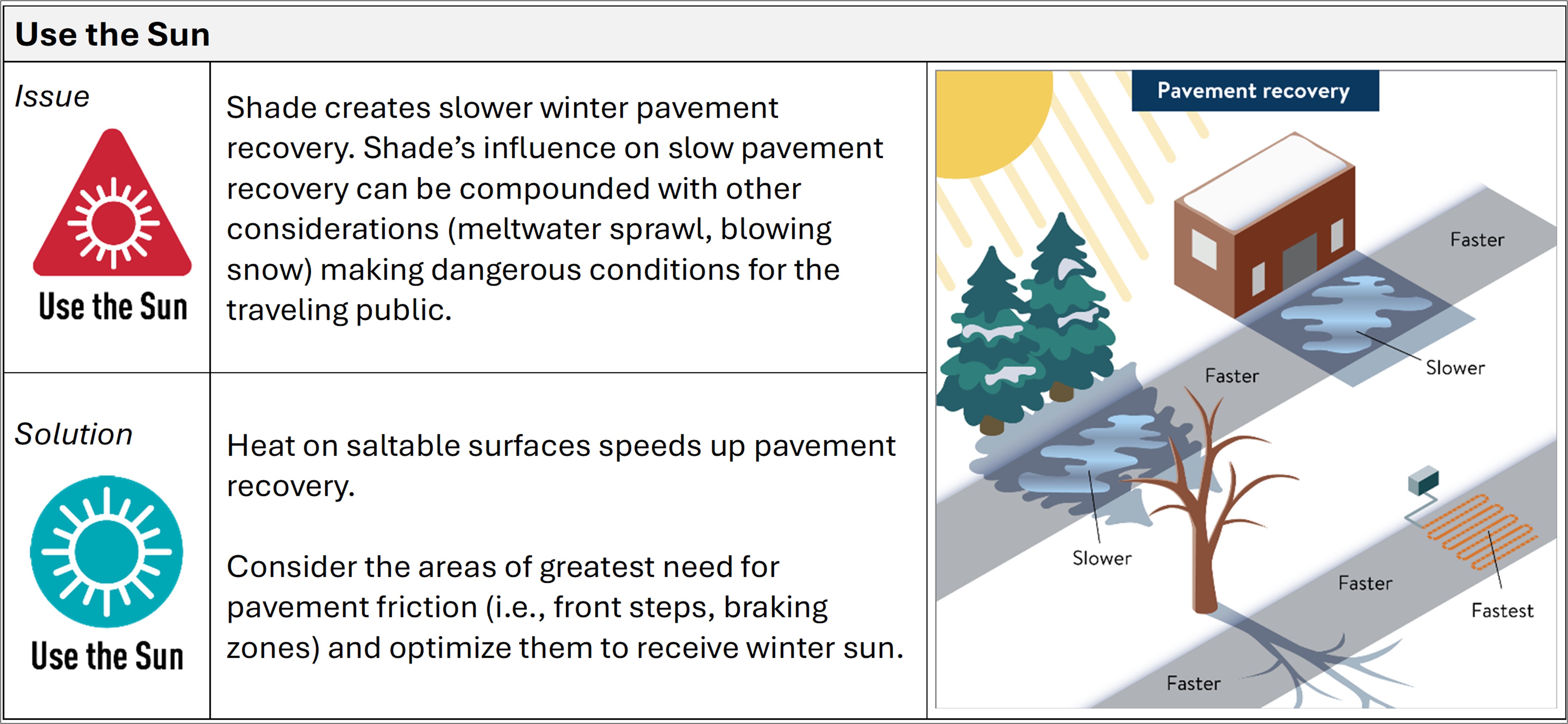
Pavement recovery is fastest when pavement is in the sun, ice and snow on shaded surfaces are slower to melt. Consider the areas of greatest need for pavement friction (i.e., front steps, braking zones) and optimize them to receive winter sun. Trees, fences, and buildings are all items to consider in neighboring infrastructure and in proposed design.
Applicability
The Use the Sun strategy should be considered for critical areas such as building entrances, braking zones, and any area where winter pavement friction is critical.
To take advantage of the sun, consider:
- Building placement/rotation
- Other structure placement (i.e., noise walls, fences)
- Vegetation selection and placement
- Vegetation management
Benefits and limitations
Making use of the sun to speed up pavement recovery can be inexpensive or free. Incorporating this design consideration from the start of your project will make it easier to capitalize on this free element in design.
Design criteria and considerations
Put the sun into your CAD system.
- Evaluate the angle of the sun on the shortest day of the year; identify the orientation of the sun and hours of sunlight. It will remind you to take advantage of this free resource for melting snow and speeding up pavement recovery.
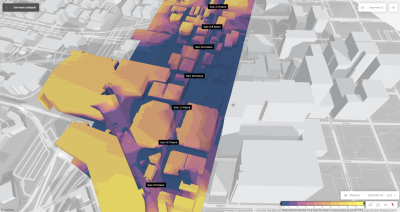
Shaded areas can be identified using sun analysis software such as Autodesk Forma. Try and optimize the location of critical areas such as braking zone, front doors, hills, sharp curves, crosswalks, high traffic areas to take advantage of sunlit areas (shown in yellow in the figure below). Using the sun is free and one of several strategies to speed up winter pavement recovery.
- Albedo is a measurement of how much light a surface reflects or absorbs. Dark surfaces, such as asphalt, have a low albedo leading to a warming effect while white surfaces such as snow or concrete have a higher albedo.
Retrofit suitability
High: Vegetation management via removal of trees and replacement with shorter vegetation or replacing coniferous trees with deciduous trees is an easily implemented retrofit opportunity to reduce winter shade.
Low: Rotate building, remove adjacent property features casting shade.
Permits and regulations
Some cities have ordinances that restrict tree removal. Some urban designs require shade cast analysis.
Potential conflicts
Climate change: If warming up winter pavement would contribute to climate change, how does that impact compare to the extra danger for the traveling public, and salt loading on a colder pavement?
Research needed
How many hours of sunlight exposure per day are needed to improve winter performance?
What is the optimal air and/or pavement temperature required to increase performance (based on pavement type, and on pavement with a layer of residual snow).
References and additional resources
- Autodesk Forma. Design software.
- B3 Guidelines. 2019. Guideline S.2: Site and Water Quality and Efficiency. B3 Guidelines. Retrieved from Guideline S.2 – B3.
- Bolton & Menk, Inc. 12/03/2024. Low Salt Design Guide®, V.120324.
- MPCA. 2020. Statewide Chloride Management Plan. Minnesota Pollution Control Agency. Retrieved from Statewide Chloride Management Plan Report.
- MPCA. 2025. Smart Salting training. Minnesota Pollution Control Agency. Retrieved from Smart Salting training | Minnesota Pollution Control Agency
- Nine Mile Creek Watershed District. 2020. Chloride Management Plan. Nine Mile Creek Watershed District. Retrieved from Template-Chloride-Management-Plan_Final.pdf
- Riley-Purgatory-Bluff Creek Watershed District. 2021. Chloride Management Plan. Riley-Purgatory-Bluff Creek Watershed District. Retrieved from 2021-09-23_13-39_967.pdf