Soils with low infiltration capacity (tight soils) are defined as soils with steady-state infiltration rates equal to or less than 0.06 inches per hour. County soil surveys are useful for initial screening to identify soils that may have low infiltration rates. Most county soil surveys are available digitally from the NRCS (National Resources Conservation Service). These surveys are not accurate enough to determine site-specific characteristics suitable for infiltration systems but are useful for initial screening. If there is a potential for slowly infiltrating soils to exist on a site, a detailed site analysis should be performed for all proposed infiltration BMPs (Susilo, 2009).
Stormwater management limitations in areas with tight soils generally preclude large-scale infiltration and ground water recharge (infiltration that passes into the ground water system). These soils will typically be categorized under Hydrologic Soil Group (HSG) D. The table below provides a general summary of infiltration rates for different soils. These are conservative estimates of long-term, sustainable infiltration rates that have been documented in Minnesota. They are based on in-situ measurement within existing infiltration practices in Minnesota, rather than national numbers or rates based on laboratory columns.

Warning: The Construction Stormwater (CSW) General Permit prohibits infiltration when an infiltration system will be constructed in areas of predominately Hydrologic Soil Group D (clay) soils.
Contents
- Why are soils with a low infiltration capacity a concern?
- How to investigate soils with low infiltration capacity
- What are general stormwater management guidelines for sites with low infiltration capacity soils?
- Related pages
Why are soils with a low infiltration capacity a concern?
Sites with low infiltration capacity soils may limit the type, location, number and/or sizing of infiltration BMPs that can be used for stormwater management. Low infiltration rates result in extended surface ponding of water, which may damage vegetation, lead to mosquito breeding, damage soil structure, and reduce pollutant treatment by the BMP. Certain watershed organizations in Minnesota do not allow the use, or strongly discourage the use, of infiltration BMPs where soil infiltration capacity is low. This does not mean, however, that these soils do not have any infiltration and recharge capabilities. It may be possible for sites to partially or fully meet infiltration objectives as long as appropriate design modifications have been incorporated, such as amending the soil with compost or sand, or incorporating an underdrain into the practice.
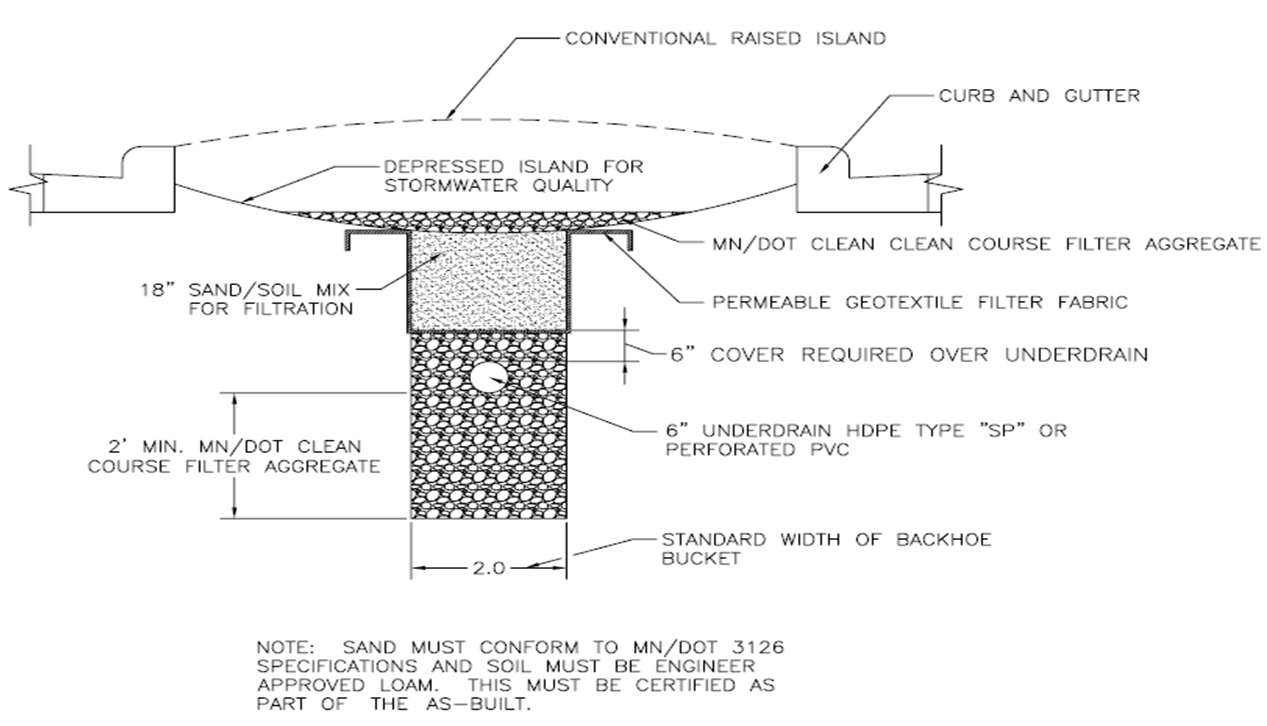

The following table provides an overview of design considerations for several groups of structural practices.
| BMP | Low infiltration capacity soil considerations |
|---|---|
| Bioretention, dry swale, permeable pavement, tree trench/box | Should be constructed with an underdrain. Recharge criteria, if applicable, can be met by modifying the design to include an infiltration gallery below the underdrain, so long as it is appropriately sized. |
| Media filter | Recommended practice in tight soils. Some design variants can be modified to incorporate an infiltration gallery that can help meet recharge criteria, if properly sized. |
| Infiltration trench or basin |
|
| Stormwater ponds | Acceptable practice with tight soils. Soils should help maintain permanent pool. |
| Constructed wetlands |
|
How to investigate soils with low infiltration capacity
Soil tests to determine infiltration capacity of soil should be performed at all proposed stormwater facilities that plan to have a recharge or infiltration component to their design. The purpose of the testing is to identify and confirm the soil characteristics and determine suitability, if any, for infiltration BMPs. Guidelines for investigating all potential physical constraints to infiltration on a site are presented in a table at this link. These guidelines should not be interpreted as all-inclusive. The size and complexity of the project will drive the extent of any subsurface investigation.
Subsurface material investigation
Soil testing is recommended for all proposed stormwater facilities that plan to have a recharge or infiltration component to their design. Testing can be less rigorous than that for karst areas or sites with shallow bedrock and groundwater. The investigation is designed to identify and confirm the soil characteristics and determine their suitability, if any, for infiltration practices.
Location of soil borings
Borings should be located in order to provide representative area coverage of the proposed BMP facilities. The location of borings should be:
- within each distinct major soil type present, as mapped in soil surveys;
- near the edges and center of the proposed practice and spaced at equal distances from one another; and
- near any areas identified as anomalies from any existing geophysical studies.
Number of soil borings
The number of recommended borings is described below.
- Infiltration trenches, bioretention, and filters - a minimum of 2 per practice. Note that more borings are recommended for infiltration BMPs greater than 5000 square feet in area. See here for recommendations on number of borings for infiltration BMPs as a function of BMP size.
- Ponds/wetlands - a minimum of 3 per practice, or 3 per acre, whichever is greater.
- Additional borings – as needed to define lateral extent of limiting horizons, or site specific conditions, where applicable.
Depth of soil borings
Borings should be extended to a minimum depth of 5 feet below the lowest proposed grade within the practice unless auger/backhoe refusal is encountered.
Identification of material
All material penetrated by the boring should be identified, as follows:
- Provide descriptions, logging, and sampling for the entire depth of the boring.
- Note any stains, odors, or other indications of environmental degradation.
- Perform a laboratory analysis of a minimum of 2 soil samples, representative of the material penetrated including potential limiting horizons, with the results compared to the field descriptions.
- Identify soil characteristic including, at a minimum: color; mineral composition; grain size, shape, and sorting; and saturation.
- Log any indications of water saturation to include both perched and ground water table levels, and descriptions of soils that are mottled or gleyed (sticky clay soils typically found in waterlogged soils).
- Measure water levels in all borings at the time of completion and again 24 hours after completion. The boring should remain fully open to total depth of these measurements.
References for conducting geotechnical investigations
Information: A section providing information on soil borings is being developed for the Manual and should be available in early 2016
The following references provide useful information for conducting geotechnical investigations. Note that some of these documents were written for investigations at contaminated sites.
- CHECKLIST AND GUIDELINES FOR REVIEW OF GEOTECHNICAL REPORTS AND PRELIMINARY PLANS AND SPECIFICATIONS
- Geotechnical Investigations
- GUIDELINES FOR PLANNING AND IMPLEMENTING GROUNDWATER CHARACTERIZATION OF CONTAMINATED SITES
- How to Read and Understand a Geotechnical Report
Infiltration rate testing
Soil permeability should be determined in the field using the procedures described here.
What are general stormwater management guidelines for sites with low infiltration capacity soils?
- Local soil surveys should be used for preliminary determination of infiltration capacity of the soils on site; if the soil survey suggests soils with very low infiltration capacities, then alternative BMPs such as filters, wet sedimentation basins, etc. should be considered. If the survey suggests the potential for infiltration, the on-site soil testing should be done to accurately characterize site soils. The testing should be conducted in the most restrictive layer of soil that is found within 5-feet below the bottom of the proposed BMP.
- Soil compost amendments should be considered for lawns and other pervious surfaces to increase pervious area storage and/or decrease pervious surface runoff. Designers should also consider disconnection of impervious surfaces, by draining rooftops and other impervious surface runoff to compost amended pervious surfaces before collection and discharge into a structural BMP.
- Where volume reduction is a primary objective for a site (e.g., required by permit, potentially a receiving water-based goal due to channel erosion, nuisance flooding, or inadequate infrastructure capacity), emphasis should be placed on practices that promote runoff reuse and evapotranspiration such as cisterns, rain barrels, green roofs, and biofiltration in order to maximize volume reduction.
- A mounding analysis should be conducted to ensure that any groundwater mound that develops under a BMP will not extend into the BMP. This mounding analysis is especially important for soils with low permeability since such soils cannot efficiently dissipate groundwater through the soil column.
Related pages
- Overview of stormwater infiltration
- Pre-treatment considerations for stormwater infiltration
- BMPs for stormwater infiltration
- Pollutant fate and transport in stormwater infiltration systems
- Surface water and groundwater quality impacts from stormwater infiltration
- Stormwater infiltration and groundwater mounding
- Stormwater infiltration and setback (separation) distances
- Karst
- Shallow soils and shallow depth to bedrock
- Shallow groundwater
- Potential stormwater hotspots
- Stormwater and wellhead protection
- Stormwater infiltration and contaminated soils and groundwater
- Decision tools for stormwater infiltration
- References for stormwater infiltration