This page provides a discussion of how permeable pavement practices can achieve stormwater credits. Permeable pavement systems with and without underdrains are both discussed, with separate sections for each type of system as appropriate.
| TSS | TP | PP | DP | TN | Metals | Bacteria | Hydrocarbons |
|---|---|---|---|---|---|---|---|
| 74 | 41 | 74 | 0 | insufficient data | insufficient data | insufficient data | insufficient data |
| TSS=total suspended solids; TP=total phosphorus; PP=particulate phosphorus; DP=dissolved phosphorus; TN=total nitrogen. | |||||||
| NOTE: removal efficiencies are 100 percent of captured water for systems with no underdrain. | |||||||
Warning: Models are often selected to calculate credits. The model selected depends on your objectives. For compliance with the Construction Stormwater permit, the model must be based on the assumption that an instantaneous volume is captured by the BMP. For more information on using models to calculate credits see Methods and resources for calculating credits.
Green Infrastructure: Permeable pavement can be an important tool for retention and detention of stormwater runoff. Permeable pavement may provide additional benefits, including reducing the need for de-icing chemicals, and providing a durable and aesthetically pleasing surface.
Credit refers to the quantity of stormwater or pollutant reduction achieved either by an individual best management practice (BMP) or cumulatively with multiple BMPs. Stormwater credits are a tool for local stormwater authorities who are interested in
- providing incentives to site developers to encourage the preservation of natural areas and the reduction of the volume of stormwater runoff being conveyed to a best management practice (BMP);
- complying with permit requirements, including antidegradation (see Construction permit; Municipal (MS4) permit);
- meeting the MIDS performance goal; or
- meeting or complying with water quality objectives, including total maximum daily load (TMDL) wasteload allocations (WLAs).
Contents
Overview
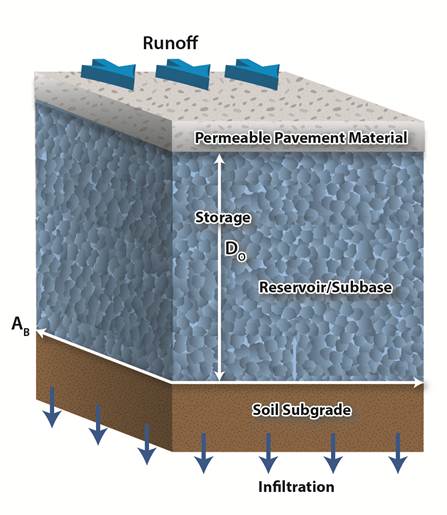
Permeable pavements are a stormwater quality practice that allows runoff to pass through surface voids into an underlying stone reservoir/subbase for temporary storage before being discharged to an underdrain and/or underlying soil via infiltration. The most commonly used types of permeable pavement are pervious concrete, porous asphalt, and permeable interlocking concrete pavers.
Pollutant removal mechanisms
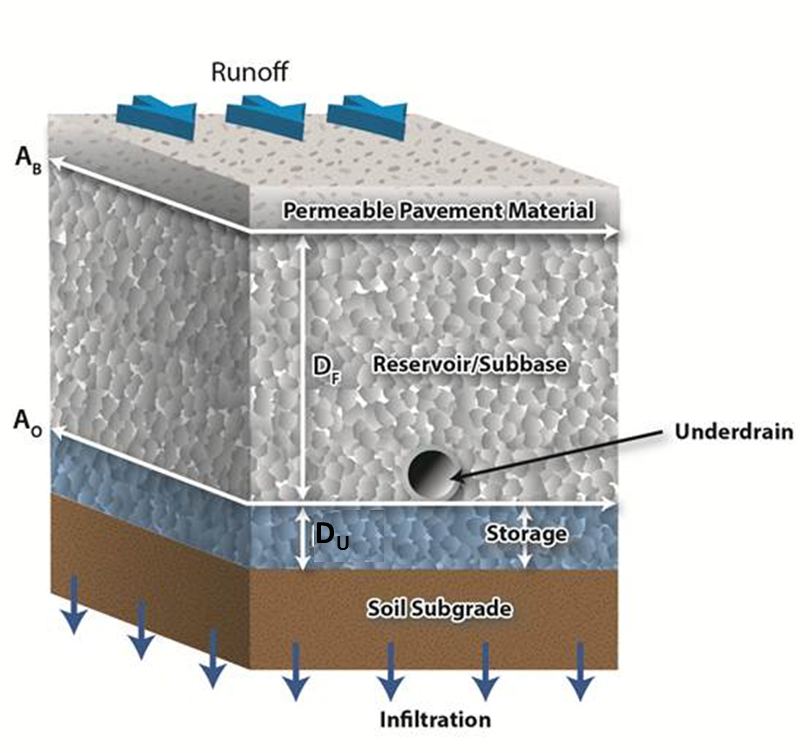
Permeable pavement systems with no underdrains provide stormwater pollutant removal by reducing the volume of runoff from a site and the pollutant mass associated with that volume when infiltration is allowed (Water Environment Federation, 2012). In systems with underdrains most of the water is captured by the underdrain after passing through the subbase. If the underdrain is raised above the underlying soil subgrade, water stored in the reservoir/subbase below the underdrain will infiltrate into the underlying soil. If the underdrain is at the bottom of the reservoir/subbase, a small amount of infiltration may occur. Thus, pollutant removal in a permeable pavement system with an underdrain occurs through filtering of water captured by the underdrain and infiltration for water infiltrating into the underlying soil subgrade.
Location in the treatment train
Stormwater Treatment Trains are comprised of multiple Best Management Practices that work together to minimize the volume of stormwater runoff, remove pollutants, and reduce the rate of stormwater runoff being discharged to Minnesota wetlands, lakes and streams. Permeable pavements are installed near the start of the treatment train as a method that directs the stormwater runoff to a subgrade storage area in order to minimize the volume and pollutant mass of stormwater runoff .
Methodology for calculating credits
This section describes the basic concepts and equations used to calculate credits for volume, Total Suspended Solids (TSS) and Total Phosphorus (TP). For specific tools and methods that can be used to calculate credits see Methods and resources for calculating credits. Permeable pavement is also effective at reducing concentrations of other pollutants including nitrogen, metals, bacteria, and hydrocarbons. This article does not provide information on calculating credits for pollutants other than TSS and TP, but references are provided that may be useful for calculating credits for other pollutants.
Assumptions and approach
In developing the credit calculations, it is assumed the permeable pavement practice is properly designed, constructed, and maintained in accordance with the Minnesota Stormwater Manual. If any of these assumptions is not valid, the BMP may not qualify for credits or credits should be reduced based on reduced ability of the BMP to achieve volume or pollutant reductions. For guidance on design, construction, and maintenance, see the appropriate article within the permeable pavement section of the Manual.
Warning: Pre-treatment is required for all filtration and infiltration practices
In the following discussion, the water quality volume (VWQ) is assumed to be delivered instantaneously to the BMP. The VWQ is stored within the reservoir/subbase below the bottom of the pavement and above the soil subgrade. The VWQ can vary depending on the stormwater management objective(s). For construction stormwater, the water quality volume is 1 inch times the new impervious surface area. For MIDS, the VWQ is 1.1 inches times the impervious surface area. In reality, some water will infiltrate through the bottom and sidewalls of the BMP as a rain event proceeds. The instantaneous method therefore may underestimate actual volume and pollutant losses.
The approach in the following sections is based on the following general design considerations.
- Credit calculations presented in this article are for both event and annual volume and pollutant load removals.
- Stormwater volume credit for permeable pavements equates to the volume of runoff that is fully contained within the stone reservoir/subbase that will ultimately be infiltrated into the soil subgrade.
- TSS and TP credits for permeable pavements are achieved for the volume of runoff that is filtered and captured by an underdrain and the volume of water that is ultimately infiltrated.
Volume credit calculations - no underdrain
Volume credits are calculated based on the capacity of the BMP and its ability to permanently remove stormwater runoff via infiltration into the underlying soil from the existing stormwater collection system. These credits are assumed to be instantaneous values entirely based on the capacity of the BMP to capture, store, and transmit water in any storm event.
Volume credits for a permeable pavement system are based on the porosity of the subbase and system dimensions, specifically the depth of the reservoir/ subbase, the area of permeable pavement, and the bottom surface area. The volume credit (Vinfb) for infiltration through the bottom of the BMP into the underlying soil, in cubic feet, is given by
$^V_{inf_b} = D_o\ n\ (A_O + A_B)\ / 2^$
Where:
AO is the overflow surface area of the permeable pavement system, in square feet;
AB is the depth at the bottom of the permeable pavement system, in square feet;
DO is the depth of the reservoir/subbase layer (engineered media), equal to the distance from the bottom of the permeable pavement material to the underlying soil subgrade, in feet; and
n is the porosity (f) of the reservoir/subbase, in cubic feet per cubic foot.
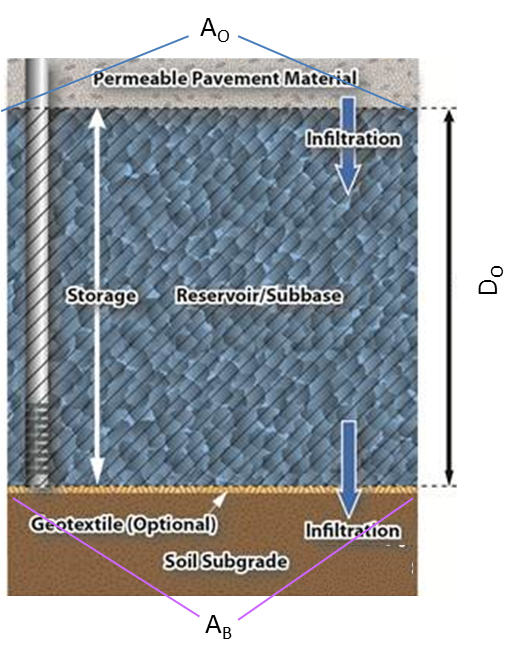
The subbase depth should be limited to the drawdown time. The construction stormwater general permit requires a maximum 48-hour drawdown time (24 hours is recommended for discharges to trout streams). For example, using a hydrologic soil group B (SM) soil with an infiltration rate of 0.45 inches per hour, the maximum depth is 1.8 feet.
Note that that entire porosity of the subbase layer is used to calculate the volume credit. This slightly overestimates the actual volume infiltrated since some water is held by the media after the runoff infiltrates. The water content after gravity drainage, called field capacity, is less than 5 percent of total porosity for a permeable pavement system.
The annual volume captured and infiltrated by the BMP can be determined with appropriate modeling tools, including the MIDS calculator. Example values are shown below for a scenario using the MIDS calculator. For example, a permeable pavement system designed to capture 1 inch of runoff from impervious surfaces will capture 89 percent of annual runoff from a site with B (SM) soils.
Volume calculations - underdrain
The volume credit (V) for permeable pavement systems with underdrains, in cubic feet, is given by
$^V = V_{inf_b} + V_U^$
The infiltrating volume (Vinf,b), in cubic feet, is given by
$^V_{inf_b} = A_B\ DDT\ I_R / 12^$
Where:
AB is the surface area at the bottom of the underdrain, in square feet;
DDT is the drawdown time for water stored below the underdrain, in hours; and
IR is the design infiltration rate of underlying soil, in inches per hour.
Information: The MIDS calculator assigns a default value of 0.06 inches per hour, equivalent to a D soil, to IR. This is based on the assumption that most water will drain to the underdrain, but that some loss to underlying soil will occur. A conservative approach assuming a D soil was thus chosen.
The construction stormwater general permit requires a maximum 48-hour drawdown time (24 hours is recommended for discharges to trout streams). Note the MIDS calculator does not provide a volume credit for a permeable pavement system with an underdrain at the bottom.
If the underdrain is raised above the bottom of the BMP (i.e. above the interface between the reservoir/subbase and underlying soil subgrade), water stored below the underdrain will infiltrate. The infiltrating volume (VU), in cubic feet, is given by
$^V_U = D_u\ n\ (A_U + A_B)\ / 2^$
Where:
Du is the depth of the reservoir layer below the underdrain, in feet;
AB is the surface area at the bottom of the underdrain, in square feet;
AU is the surface area at the bottom of the reservoir layer/subbase, in square feet; and
n is the porosity of the reservoir/subbase layer, in cubic feet per cubic foot.
The depth below the underdrain should be limited to the drawdown time. The construction stormwater general permit requires a maximum 48 hour drawdown time (24 hours is recommended for discharges to trout streams). For example, using a hydrologic soil group C soil with an infiltration rate of 0.2 inches per hour, the maximum depth below the underdrain is 0.8 feet.
Total Suspended Solids (TSS)
The TSS credits available for installation of permeable pavement depend on the design of the storage volume below the pavement and whether the runoff is filtered (through an underdrain), infiltrated, or both. Designs that filter runoff with an underdrain at the bottom of the storage layer are less effective in removing pollutants than infiltration designs. Runoff is filtered while flowing through the permeable pavement and the storage layer and out the underdrain. TSS removal credit of 100 percent is assumed for the infiltrated water. The recommended removal rate for filtered water is 74 percent, based on review of literature.
Removal of TSS by permeable pavement (MTSS), in pounds per event or pounds per year, is given by
$^M_{TSS} = M_{TSS_I}\ + M_{TSS_F}^$
Where:
MTSSI = mass of TSS removed by infiltration (pounds per event or pounds per year); and
MTSSF = mass of TSS removed by filtration (pounds per event or pounds per year).
The annual TSS credit (MTSSI) for infiltrated runoff is given by
$^M_{TSS_I} = 2.72\ V_{_{Annual}}\ F_I\ EMC_{_{TSS}} ^$
Where:
VAnnual is the annual volume treated by the BMP, in acre-feet;
FI is the fraction of the total annual volume treated by the BMP that is infiltrated;
EMCTSS = event mean concentration of TSS in the runoff, in mg/L; and
Factor of 2.72 used for conversion to pounds.
In a permeable pavement system with an underdrain, some of the water captured by the BMP will enter the underdrain while some will infiltrate below the underdrain. The amount infiltrating depends on several factors, including whether the underdrain is raised above the soil subgrade, the infiltration rate of the underlying soil, and size and spacing of the underdrains. Pollutants in water that enters the underdrain are filtered. The Annual TSS credit for filtered runoff (MTSSF) is given by
$^M_{TSS_F} = 2.72\ R_{_{TSS}}\ V_{_{Annual}}\ (F_F)\ EMC_{_{TSS}}^$
Where:
FF is the fraction of the total volume treated by the BMP that is filtered; and
RTSS is the pollutant removal fraction for filtered water. A value of 0.74 is recommended.
If the permeable pavement is not the upstream most BMP in the treatment train, EMCTSS should be dependent on the MTSS effluent (mg/L) from the next upstream tributary BMP.
The annual volume treated by the BMP can be determined with appropriate modeling tools, including the MIDS calculator. Example values are shown below for a scenario using the MIDS calculator. For example, a permeable pavement system designed to capture 1 inch of runoff from impervious surfaces will capture 89 percent of annual runoff from a site with B (SM) soils. If an underdrain is in the system, this volume will have to be divided into the portion that infiltrates and the portion that is captured by the underdrain. The MIDS calculator can be used to determine these values.
The event (storm) based TSS credit (MTSSI) for infiltrated runoff is given by
$^M_{TSS_I} = 2.72\ V_I\ EMC_{_{TSS}}\ / 43,560^$
Where
VI is the event-based volume infiltrated by the BMP, in cubic feet, and
a factor of 43,560 is used for conversion of volume from cubic feet to acre-ft.
The storm event based TSS credit (MTSS-F) for filtered runoff is given by
$^M_{TSS_F} = R_{_{TSS}}\ 2.72\ V_F\ EMC_{_{TSS}}\ / 43560^$
Where
VF is the event-based volume filtrated by the BMP, in cubic feet.
Total phosphorus (TP) credit calculations
Similar to TSS, TP reduction credits correspond directly with volume reduction through infiltration and filtration of captured stormwater. The water quality credits available for a permeable pavement system depend on the design of the storage volume below the pavement and whether or not the runoff is filtered (through underdrain) or infiltrated. TP credit is divided into particulate phosphorus (PP) and dissolved phosphorus (DP) removal, respectively making up 55 percent and 45 percent of the total TP credit. Because the volume of infiltrated water (calculated above) is completely removed from the existing system, 100 percent TP credit is assumed for all infiltrated stormwater. Filtered stormwater only receives credit for PP credit, and no credit is given for DP. This approach is consistent with the approach used in the MIDS calculator.
Removal of TP by permeable pavement is given by
$^M_{TP} = M_{TP_I}\ + M_{TP_F}^$
Where
MTP is the annual or event TP removal (lb/yr or lb/event);
MTPI is the annual or event TP removal from infiltrated runoff (lb/yr or lb/event); and
MTPF is the annual or event TP removal from filtered water (lb/year or lb/event).
The total annual TP removal for infiltrated runoff is given by
$^M_{TP_I} = 2.72\ V_{annual}\ F_I\ EMC_{_{TP}}^$
Where
Vannual is the annual volume treated by the BMP, in acre-feet,
FI is the fraction of the total annual volume treated by the BMP that is infiltrated,
EMCTP = event mean concentration of TP in the runoff, in mg/L, and
a factor of 2.72 used for conversion to pounds.
In a permeable pavement system with an underdrain, some of the water captured by the BMP will enter the underdrain while some will infiltrate below the underdrain. The amount infiltrating depends on several factors, including whether the underdrain is raised above the soil subgrade, the infiltration rate of the underlying soil, and size and spacing of the underdrains. Pollutants in water that enters the underdrain are filtered. The Annual TP credit for filtered runoff (MTPF) is given by
$^M_{TP_F} = 2.72\ R_{_{TP}}\ V_{_{Annual}}\ F_F\ EMC_{_{TP}} ^$
Where
FF is the fraction of the total volume treated by the BMP that is filtered; and
RTP is the pollutant removal fraction for filtered water.
The pollutant removal fraction applies only to particulate phosphorus (PP), which is assumed to be 55 percent of total phosphorus (TP). The recommended removal efficiency for PP is 74 percent. Thus, the recommended value for RTP is 0.55 * 0.74 or 0.41. The assumption of 55 percent particulate phosphorus and 45 percent dissolved phosphorus is likely inaccurate for certain land uses, such as industrial, transportation, and some commercial areas. Studies indicate particulate phosphorus comprises a greater percent of total phosphorus in these land uses. It may therefore be appropriate to modify the above equation with locally derived ratios for particulate and dissolved phosphorus. For more information on fractionation of phosphorus in stormwater runoff, link here.
If the permeable pavement is not the upstream most BMP in the treatment train, EMCTP should be dependent on the MTP effluent (mg/L) from the next upstream tributary BMP.
The annual volume treated by the BMP can be determined with appropriate modeling tools, including the MIDS calculator. Example values are shown below for a scenario using the MIDS calculator. For example, a permeable pavement system designed to capture 1 inch of runoff from impervious surfaces will capture 89 percent of annual runoff from a site with B (SM) soils. If an underdrain is in the system, this volume will have to be divided into the portion that infiltrates and the portion that is captured by the underdrain. The MIDS calculator can be used to determine these values.
The event (storm) event based TP credit (MTPI) for infiltrated runoff is given by
$^M_{TPI} = 2.72\ V_I\ EMC_{_{TP}}\ / 43,560^$
Where
VI is the event-based volume infiltrated by the BMP, in cubic feet; and
a factor of 43,560 is used for conversion of volume from cubic feet to acre-ft.
The storm event based TP credit (MTP-F) for filtered runoff is given by
$^M_{TP - F} = R_{_{TP}}\ 2.72\ V_F\ EMC_{_{TP}}\ / 43560^$
Where
VF is the event-based volume filtered by the BMP, in cubic feet.
Example calculations for TSS and TP
NOTE: The MIDS calculator was used for the following examples. The performance goal was changed from the MIDS default of 1.1 inches to 1 inch.
Assume a permeable pavement system is designed to capture and treat 1 inch of runoff from a 1 acre impervious area. Note that in these calculations, the permeable pavement is considered part of the impermeable surface.
For this example, assume a 9000 square foot surface area at the top of the reservoir/subbase, a 9000 square foot area at the reservoir/soil subgrade, an underlying B soil with an infiltration rate of 0.45 inches per hour, a porosity of 0.4 cubic feet per cubic foot, a depth below the underdrain of 1 foot, a TSS EMC of 54.5 milligrams per liter, and a TP EMC of 0.3 milligrams per liter. With this depth below the underdrain, all the water can be infiltrated (3600 cubic feet per event; 2.3446 acre-feet per year).
Annual TSS removal, in pounds, is given by
2.72 x (2.3446) x (1) x (54.5) = 347
Annual TP removal is given by
2.72 x (2.3446) x (1) x (0.3) = 1.91
If the depth below the underdrain was 0.5 feet instead of 1 foot, only half of the 1 inch performance goal is infiltrated, corresponding to an annual infiltration volume of 1.60 acre-feet. Note that the relationship between infiltration performance goal and annual volume infiltrated is not linear. The first step is to calculate the infiltration and filtered fractions of total volume captured by the BMP. The infiltrated fraction is 1.60/2.3446 or 0.68, leaving a filtered fraction of 0.32.
Annual TSS removal, in pounds, is given by
(2.72 x (2.3446) x (0.68) x (54.5)) + ((2.72 x (2.3446) x (0.32) x (0.74) x (54.5)) = 319
The first term in parentheses corresponds with the infiltrated portion and equals about 236.3 pounds. The second term in parentheses corresponds with the filtered portion, having a removal efficiency of 0.74 (74 percent), for a total removal of about 82.3 pounds.
Annual TP removal, in pounds, is given by
(2.72 x (2.3446) x (0.68) x (0.3)) + ((2.72x (2.3446) x (0.32) x (0.55) x (0.74) x (0.3)) = 1.55
The first term in parentheses corresponds with the infiltrated portion and equals about 1.30 pounds. The second term in parentheses corresponds with the filtered portion, having a particulate P fraction of 0.55, and a removal efficiency of 0.74 (74 percent) for the particulate fraction, for a total removal of about 0.25 pounds.
Other pollutants
Permeable pavements provide removal of sediment (TSS), nutrients (phosphorus and nitrogen), and metals through filtration, infiltration, and soil adsorption. Temperature control occurs in the stone reservoir/subbase and soil subgrade. Phosphorus, metals, and hydrocarbons are adsorbed onto soils within the subgrade. In addition, nutrients such as phosphorus and nitrogen may be biologically degraded.
According to the International Stormwater Database, studies have shown that permeable pavements are effective at reducing concentration of pollutants including solids, bacteria, metals, and nutrients. A compilation of the pollutant removal capabilities from a review of literature of permeable pavement studies are summarized in the table below.
| Pollutant | Constituent | Treatment capabilities1 |
|---|---|---|
| Metals2 | Cadmium, Chromium, Copper, Zinc, Lead, Nickel | Medium/High |
| Nitrogen | Total nitrogen, Total Kjeldahl nitrogen | Medium/High |
| Bacteria | Fecal coliform, e. coli | Insufficient data |
| Organics | Medium | |
| 1 Low: < 30%; Medium: 30 to 65%; High: >65% 2 Results are for total metals only |
||
Related articles
- Methods and resources for calculating credits
- Permeable pavement
- Permeable pavement
- Overview for permeable pavement
- Types of permeable pavement
- Design criteria for permeable pavement
- Construction specifications for permeable pavement
- Assessing the performance of permeable pavement
- Operation and maintenance (O&M) of permeable pavement
- Case studies for permeable pavement
- Green Infrastructure benefits of permeable pavement
- Summary of permit requirements for infiltration
- Permeable pavement photo gallery
- Additional considerations for permeable pavement
- References for permeable pavement
- Fact sheets for permeable pavement
- Requirements, recommendations and information for using permeable pavement BMPs in the MIDS calculator