This new (October 2026) content is under construction.
Contents
Introduction
Construction practices such soil stripping, stockpiling, and equipment use often result in degraded soil health which ultimately reduces infiltration and creates higher runoff. However, by integrating soil health principles into construction, soil health can be protected and restored. The resulting infiltration, runoff, and vegetation improvements benefit not only water resources but construction managers. The soil health principles are:
- Decompact or aerate to reset soil, if necessary
- Increase soil organic matter
- Establish diverse, dense, and deep-rooted vegetation
- Minimize physical and chemical disturbance to maintain healthy soil
Improving soil health reduces burdens to downstream stormwater infrastructure and saves time, energy, and money meeting post-construction stormwater needs. Preserving existing vegetation and well-functioning soils are the most cost-effective ways to maintain soil health benefits. While post-construction soil health restoration practices accelerate vegetation establishment and more effectively treat stormwater.
While the principles of soil health apply regardless of the landscape, the approach to protecting and restoring soil health in construction is different than in already established landscapes. Construction projects typically include a huge disturbance of soil and landscape and have an end date, where developers or contractors hand off management of the property to its owner. Therefore, the approach for preserving and restoring soil health in construction varies from the approach in established landscapes, which can be referenced at Restoring Soil Health in Established Landscapes.
For background information and a review of the literature supporting the soil health principles and the approach recommended below, see Soil Health for Stormwater - Introduction and Research Summary.
Supplemental resources for soil health in construction
In addition to the planning and implementation guidance provided here, supplemental resources are available for download:
- Sample construction specifications are available for engineers to modify and use.
- Quick guide for designers (currently under development)
- Quick guide for contractors (currently under development)
Develop and implement a soil preservation and restoration plan
The following section discusses items to include in a soil preservation and restoration plan. If possible, integrate this plan into the design, construction notes, and SWPPP to help ensure the plan is followed. In addition, Restoring Soil Health in Established Landscapes provides helpful background information on how to prioritize and tune soil health restoration practices based on assessment results for different desired vegetation landcover types.
Identify knowledgeable staff to oversee the development and implementation of the plan
Staff with knowledge of soil and construction practices are best to assess, develop, and oversee the implementation of the soil preservation and restoration plan. Identify which staff will conduct various steps of planning and implementation. Identify how key information will be shared amongst the various steps and staff who work to develop and implement the plan.
Assess soil and vegetation before construction
Determine the depths and quality of the topsoil before construction to plan for topsoil needs at the end of the project. Measuring the amount of organic matter and nutrient content in the existing soil can help you plan if compost or other organic matter amendments may be needed post construction. On a five-acre site, two people with modest training and inexpensive equipment can assess topsoil depths and soil health in half a day in the field. Refer to Soil Health Assessment Guide for details on the recommended methods to assess key soil health metrics.
Review the site in context of the construction needs to develop construction limits. Identify good quality vegetation and soils to identify areas that are high priority for protection. View and analyze the landscape using the site topography, on-site soils, vegetation observations, and construction needs. Record all the pre-construction information on a map for planning.
Adjust the design to avoid high-quality soils and vegetation
Ideally, early design phases will consider and avoid high-quality soils and vegetation, where possible. However, if these conditions were not considered, or when new information becomes available, explore options for protecting high-quality areas by adjusting the site design.
Sequence construction activities
Consider how construction activities can be sequenced to work in smaller areas at a time to allow for restoration to begin as quickly as possible after substantial disturbance. Restoration is best done in phases to minimize soil stockpiling time and maximize the time to establish a vegetation cover.
Identify work exclusion zones
Determine where vegetation and soil health should be protected with work exclusion zones. Plan to protect areas not intended for traffic to prevent accidental compaction in these areas. The root zone of trees (at least canopy diameter) should be protected to protect trees. Determine the method (like fencing) that will be used to preserve these areas. Clearly mark the vegetation and soil health preservation zones to prevent inadvertent negative impacts.
Identify work areas
Identify equipment use zones and traffic management. Zone and designate areas for foot and vehicle traffic. Define wheel traffic locations when establishing the construction site. Consider where temporary structures, roadways, storage/stockpiling, and other work areas will be located. Identify areas where topsoil will be stockpiled.
Select equipment
Identify any specific construction equipment that will be used to minimize compaction. Minimize equipment weight where possible, and use wide, smooth, low ground pressure tires and tracks. Load distributing equipment can lessen compaction and help preserve some of the soil structure.
Minimize chemicals
Consider ways to minimize or eliminate chemical disturbance from herbicides, pesticides, and other chemicals which adversely impact soil health. If chemicals must be used, consider ways to use them strategically to avoid excessive use.
Follow best practices for topsoil stripping and stockpiling
Identify where topsoil will be stripped due to grading, stockpiling, replacement by permanent structures, temporary structures or storage, or other construction activities. Identify which practices for stripping and topsoil storage will be used.
Identify the depth of topsoil prior to moving topsoil for stockpiles and limit topsoil removal to soil material with high organic matter. Note that the depth of topsoil is usually shallower at the topslope and slideslope positions than in the bottom slope portions of landscapes, so topsoil stripping plans should account for landscape position.
Topsoil stockpiling can have a dramatic effect on preserving or destroying soil health properties. Keep topsoil stockpiles to a minimum depth to prevent anoxic conditions within the stockpile. Anoxic conditions decrease microbial activity and increase nutrient export. Topsoil stockpiles should be under six feet tall. Finer-textured soils need shallower stockpiles because there is less oxygen exchange.
Soil stockpiles can be strategically placed and configured on the construction site to serve multiple additional benefits. For instance, long narrow stockpile berms help preserve soil health and can also be used to control water movement and erosion and direct traffic.
The ideal topsoil stockpile should be as short-lived as possible, with return from stockpile to topsoil within the season and not to exceed more than a year of storage. Stage different phases of topsoil stripping and replacement, to minimize time that a topsoil is stockpiled and the size of the pile.
Cover topsoil stockpiles to resist erosion. The cover needs to be breathable, either in the form of vegetation, a breathable geotextile cover, hydromulch or an erosion-control blanket. Topsoil covers should not contain plastics to prevent microplastic pollution and wildlife entanglement. Perimeter control at the base of the stockpile is not sufficient to prevent wind or water erosion of the stockpile.
MNDOT recommends using their Two-Year Cover Crop seed mix to cover longer term stockpiles while also building soil health. This seed mix includes wheatgrass, perennial ryegrass, and three nitrogen-fixing forbs. See MnDOT Seeding Manual 2024 for seed mix and planting details.
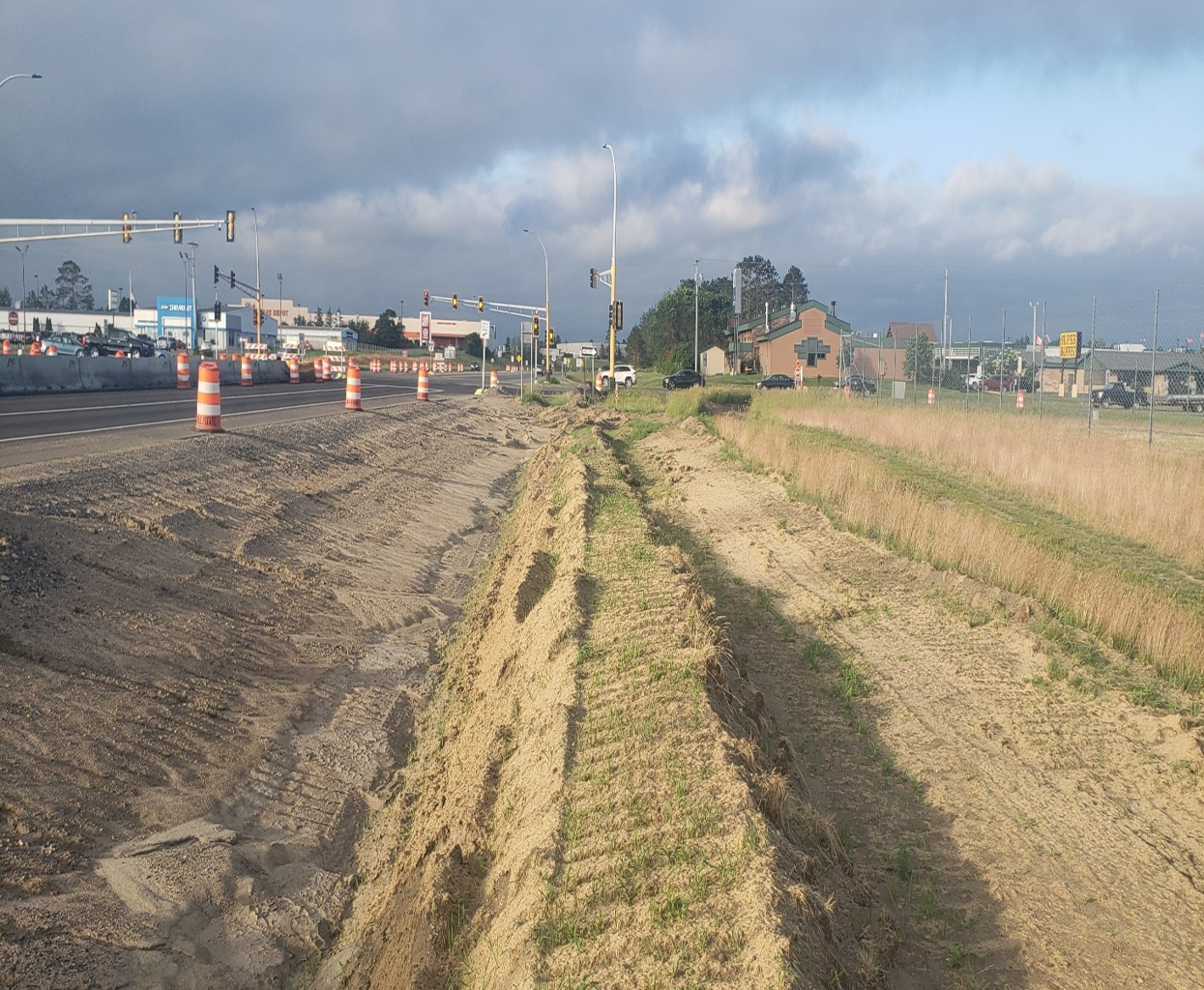
Use mulch or gravel in traffic areas
Areas that cannot be protected from construction traffic can still be managed to reduce compaction. Identify areas of expected machine traffic to protect from compaction. Compaction from vehicle traffic is most severe in the top zero to four inches, even where the ground does not have compaction protection in place. A minimum compaction prevention layer of 6-inches of mulch or 4-inches of gravel, with or without a geotextile or plastic grid below the fill, resist soil compaction better than ground protection mats.
Avoid working the soil in wet conditions
Identify when the soil is too wet to be worked, and how and what work should or should not be done under wet soil conditions. Soil that is too moist is more susceptible to compaction, leaves deep ruts from traffic, damages soil structure, and is generally less manageable than drier soils. Moving topsoil into stockpiles during moist conditions may also result in increased compaction, loss in viability of seeds in the topsoil, and a faster pathway to anoxic conditions, which impact soil health. Soil moisture is key to workability during spreading, similar to stripping.
Only work with soil that is below field capacity, and limit equipment use to periods when the soil is sufficiently dry. This may be one to two days after an average rainfall event.
To test soil moisture, take a small amount of topsoil and squeeze it into a ball in one hand. If the soil is able to hold together and water appears briefly on the soil surface after squeezing or shaking, then the soil is at field capacity and needs to dry prior to vehicle traffic. If water does not appear on the soil surface after squeezing, the soil may be dry enough for equipment (check for rutting). Complete instructions for soil moisture by feel: https://www.wcc.nrcs.usda.gov/ftpref/wntsc/waterMgt/irrigation/EstimatingSoilMoisture.pdf
Decompact soils after construction
The recommended process to decompact soil in construction areas where topsoil was stripped or otherwise substantially impacted is outlined below. To restore soil health in any areas that did not have topsoil stripped or otherwise substantially impacted or vegetation is still intact, consider soil restoration practices from Restoring Soil Health in Established Landscapes. Decompaction may also benefit vegetated soils that were protected during construction.
Complete subsoil decompaction (referred to as “subsoiling”) on all areas that have been stripped of topsoil before topsoil is replaced. Use penetrometer readings to guide decompaction depths to at least 12” or as much as 24” deep. A winged-shank subsoiler is often ideal, as it lifts the soil slightly (½” to 1”) along grooves cut into the soil. However, effective subsoiling is nuanced. We strongly recommend referring to this guide: A guide to successful subsoiling | CETAB+ (Weill, 2015).
Subsoilers range in size from single-shank attachments for skid loaders or backhoes to multiple-shank implements intended for use with farm implements or earth moving equipment. Weill (2015) describes the many options for subsoiler shank/leg shapes, tool, frame types and geometries, and machinery to pull the subsoiler options and provides recommendations. Selecting low-ground pressure equipment for subsoiling, topsoiling, and seeding can help prevent recompaction as can excluding heavy equipment.
Subsoiler vendor websites, such as the following, can provide information: HRA: Ripper / Middle Buster Plow / Subsoiler Plow / Potato Plow, XR Ripper Skid Steer Attachment, and Enhancing Soil Structure. Construction, Benefits, and Application of Subsoilers in Modern Agriculture.
Additional information can be reviewed at Restoring Soil Health in Established Landscapes – Considerations for Principle 1 - and Alleviating compaction from construction activities | Minnesota Stormwater Manual – soil for further information and options on subsoiling equipment and methods
Replace and amend topsoil
Mixing compost (and possibly other amendments) into topsoil as its being replaced preserves decompaction benefits, increases organic matter, and aids in plant establishment. Final in place organic matter of the amended topsoil should be 5-15% over 6” to 9” of topsoil. Refer to the Restoring soil health in established landscapes – considerations for principle 2 - increase organic matter for additional considerations.
Spread stockpiled topsoil 4” to 6” deep over the decompacted subsoil. Spread 2” to 4” of compost over the topsoil, with the exact amount depending on the organic matter and nutrient content and depth of the topsoil. Biochar may also be considered as an amendment where organic matter without nutrients is desired. Other amendments such as nutrients or agricultural lime can also be mixed in at this time, based on soil testing results.
Incorporate the compost and amendments into the upper 6” to 9” of the soil profile using a spading machine, power spader, or other reduced tillage equipment to minimize destruction of beneficial soil structure. This method purposefully incorporates organic matter and amendments into the upper subsoil, promoting deeper plant root growth that increases infiltration and vegetation resiliency to drought.
Establish vegetation with diversity, density, and deep roots
Diverse, dense, and deep-rooted vegetation is key to restoring and maintaining soil health and its many stormwater benefits. Refer to Restoring soil health in established landscapes – considerations for principle 3 for details and resources.
Assess post-construction soil health and vegetation
Prior to project completion, assess the soil and vegetation conditions. If problematic areas are encountered, assess the reason and address accordingly. Municipalities and construction specifications are beginning to add soil health standards. In these cases, it may be required to perform a post-construction soil health assessment.