This new (October 2026) content is under construction.
NOTE: Information and guidance in this section applies to landscape scale practices for management of urban green space during and after construction. It does not replace information in the Manual pertaining to the design of structural stormwater infiltration practices.
Contents
Introduction
Soil health is the simple term reflecting the complex interaction of physical, chemical, and biological properties of healthy soil. Sometimes bundled under the terms low impact development (LID) or green infrastructure (GI), restoring soil health enables the natural functions of a soil to be reinstated. Healthy soils absorb rainfall, filter recharge to groundwater, recycle nutrients, resist erosion, mitigate flooding, sequester carbon, regulate climate, provide habitat for organisms, and support plant growth. Sites with restored, healthy soils and vegetation are less prone to erosion and require fewer inputs to maintain vegetation cover, saving money and time in the long term.
Soil health dictates the infiltration and water holding capacity, nutrient cycling, and other aspects of soil that substantially interact with stormwater. Healthy soil reduces runoff, decreases total storm volumes, and improves water quality in turn lessening pressure on downstream stormwater BMPs and receiving waters. Restoring soil health to urban, residential, and other landscapes can substantially impact the quantity and quality of stormwater.
The research summarized here illustrates how healthy soil can reduce stormwater runoff and improve stormwater quality. For practical guidance on restoring soil health, see the following pages:
- Soil health assessment guide
- Restoring soil health in established landscapes
- Preserving and restoring soil health in construction
- Soil amendment and restoration practices
For information on design infiltration rates for structural stormwater BMPs see these page:
- Determining soil infiltration rates
- Design criteria for infiltration
- Soils with low infiltration capacity
- Shallow soils and shallow depth to bedrock
For general information on soil properties and classification systems see the sections:
Research Summary
Below is a summary of research related to soil health and soil restoration in urban, residential, and developed spaces as a pollution prevention and source reduction strategy to address stormwater.
Supplemental Resources
The following resources were developed alongside this new (2026) soil health information for the MN Stormwater Manual by the MPCA’s contractor, LimnoTech.
- Soil Health Annotated Bibliography provides references and for summary of literature and other resources related to soil health. This resource also includes links to a number of other resources related to soil health.
- Researched Infiltration Impact & Supporting Analysis Spreadsheet summarizes the numeric impacts observed in the research studies identified in the annotated bibliography. from a number of soil health practices (first tab). Subsequent tabs include supporting information on the development of the below tool.
- Soil Health Impacts on Water Storage & Hydraulic Conductivity – Soil Health & Water Storage is a tool to visualize how changes to the bulk density (compaction) and organic matter content of soils changes their ability to hold water.
Soil health in stormwater management
Common soil references have minimized the role of health soil by relaying that a soil’s capacity to infiltrate and store water is largely a function of a soil texture. For instance, soil science textbooks show how soil water storage capacity depends on soil texture. What such graphics do not convey is how a soil’s health, such as the compaction/porosity and biological activity, have huge influences on the ability of a soil to infiltrate, store, and use water. Similarly, stormwater design infiltration rate tables classify infiltration rates by Hydrologic Soil Groups (HSG), again relaying that infiltration potential relies mostly on texture.
Above and beyond soil texture, bulk density and porosity substantially impact a soil’s water storage potential. A soil with a water-stable, granular soil structure can have nearly double the soil porosity of what texture alone would predict. For example, Robinson (2022) shows how an uncompacted clay loam with no aggregates has a textural porosity of about 0.46 fraction of total volume, but the same texture with a granular structure formed from soil aggregates and organic matter can have a total porosity of 0.70. This differences in soil porosity alone would equate to a bulk density change from 1.43 to 0.8 g/cm3. Infiltration rates in such a soil can improve by 5 to 50 times, depending on the soil architecture and connectivity of the macropores.
Research shows that soil infiltration capacity can vary substantially for similarly textured soils over a range of land cover and soil health conditions (NRCS 2008; Robinson et al. 2022), as illustrated in the below figure.
[IMAGE PLACEHOLDER]
[IMAGE CAPTION] For any given soil texture, the infiltration rate and water storage potential can vary substantially depending on the vegetation type and soil health and management (Robinson et al. 2022).
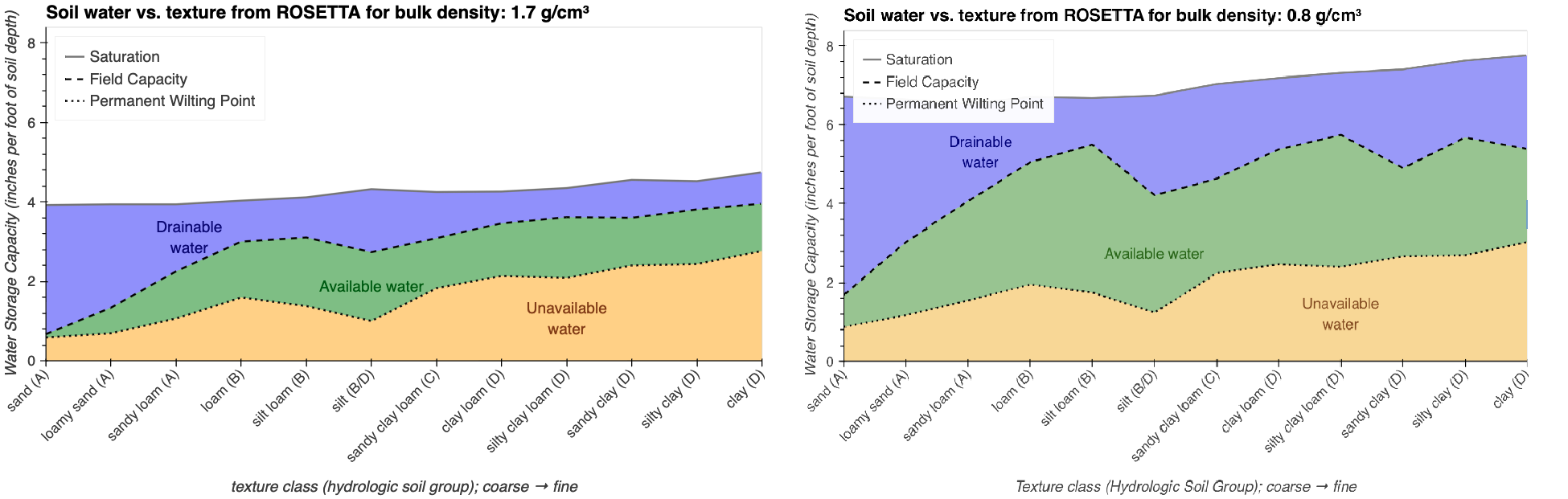
The below side-by-side images illustrate how the water storage capacity varies under different bulk density scenarios. Comparing the compacted scenario (left, bulk density of 1.7 g/cm3) to the uncompacted scenario (right, 0.8 g/cm3), we can see that one foot of soil profile can store three more inches more water. These images were made using Soil Health Impacts on Water Storage & Hydraulic Conductivity – Soil Health & Water Storage. This is an interactive tool that can be used to visualize the impact of changing bulk density and organic matter have on soil’s water storage capacity.
Healthy soils need soil architecture, biology, and proper management
Soil architecture is a fundamental concept to understand how healthy soils improve bulk density, porosity, water storage capacity, and the infiltration potential of a soil. Soil architecture is how primary soil particles (sand, silt, clay) aggregate. The aggregates create macropore spaces (i.e. cracks, root channels, spaces between granular aggregates) and connectivity for water and air to flow as illustrated in the below figure. Soil aggregates are also able to hold together when water hits them, so the soil is less prone to runoff, and has structural porosity to store water under saturated conditions. In short, a healthy soil with soil architecture consisting of soil aggregates will function like a sponge and absorb water (Brady & Weil, 1996; Orta-Ortiz & Geneletti 2022, Robinson et al. 2022, USDA 2009, Rawls et al. 2003).
[IMAGE PLACEHOLDER]
[IMAGE CAPTION] Plants, fungi, and microbes work interdependently to create soil aggregates which in turn allow for macropore formation and the enhanced ability for soil to infiltrate and store water. Image from Vanek, adapted from Fonte https://courses.ems.psu.edu/geog3/book/export/html/860.
Soil architecture and structure are created and maintained by diverse soil ecosystems of plant roots, fungi, microbes, and animals (Das et al. 2023, Lehmann et al. 2017). The infiltration and water storage capacity provided by healthy soils are therefore dynamic since they rely on the health of the associated biology. The dynamic nature of soil aggregates requires inputs of fresh organic matter from plant roots along with mycorrhizal fungi (and their glomalin) to maintain granular soil structure and macropores. Physical and chemical disturbance breaks down aggregates (Six et al. 2004). As such, improving soil health through management and vegetation practices improves soil architecture and the ability of the soil to infiltrate, store, and use water (Orta-Ortiz & Geneletti 2022, Robinson et al. 2022, USDA 2009, Rawls et al. 2003).
How to build soil health for stormwater management
Research points to four soil health restoration principles to reduce runoff and that multiple principles applied together substantially out-perform single practices. Once soil health is restored, natural processes of plant root growth and turnover can maintain the healthy soil architecture for reducing runoff, as long as new disturbances can be minimized. (Akpinar et al. 2023, Chen et al. 2014, Schwartz 2020)
- Decompact or aerate to reset soil, if necessary
- Increase soil organic matter
- Establish diverse, dense, and deep-rooted vegetation
- Minimize physical and chemical disturbance to maintain healthy soil
Principle 1. Decompact and aerate to reset soil
Compaction is one of the biggest constraints for soil health after construction or years of impact by lawnmowers and foot traffic. Compacted soils have low porosity, high bulk density, low infiltration and water storage capacity, inhibited root growth, and reduced microbial activity. Decompacting subsoil is crucial to soil restoration and vegetation establishment. Deep decompaction is more effective than shallow tillage as it supports and root growth and infiltration capacity. The rooting depth of many plant species is limited by the depth of soil moisture, and the above ground plant productivity is directly related to the root biomass. The impact of a compacted plow pan layer is shown in the below image.
[IMAGE PLACEHOLDER]
[IMAGE CAPTION] A cotton plant’s roots grow to avoid compacted topsoil from interrow traffic and following a deep decompaction channel created by a “subsoiler” plow through a compacted subsoil layer referred to as plow plan (Brady & Weil 1996; USDA National Tillage Machinery Laboratory).
When decompaction and aeration are correctly timed and applied, decompaction can reset an unhealthy soil by creating instant macropore channels for potential plant growth, incorporation of organic matter, and water infiltration.
Although deep-rooted plants can decompact moderately compacted soils over time, plant roots cannot penetrate heavily compacted soils. The limiting bulk densities for plant root growth is related to soil texture. Fine, cohesive soils (i.e. clay, silt) can fully limit plant root growth with bulk density values as low as 1.40 g/cm3, whereas in coarser textured soils (i.e. sand, sandy loam, sandy clay loam) some root penetration still can occur at 1.60 to 1.80 g/cm3 bulk densities (Daddow & Warrington 1983; NRCS 2008; Soil health indicator sheet - Soil compaction (bulk density)).
Subsoiling and plug core aeration have proven effective at improving infiltration. Aeration, used where soils have existing vegetative cover, was found in a study of golf courses to increase infiltration 25-188% after just one core removal event (Atkinson et al., 2012). Aeration with compost amendment decreased soil bulk density and increased water storage capacity (Logsdon & Sauer, 2017). Improvements from conducting aeration may not persist without additional practices, however.
Many studies find that deeper decompaction has an even greater benefit, especially when combined with compost addition which decreases bulk density and increases infiltration, soil organic matter, and rooting depth for lasting benefits (Chen et al. 2014; Olson et al. 2013, Rivers et al. 2021, Schwartz 2021, McDaniel et al. 2024). For example, a study of a pavement to turf conversion by Schwartz & Smith (2016) observed that subsoiling a loam subsoil to 18” with 3” of compost amendment had 14 times higher infiltration than standard topsoil treatment (3.3 in/h vs. 0.2 in/h) after 3 years, with the adjacent reference lawn that was never under pavement only infiltrating at 2.0 in/hr. In controlled study by Maryland DOT, the same authors found 8.7 in/hr infiltration rates after subsoiling down to 20”, adding 3” of compost blended into topsoil 9” deep, and planted with meadow vegetation, relative to 0.04 in/hr prior to treatment (Schwartz & Smith 2021, Schwartz 2021).
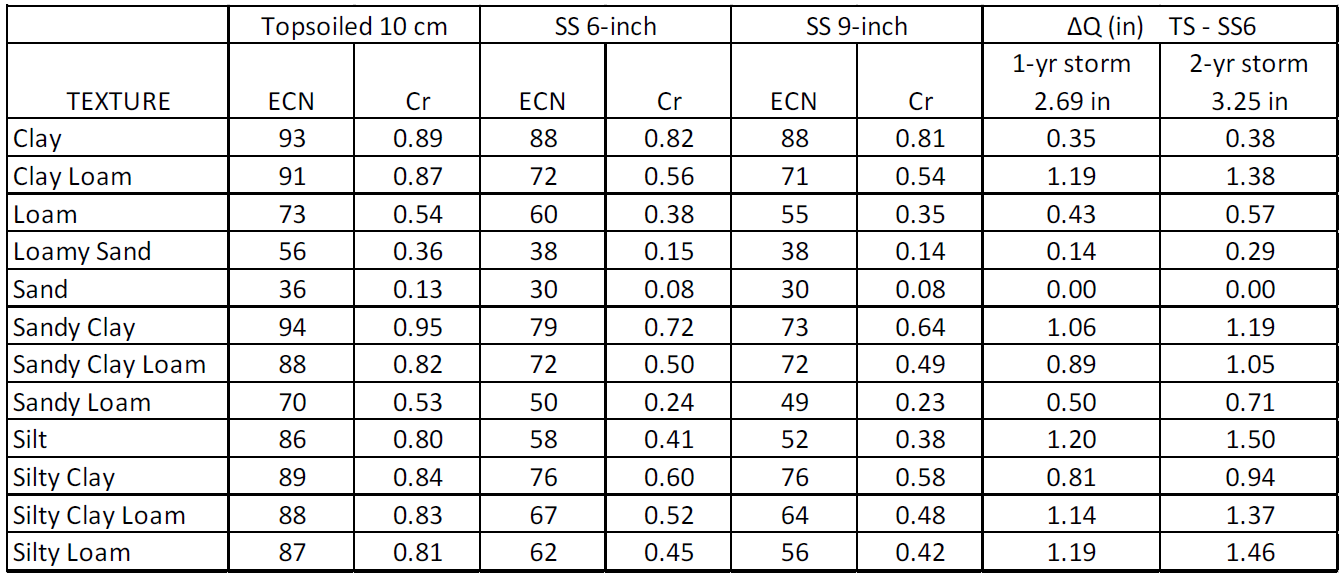
Schwartz (2021) estimated the difference in curve numbers (used in runoff modeling) due to implementing soil health practices after construction. This work applied a conservative approach, synthesizing observations from many studies in a modeling study. Schwartz estimated the effective curve number decreased by roughly 10-20 with subsoiling at 20” and 3” of compost mixed into the top 9” of soil, depending on the soil type, as shown in the below table. These changes in curve number resulted in runoff reductions of roughly 0.5” to 1.5” for a 3.25” design storm for most soil types.
The prevalence of supplementing decompaction treatments with compost and immediate seeding is due to findings that physically opened vertical channels will collapse and reseal in 1-2 years if organic matter and actively growing plant roots do not populate macropores to keep them open (Brady and Weil, 1996).
Principle 2: Increase soil organic matter
Soil organic matter refers to the decaying remains of plants and other life in soils. Soil organisms – such as bacteria, fungi, earthworms, and insects – continually consume organic matter, recycling nutrients for new plant growth. Soil organic matter also absorbs water and adds cation exchange capacity, increasing available water content and fertility for improved plant growth. Biochar is a special form of organic matter with exceptionally high surface area and cation exchange capacity that improves microbial activity and plant fertility despite being resistant to decay. In short, organic matter is the food source for soil microbes, and biochar functions as habitat.
Soil organic matter is the key ingredient to soil health. Increasing soil organic matter reduces bulk density, increases porosity, enhances infiltration and water retention, and helps build stable aggregates (Kranz et al. 2020). Specifically, as beneficial soil microbes feed on organic matter, they secrete substances that adhere soil particles into granular aggregates that are stable when wet and create macropores for the flow of water and air. High biodiversity of soil microbes and plants builds the most stable soil aggregates (Lehmann et al. 2017). Therefore, continuous fresh inputs of soil organic matter provided by continuous decay of plant leaves and roots is required for soil to resist erosion, infiltrate water, and store stormwater.
Amendments of compost and/or biochar have been extensively studied in urban and residential settings. Research has shown that compost amendments lead to substantial improvements to stormwater outcomes, such as increasing infiltration, hydraulic conductivity, and water storage capacity (Kranz et al. 2020). Studies of compost combined with decompaction show the greatest positive response for soil hydraulic properties, including 6-11-fold increase in subsurface hydraulic conductivity (Chen et al., 2014), and greater than 10-fold increase in infiltration (Schwartz & Smith, 2020). Even the lowest measured responses showed an 18% increase in infiltration (Martens and Frankenberger 1992). The most effective way to get soil to retain added compost is by incorporating it into the topsoil during construction (Chen et al. 2014, Schwartz 2020) or immediately following deep plug aeration in existing turf, meadow, or prairie.
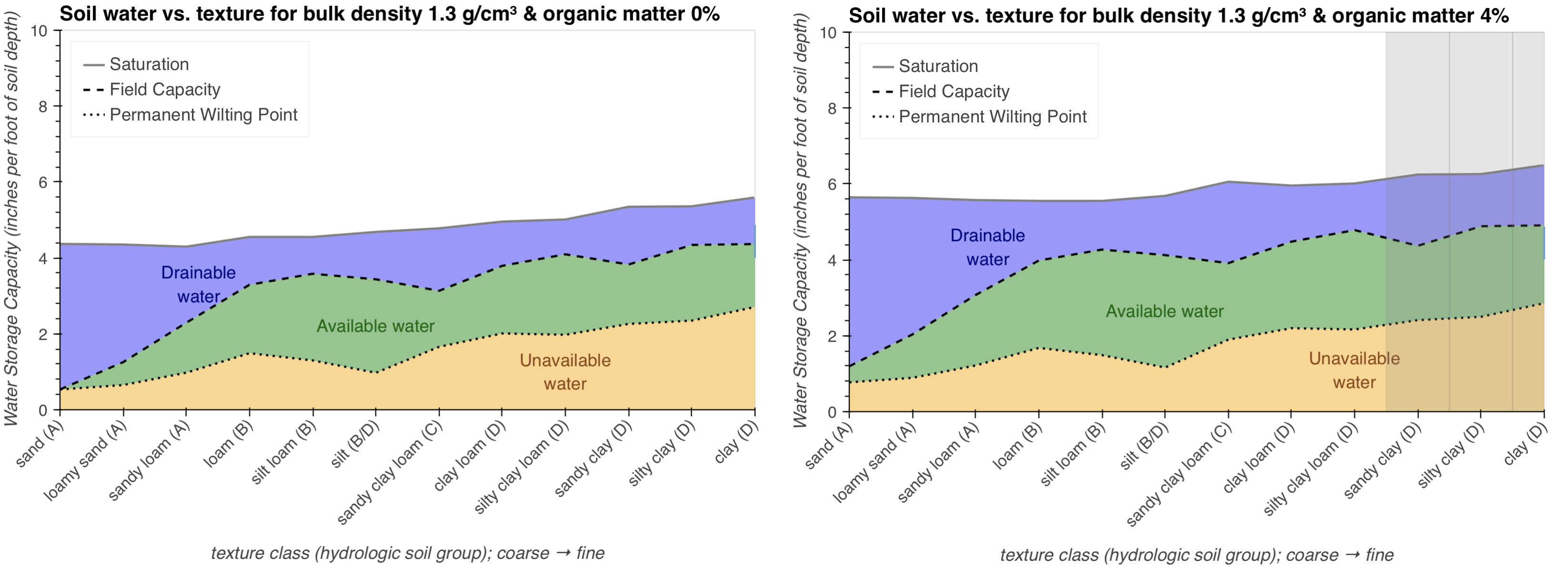
Organic matter also increases long-term water storage between storms. For example, an increase from 1% organic matter content to 5% increases plant available water content by 0.9 inches for a 6-inch deep silt loam topsoil held at the same bulk density (Hudson 1994, Iowa Stormwater Management Manual (ISWMM) Chapter 5 Section 6). This has a direct benefit on establishing vegetation (next section). The below figure illustrates how changes in organic matter alone increase the water storage capacity of soil.
The following images were made using Soil Health Impacts on Water Storage & Hydraulic Conductivity – Soil Health & Water Storage. This is an interactive tool that can be used to visualize the impact of changing bulk density and organic matter have on soil’s water storage capacity.
Principle 3: Establish diverse, dense, and deep-rooted vegetation
Diverse, dense, and deep-rooted vegetation maintains a healthy soil. Plant root growth and turnover adds fresh organic matter, feeds the soil microbiome, and creates macropores to store and transmit air and water.
Literature provides repeated evidence that greater plant diversity and biological complexity improve infiltration and soil function. Increasing plant diversity was shown to increase infiltration, even in minimally-disrupted, human-trampled soils (Su et al., 2018). Making sure the plants have a dense arrangement of shoots also improves infiltration (Easton & Petro.vic 2004).
Replacing turf with prairie plants has been shown to improve infiltration substantially (Alshraah et al., 2024; Logson et al., 2017; Selbig & Balster, 2010). For example, a USGS experimental field study in Madison, WI compared rain garden infiltration basins planted in turf versus a diverse prairie (Selbig & Balster, 2010). For identical clay-rich soils, median infiltration rates for prairie were 0.88 inches per hour vs 0.28 in/h for turf. For identical sand-rich soils, the prairie’s median was 4.2 in/h vs 2.5 in/h for turf. Furthermore, in both soil types, the prairie rain gardens showed increasing infiltration rates. Over four years, the sandy rain garden’s infiltration rate increased from about 2” to 10”, and the clayey rain garden’s infiltration increased from about 0.6” to 1” per hour.“
Increasing plant diversity in existing lawn, prairie, and forested contexts has also been shown to improve infiltration (Orta-Ortiz & Geneletti 2022; Robinson et al 2022). Multiple species in a multi-layered, diverse canopy forest had higher infiltration (4.3 in/hr) than forest with grass (3.14 in/hr) or bare soil (2.0 in/hr) (Wang et al. 2018).
Combining other practices shows compounding benefits. Adding compost with vegetation improves infiltration and provides nutrients for the vegetation (Alshraah et al. 2024, Islam et al. 2024).
Principle 4: Minimize physical and chemical disturbance to maintain healthy soil
When human caused physical and chemical disturbances are minimized, natural ecosystems can maintain healthy soils. Once a soil restoration effort begins, additional disturbances should be limited to protect the restoration progress. Soil compaction from machinery or even heavy foot traffic should be limited. Plant diversity should be maintained to protect microbial communities. Topsoil should be protected, and chemical use should be limited as it can kill or impair soil biological communities.
Physical disruption of digging and movement of earth for construction vastly degrades soil. Compaction reduces infiltration by orders of magnitude because it increases bulk density, structural porosity, and macropores (Das et al. 2023). In addition to compaction, other construction disturbances include removing the topsoil, usually to store on site for later replacement. This results in compaction, loss of organic matter, and degradation of soil structure (Chen et al. 2013).
Chemical disturbances also decrease the stability of soil aggregates and thus decrease infiltration and water storage in soils. Many chemicals that are intended to kill weeds or pests may harm microbial and fungal activity (Zaller et al. 2014). Chemicals such as herbicides have been shown to decrease population diversity, quantity, or activity of soil organisms, including bacteria, archaea, earthworms, and arbuscular mycorrhizal fungi (Bueno de Mesquita et al., 2023; van Bruggen et al., 2021; Zaller et al., 2014). These soil organisms are essential for the formation of stable soil aggregates (A. Lehmann et al., 2017; J. Lehmann et al., 2007; Tisdall and Oades, 1982; Yudina & Kuzyakov, 2023), which hold together when wetted and thus resist erosion and act as a sponge in the soil (Robinson et al. 2022, Six et al., 2004). As such, chemical disruption decreases the organisms that form soil aggregates, and likely also impact infiltration and storage of water in soils. In addition, restoring healthy soils makes these inputs largely unnecessary.
Conclusion: Adaptive Management using Multiple Principles
Restoring soil health in residential, urban, construction, and other developed settings has the potential to dramatically reduce runoff. Research shows that it is possible to increase infiltration rates by several inches per hour even for clay-rich soils (Robinson, 2022). Soil health restoration enables practitioners to manage stormwater on all green spaces, where it lands, reducing what is conveyed to downstream infrastructure. Soil health practices can contribute to climate resiliency both in the ability of healthy soil to better manage stormwater during more intense rain events as well as preserve water in the root zone for plants during periods of drought.
The scientific literature shows that there is not a one-size fits all approach to improving and managing soil health, nor will a one and done approach be as successful as a multi-year and multi-practice approach. Soil context and history matters. The most successful soil restoration projects consider the context and are adaptive, working in cycles that involve testing or monitoring, applying practices, and evaluating progress toward desired outcomes.
Adaptive management is an approach to environmental resource management that focuses on optimizing measurable outcomes through iterative cycles of monitoring and decision-making based on results. Adaptive management approaches have proven to be highly effective when feedback between monitoring and management decisions are clear, and data collection and analysis steps are easily completed. In the context of soil health practices, an adaptive management approach serves as a framework for efficiently selecting which practices to prioritize (and which may be excluded) for a given site, rapidly measuring the response in a following year, and deciding which practices to apply the following year, if any. The goal is to maximize outcomes for the minimum effort and cost.
Fortunately, four principles of soil health management have proven effective at reducing stormwater runoff over a wide range of contexts. Also, implementing multiple practices simultaneously is most effective, due to synergies in the underlying processes that build soil health. For example, a combination of decompaction followed by adding compost and planting diverse vegetation is a successful method to rebuild soil structure regardless of soil texture. Last, focusing on a desired outcome (i.e. increasing infiltration) will simplify the approach and provide clear metrics of success, which ultimately reduces effort and cost.