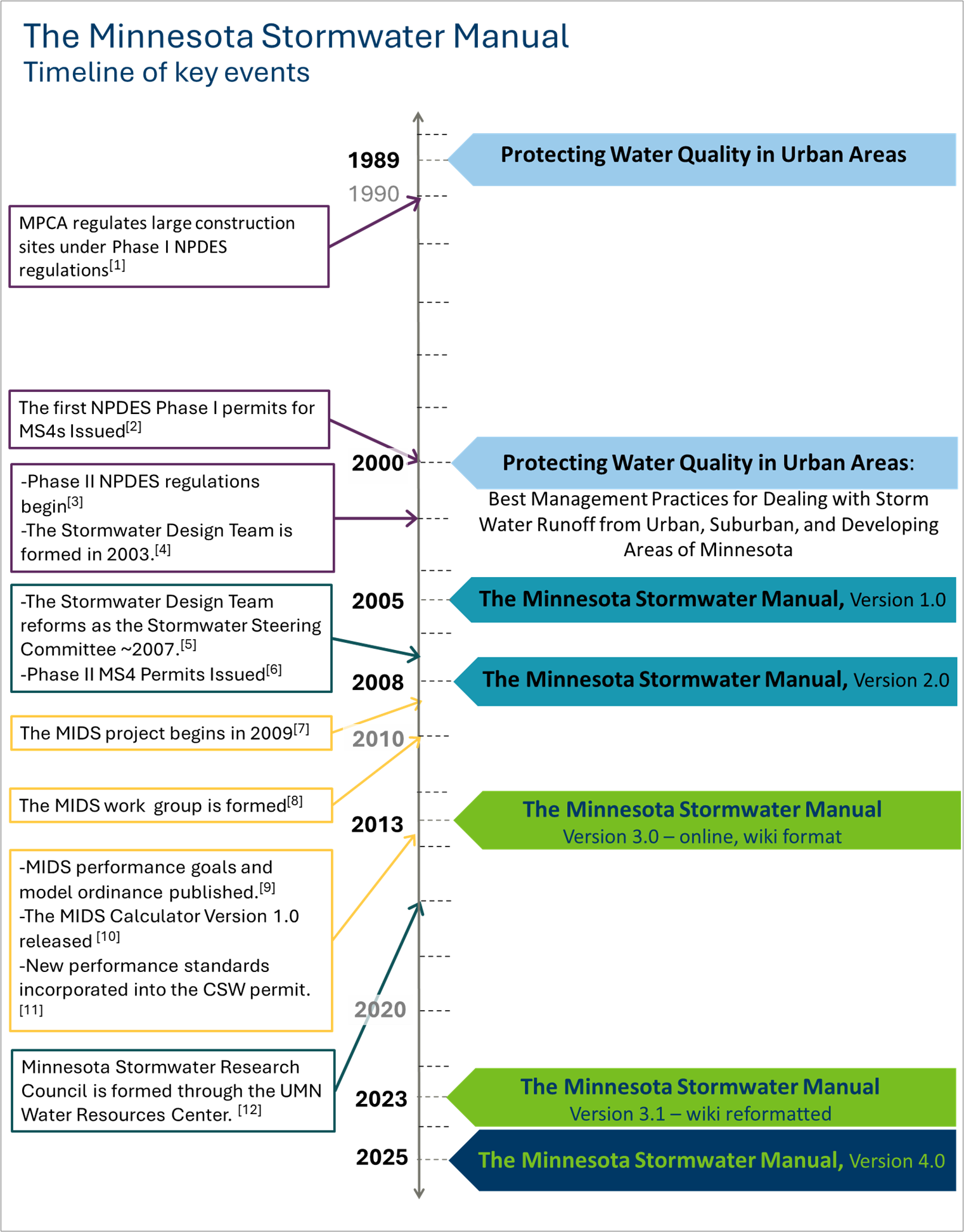
The Manual has changed a lot over the years in response to state and federal legislation, stormwater management research, new stormwater technologies, and a growing demand for guidance for stormwater permittees and practitioners. Key milestones and events from the Manual timeline are summarized below.
The Minnesota Pollution Control Agency (MPCA) first published stormwater management guidance in 1989 around the time that the MPCA began regulating large construction sites under the National Pollutant Discharge Elimination System (NPDES) phase I federal regulations. This important predecessor to the Minnesota Stormwater Manual, Protecting Water Quality in Urban Areas, contained guidance on stormwater best management practices for local government officials, urban planners, developers, contractors, and citizens.
The original, print version of the Minnesota Stormwater Manual was initiated by the Minnesota Stormwater Design Team in 2003 when NPDES phase II regulations were enacted, and first published in 2005. The project was overseen by the Stormwater Steering Committee (SSC), a successor to the Minnesota Stormwater Design Team. The SSC's manual sub-committee continued to provide input until 2011. The Minimal Impact Design Standards (MIDS) work group provided input between 2010 and 2012. The MIDS workgroup and SSC completed their work between 2012 and 2013. In 2012 and 2013, the Manual was converted to an electronic format using MediaWiki, an online publishing platform. With this change, the manual became a 'living document' that could be updated regularly in response to new information, legislation, etc. In 2025, the electronic version was transferred to Drupal, an online content management system. This new platform provides improved capacity to meet accessibility standards and consistency with other MPCA websites. A listing of contributors and participants appears in the Acknowledgements section.
Notes on the timeline:
- MPCA began regulating large construction sites (≥50-acres disturbed) under NPDES phase I regulations.
- The first individual MS4 permits were issued to the cities of Minneapolis and St. Paul under NPDES phase I regulations.
- Under NPDES phase II legislation, MPCA begins regulating smaller construction sites (≥1-acres disturbed).
- The Minnesota Stormwater Design Team was initiated by MPCA. The Design Team include a multi-sector group of stormwater professionals who provide input and oversight in the development of stormwater management guidance and standards for Minnesota, including the Minnesota Stormwater Manual.
- The Minnesota Design Teams is reformed as the Stormwater Steering Committee and a sub-committee is formed to oversee production of the Minnesota Stormwater Manual.
- MPCA issues the first MS4 permits for small cities (population ≤50,000) in Minnesota under NPDES Phase II regulations.
-
The Minimal Impact Design Standards (MIDS) project begins when the Minnesota Legislature directs MPCA to develop stormwater performance standards under Minnesota Statute 115.03, subdivision 5c, paragraph c. This statute reads:
The agency shall develop performance standards, design standards, or other tools to enable and promote the implementation of low impact development and other storm water management techniques. For the purposes of this section, "low impact development" means an approach to storm water management that mimics a site's natural hydrology as the landscape is developed. Using the low impact development approach, storm water is managed on site and the rate and volume of predevelopment storm water reaching receiving waters is unchanged. The calculation of predevelopment hydrology is based on native soil and vegetation.
- The MIDS workgroup is formed in response to the legislative directive to develop stormwater performance standards.
- The MIDS project is completed. Key products include a model stormwater management ordinance for MS4 with stormwater performance standards for new development, re-development, and linear projects.
- The MIDS calculator, version 1.0 is released to support compliance with MIDS performance standards.
- The Construction Stormwater General permit is reissued with new performance standards and flexible treatment options based on MIDS.
- The Minnesota Stormwater Research Council (MSRC) is formed through the University of Minnesota Water Resources Center to support continued research in the field of stormwater including practical issued faced by stormwater managers and designers. MPCA has had standing seat on the council advisory board and partners with the MSRC on various education and outreach efforts.