Green Infrastructure: Trees can be an important tool for retention and detention of stormwater runoff. Trees provide additional benefits, including cleaner air, reduction of heat island effects, carbon sequestration, reduced noise pollution, reduced pavement maintenance needs, and cooler cars in shaded parking lots.
Practices incorporating trees into the design are often a specific type of bioretention practice. This page provides an overview of tree-based practices. Also see Overview for bioretention.
Contents
- Function within stormwater treatment train
- MPCA permit applicability
- Retrofit suitability
- Special receiving waters suitability
- Water quantity treatment
- Water quality treatment
- Non-stormwater benefits of trees
- Constraints on the use of trees
- References
- Related pages
Function within stormwater treatment train
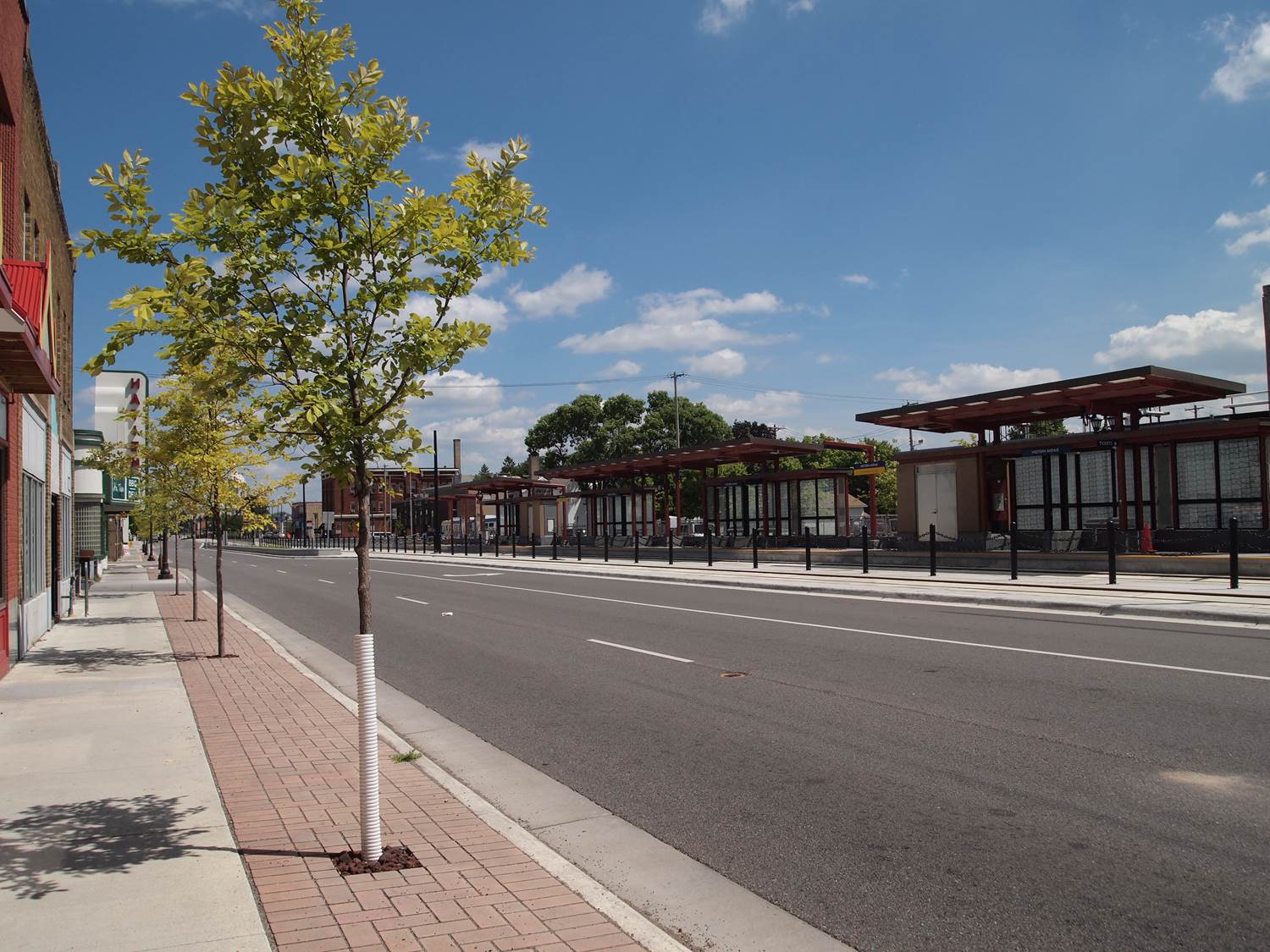
Use of trees to manage stormwater runoff encompasses several practices. Tree trenches and tree boxes (collectively called tree best management practice (BMPs)), the most commonly implemented tree BMPs, can be incorporated anywhere in the treatment train but are most often located in upland areas of the treatment train. The strategic distribution of tree BMPs help control runoff close to the source where it is generated. Tree BMPs can mimic certain physical, chemical, and biological processes that occur in the natural environment. Depending upon the design of a facility, different processes can be maximized or minimized depending on the type of pollutant loading expected (Prince George’s County, 2002). As with any filtration and infiltration BMPs, pretreatment is recommended to prevent clogging of the media, particularly when permeable pavement is used in conjunction with the tree BMP.
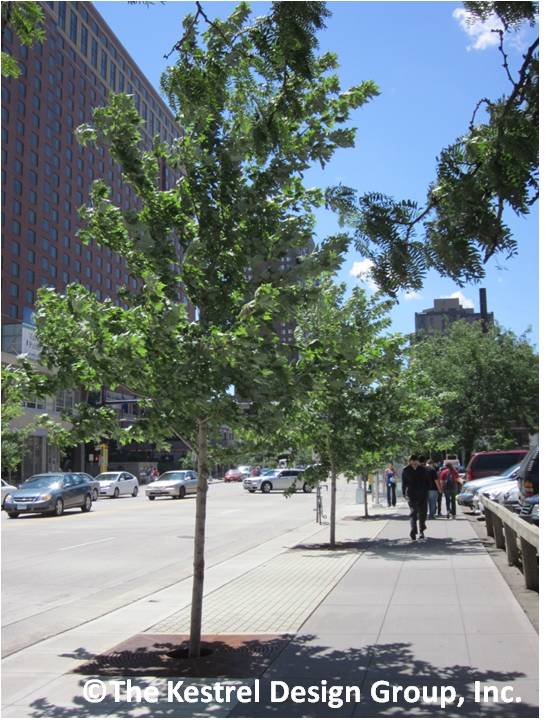
Tree BMPs are one component of urban forestry. Urban forestry is a broad term that applies to all publicly and privately owned trees within an urban area, including individual trees along streets and in backyards, as well as stands of remnant forest (Nowak et al., 2001). Urban forests are an integral part of community ecosystems, whose numerous elements (such as people, animals, buildings, infrastructure, water, and air) interact to significantly affect the quality of urban life. (Nowak et al., 2010 Sustaining America’s Urban Trees and Forests). Trees are already part of virtually all development and can be integrated anywhere in the treatment train, even into the densest urban areas. Many cities already have tree requirement ordinances. However, the potential of these trees to provide significant stormwater benefits is largely untapped to date.
For more information on urban forestry, we suggest visiting the following websites.
- Urban and Community Forestry - USDA Forest Service
- Urban Forestry & Ecosystem Management - City of Philadelphia
- Watershed Forestry Resource Guide - Center for Watershed Protection and US Forest Service - Northeastern Area State & Private Forestry
- American Forests
- Urban Forestry - Virginia Tech University
- Stormwater to Street Trees: Engineering Urban Forests for Stormwater Management - U.S. EPA
MPCA permit applicability
One of the goals of this Manual is to facilitate understanding of and compliance with the MPCA Construction Stormwater (CSW) General Permit, which includes design and performance standards for permanent stormwater management systems. Standards for various categories of stormwater management practices must be applied in all projects in which at least one acre of new impervious area is being created.
For regulatory purposes, tree BMPs with no underdrain are infiltration systems as described in the CSW Permit. Tree BMPs with an underdrain are filtration systems as defined in the permit. If used in combination with other practices, credit for combined stormwater treatment can be given. Due to the statewide prevalence of the MPCA permit, design guidance in this section is presented with the assumption that the permit does apply. Also, although it is expected that in many cases tree BMPs will be used in combination with other practices, standards are described for the case in which it is a stand-alone practice.
There are situations, particularly retrofit projects, in which a tree BMP is constructed without being subject to the conditions of the MPCA permit. While compliance with the permit is not required in these cases, the standards it establishes can provide valuable design guidance to the user. It is also important to note that additional and potentially more stringent design requirements may apply for a particular tree BMP, depending on where it is situated both jurisdictionally and within the surrounding landscape.
Retrofit suitability
Tree BMPs are an ideal and potentially important BMP in urban retrofit situations where existing stormwater treatment is absent or limited. Tree BMPs can be utilized in highly urban and ultra-urban environments.
Special receiving waters suitability
The following table provides guidance regarding the use of tree BMPs in areas upstream of special receiving waters.
Water quantity treatment
Trees with underdrains are not typically suitable for providing water quantity control. In limited cases, a tree filtration practice may provide some (albeit limited) storage volume. Tree BMPs can help reduce detention requirements for a site by providing elongated flow paths, longer times of concentration, and volumetric losses from infiltration and evapotranspiration. Experience and modeling analysis have shown that tree BMPs can be used to reduce runoff and maintain the pre-existing time of concentration. This effort can be incorporated into the site hydrologic analysis. Generally, however, it is Highly Recommended that in order to meet site water quantity or peak discharge criteria, another structural control (e.g. detention) be used in conjunction with tree BMPs.
Depending on sizing and design, tree infiltration practices can retain significant volumes of water.
Water quality treatment
Tree BMPs that utilize engineered media provide water quality benefits through the same mechanisms as standard bioretention systems. The soil, trees, and microbes in a bioretention system with trees work together as a system to improve water quality of stormwater that falls on the tree and/or is filtered through the soil volume. Some pollutants are adsorbed or filtered by soil, others are taken up or transformed by plants or microbes, and still others are first held by soil and then taken up by vegetation or degraded by bacteria, “recharging” the soil’s sorption capacity in between rain events.
| Pollutant | Bioretention cleansing mechanism |
|---|---|
| Total suspended solids | Sedimentation and filtration (e.g. Davis et al., 2009) |
| Metals | Filtration of particulate metals, sorption of dissolved metals into mulch layer (e.g. Davis et al, 2009), plant uptake (e.g. Toronto and Region Conservation, 2009) |
| Nitrogen | Sorption; uptake by microbes and plant material, uptake into recalcitrant soil organic matter (e.g. Henderson, 2008) |
| Phosphorus | Sorption, precipitation, plant uptake, uptake into recalcitrant soil organic matter (e.g. Henderson, 2008) |
| Pathogens | Filtration, UV light, competition for limited nutrients, predation by protozoa and bacterial predators (e.g. Zhang et al., 2010) |
| Hydrocarbons | Filtration and sorption to organic matter and humic acids, then degraded by soil microbes (e.g. Hong et al., 2006) |
Several recent literature reviews of lab and field studies concluded that tree BMPs have the potential to be one of the most effective BMPs for pollutant removal. High load reductions are consistently found for suspended solids, metals, polycyclic aromatic hydrocarbons (PAHs), and other organic compounds. Nutrient (dissolved nitrogen and phosphorus) removal has been more variable. Healthy vegetation has been found to be especially crucial for removal of dissolved nitrogen and phosphorus, hence the importance of large trees. Several studies that have compared vegetated media to unvegetated media have found that the presence of vegetation substantially improves total phosphorus (TP) and total nitrogen (TN) retention, as vegetated media is much more effective than unvegetated media at removing phosphate (PO4) from solution and preventing nitrate (NO3) leaching from media (e.g. Henderson, 2008, Lucas and Greenway, 2007a, 2007b, 2008, May et al., 2006). Not only has vegetation been shown to significantly improve nutrient removal, trees also benefit from the nutrients in stormwater (May et al., 2006), with greater growth in height and greater root density compared with those irrigated with tap water, turning stormwater nutrients into an asset.
For a summary of these literature reviews see File:Trees Tasks 2 and 13 Water quality benefits.docx.
Information on pollutant removal is provided in the following table.
Non-stormwater benefits of trees
In addition to stormwater management, trees provide a host of other benefits including other environmental benefits, energy savings, social and health benefits, wildlife benefits, and economic benefits. For more detailed information on these, see File:Trees Task 2 Overview.docx
Environmental benefits include
- cleaner air;
- reduction of heat island effect;
- carbon sequestration;
- reduced noise pollution;
- reduced pavement maintenance needs; and
- cooler cars in shaded parking lots.
Strategically placed trees can reduce building and heating energy use. Examples include the following.
- Trees properly placed around buildings as windbreaks can reduce winter heating costs.
- Shade from two large trees on the west side of a house and one on the east side can save on annual air conditioning costs.
Trees have a wide range of social benefits, including
- reduced stress of both body and mind in urban areas (Parsons et al., 1998; USDA Forest Service, 2004);
- improved outdoor leisure and recreation experiences (Dwyer et al., 1989; USDA Forest Service 2004) ;
- reduced crime (Kuo and Sullivan, 2001; USDA Forest Service 2004);
- improved recovery from surgery (Ulrich 1984 and Ulrich, 1985; USDA Forest Service, 2004);
- improved ability of automobile drivers to cope with driving stresses (Wolf, 2000; USDA Forest Service, 2004); and
- improved safety on streets (Wolf, 2010)
Monetary benefits as ecosystem services significantly outweighs the cost of utilizing trees in an urban setting. McPherson et al. (2005) observed Minneapolis’s municipal tree resource provides approximately 79 dollars per tree in total net annual benefits to the community. Examples of other economic benefits include the following.
- Shoppers in well-landscaped business districts are willing to pay more for parking and up to 12 percent more for goods and services (Wolf, 1999; USDA Forest Service, 2004).
- Landscaping, especially with trees, can significantly increase property values (Neely 1988 in USDA Forest Service 2004).
- Desk workers with and without views of nature were surveyed. Those without views of nature, when asked about 11 different ailments, claimed 23 percent more incidence of illness in the prior 6 months (Kaplan and Kaplan 1989 in USDA Forest Service 2004).
- Amenity and comfort ratings were about 80 percent higher for a tree-lined sidewalk compared with those for a nonshaded street (Wolf, 1998; USDA Forest Service, 2004).
- Quality of products ratings were 30% higher in districts having trees over those with barren sidewalks (Wolf, 1998; USDA Forest Service, 2004).
Trees also benefit wildlife. For example Talamy and Darke (2007) observed that the Oaks genus supports 534 species of Lepidoptera (a large order of insects that includes moths and butterflies) as well as many bird species.
The following table summarizes some additional benefits for select tree species.
| Scientific name1,2,3 | Common name 1,2,3 | Additional benefit (F=human food, W=wildlife habitat/browse, L=lumber)3 |
|---|---|---|
| Acer saccharinum 1,2 | Silver maple | FWL |
| Amelanchier spp. 2 | Juneberry/serviceberry | FW |
| Betula populifolia 2 | Gray birch | W |
| Carya ovata 2 | Shagbark hickory | FWL |
| Catalpa speciosa 2 | Northern catalpa | WL |
| Celtis occidentalis 2 | Common hackberry | W |
| Cercis canadensis 2 | Eastern redbud | W |
| Cladrastis kentukea 2 | Yellowood, Kentucky yellowood | L |
| Crataegus crus-galli var. inermis 2 | Thornless cockspur hawthorn | W |
| Fraxinus americana 2 | White ash | WL |
| Fraxinus mandschurica | Manchurian ash | WL |
| Fraxinus nigra 1 | Black ash | WL |
| Fraxinus pennsylvanica 1,2 | Green ash | WL |
| Gleditsia tricanthos var. inermis 2 | Thornless common honeylocust | WL |
| Gymnocladus dioicus 2 | Kentucky coffeetree | WL |
| Larix decidua 3 | European larch | L |
| Larix laricina 1 | Tamarack | L |
| Malus spp. 2 | Crabapple spp. | FW |
| Ostrya virginiana 2 | American hophornbeam, ironwood | W |
| Populus grandidentata Michx. | Bigtooth aspen | WL |
| Populus deltoides 1,2 | Eastern cottonwood | L |
| Populus tremuloides 1,1 | Quaking aspen | L |
| Prunus virginiana 2 | Chokecherry | FW |
| Quercus bicolor 2 | Swamp white oak | WL |
| Quercus macrocarpa 2 | Bur oak | WL |
| Quercus rubra 2 | Red oak | WL |
| Robinia pseudoacacia 2 | Black locust, false acacia, robinia | L |
| Salix babylonica | Weeping or Babylon willow | L |
| Taxodium distichum 2 | Common baldcypress | L |
| Tilia americana 2 | Basswood | WL |
| 1 Shaw, D. and R. Schmidt. 2003. Plants for Stormwater Design: Species Selection for the Upper Midwest. Minnesota Pollution Control Agency (MPCA) 2 Bassuk, N. et al. 2009. Recommended Urban Trees: Site Assessment and Tree Selection for Stress Tolerance. Urban Horticulture Institute, Dept of Horticulture, Cornell University, Ithaca, NY 3 USDA NRCS Plants Database. |
||
Constraints on the use of trees
Potential constraints on the use of urban trees for stormwater management include:
- above ground space limitations such as utilities, lighting, signs, structures;
- below ground space limitations such as structures, pavement, existing trees, and utilities;
- regulations regarding types and locations of trees planted along public streets and right of ways, such as, for example, minimum sight distances and setbacks from street corners; and
- the need to locate trees outside of snow plow paths and snow storage areas.
While engineers often worry that tree roots will affect underdrains, inspections of underdrains in hundreds of bioretention practices by North Carolina State Engineers did not find roots clogging underdrains (Winston, 2013).
Tree performance can be adversely affected by a variety of factors, including
- salt (soil salt and salt spray exposure);
- high temperatures, particularly in urban areas due to heat island effects or reflected heat from adjacent buildings;
- vehicle exhaust;
- drought tolerance;
- exposure to frequent inundation;
- atmospheric pollution;
- physical damage from vandalism, mowers, and other maintenance;
- droughty conditions in between rain events, particularly if sandy soils are used; and
- tree bioretention areas that are used for snow storage due to compaction from the snow as well as salt from the snow.
According to Coder (2007), by far the most important factor to grow healthy trees is to provide an adequate volume of rootable soil (i.e. not compacted to a level that affects root growth). The top three factors causing the greatest growth limitations for tree growth are soil water availability, soil aeration, and soil drainage. Each of these can be related to site compaction.
Research has shown that trees need 2 cubic feet of rootable soil volume per square foot of tree canopy to thrive (e.g. Lindsey and Bassuk, 1991). Most urban trees, confined to a 4 foot by 4 foot (i.e. 64 cubic feet if assumed to be 4 feet deep) tree pit hole, have less than 1/10th the rooting volume they need to thrive. To provide 2 cubic feet of rootable soil to allow a tree with a 30 foot canopy to thrive would require 1413 cubic feet of rootable soil. Not surprisingly, studies have found that trees surrounded by pavement in urban downtown centers only live for an average of 13 years (Skiera and Moll, 1992), a very small fraction of their much longer lifespan under natural conditions.
References
This list contains many references not cited on this page. A review of many of these articles can be found in File:Trees Task 2 Overview.docx.
- Breen, P., L. Denman, P. May, and S. Leinster. 2004. Street trees as stormwater treatment measures. In 2004 International Conference on Water Sensitive Urban Design – Cities as catchments 21-25 November 2004. Adelaide.
- Coder, Kim. 2007. Soil Compaction Stress and Trees: Symptoms, Measures, and Treatments. Warnell School Outreach Monograph WSFNR07-9.
- Davis, A.P, W.F. Hunt, G.R. Traver, M. Clar. 2009. Bioretention Technology: Overview of Current Practice and Future Needs. J. Environ. Eng-ASCE. 135(3): 109-117.
- Denman, Liz. 2006. Are Street Trees And Their Soils An Effective Stormwater Treatment Measure?. The 7th National Street Tree Symposium.
- Denman, Elizabeth C., Peter B. May, and Gregory M. Moore. 2011. The use of trees in urban stormwater Management. Trees, people and the built environment. Proceedings of the Urban Trees Research Conference. 13–14 April 2011. Hosted by The Institute of Chartered Foresters At The Clarendon Suites, Edgbaston, Birmingham, UK. Edited by Mark Johnston and Glynn Percival. Forestry Commission: Edinburgh.
- Dwyer, John F., Schroeder, Herbert W., Louviere, Jordan J., and Anderson, Donald H. 1989. Urbanities (sic) Willingness to Pay for Trees and Forests in Recreation Areas. Journal of Arboriculture 15(10).
- Dwyer, J. F., Schroeder, H.W., and Gobster, P. H. 1991. The Significance of Urban Trees and Forests: Toward a Deeper Understanding of Values. Journal of Arboriculture 17(10).
- Heisler, G.M. 1986. Energy Savings With Trees. Journal of Arboriculture. 12.
- Heisler, Gordon M. 1990. Tree plantings that save energy. In: Rodbell, Philip D., ed. Proceedings of the Fourth Urban Forestry Conference; 1989 October 15-19; St. Louis, MO.Washington, DC: American Forestry Association.
- Henderson, C.F.K. 2008. The Chemical and Biological Mechanisms of Nutrient Removal from Stormwater in Bioretention Systems. Thesis. Griffith School of Engineering, Griffith University.
- Hong, E., E.A. Seagren, A.P. Davis. 2006. Sustainable Oil and Grease Removal from Synthetic Stormwater Runoff Using Bench-Scale Bioretention Studies. Water Environ. Res. 78 (2), 141-155.
- Kaplan, R., and Kaplan, S. 1989. The Experience of Nature: A Psychological Perspective. Cambridge, MA: Cambridge University Press.
- Kuo, F., and Sullivan, W. 2001. Environment and Crime in the Inner City: Does Vegetation Reduce Crime? Environment and Behavior 33(3).
- Lenth, John and Rebecca Dugopolski (Herrera Environmental Consultants), Marcus Quigley, Aaron Poresky, and Marc Leisenring (Geosyntec Consultants). 2010. Filterra® Bioretention Systems: Technical Basis for High Flow Rate Treatment and Evaluation of Stormwater Quality Performance. Prepared for Americast, Inc.
- Lindsey, P., and N. Bassuk. 1991. Specifying Soil Volumes to Meet the Water Needs of Mature Urban Street Trees and Trees in Containers. Journal of Arboriculture 17(6): 141-149.
- Luley, Christopher J., and David J. Nowak. 2004. Help Clear the Smog with Your Urban Forest: What You and Your Urban Forest Can Do About Ozone. Brochure. Davey Research Group and USDA Forest Service, Northeastern Research Station.
- McPherson, E.G. 2001. Sacramento's Parking Lot Shading Ordinance: Environmental and Economic Costs of Compliance. Landscape and Urban Planning 57:105-123.
- McPherson, E.G., and Simpson, J.R. 2003. Potential Energy Savings in Buildings by an Urban Tree Planting Program in California. Urban Forestry and Urban Greening 2(2003):73-86.
- McPherson, E. G., and J. Muchnick. 2005. Effects of Street Tree Shade on Asphalt Concrete Pavement Performance. Journal of Arboriculture 31:6:303-309.
- Neely, D., ed. 1988. Valuation of Landscape Trees, Shrubs, and Other Plants. 7th ed. Council of Tree and Landscape Appraisers. International Society of Arboriculture.
- Nowak, D., Crane, D., and Stevens, J. 2003. Draft Plan. Philadelphia’s Urban Forest, Urban Forest Effects Model (UFORE) Analysis. Newtown Square, PA: USDA Forest Service, Northeastern Research Station.
- Nowak, David J., Stein, Susan M., Randler, Paula B., Greenfield, Eric J., Comas, Sara J., Carr, Mary A., and Alig, Ralph J. 2010. Sustaining America’s urban trees and forests: a Forests on the Edge report. Gen. Tech. Rep. NRS-62. Newtown Square, PA: U.S. Department of Agriculture, Forest Service, Northern Research Station. 27 p.
- Parsons, R., Tassinary, L.G., Ulrich, R.S., Hebl, M.R., and Grossman-Alexander, M. 1998. The View From the Road: Implications for Stress Recovery and Immunization. Journal of Environmental Psychology 18(2):113-139.
- Scott, Klaus I., Simpson, James R., and McPherson, E. Gregory. 1999. Effects of Tree Cover on Parking Lot Microclimate and Vehicle Emissions. Journal of Arboriculture 25(3).
- Simpson, J.R., and McPherson, E.G. 1996. Potential of Tree Shade for Reducing Residential Energy use in California. Journal of Arboriculture 22(1):10-18..
- Tallamy, Douglas W., and Rick Darke. 2007. Bringing Nature Home: How You Can Sustain Wildlife with Native Plants. Timber Press.
- Taylor, A.F.; Kuo, F., and Sullivan,W. 2001. Coping with ADD: The Surprising Connection to Green Play Settings. Environment and Behavior 33(1):54-77.
- Taylor, Andrea Faber, Kuo, Frances E., and Sullivan, William C. 2002. Views of Nature and Self-Discipline: Evidence from Inner City Children. Journal of Environmental Psychology 22(1-2):1-15.
- The National Arbor Day Foundation. 2004. The value of trees to a community.
- Toronto and Region Conservation. 2009. Review of the Science and Practice of Stormwater Infiltration in Cold Climates. 2009.
- Ulrich, R. 1984. View through Window May Influence Recovery from Surgery. Science 224:420-422.
- Ulrich, R.S. 1985. Human Responses to Vegetation and Landscapes. Landscape and Urban Planning 13:29-44.
- USDA Forest Service. The Value of Trees. Urban and Community Forestry Appreciation Tool Kit NA-IN-02-04.
- Wolf, K.L. 2010. Safe Streets - A Literature Review. In: Green Cities: Good Health. College of the Environment, University of Washington.
- Wolf, Kathy L. 2000. The Calming Effect of Green: Roadside Landscape and Driver Stress. Factsheet #8. Seattle: University of Washington, Center for Urban Horticulture.
- Wolf, K. L. 1999. Nature and Commerce: Human Ecology in Business Districts. In: Kollins, C., ed. Building Cities of Green: Proceedings of the 9th National Urban Forest Conference.Washington, DC: American Forests.
- Xiao, Qingfu, and E. Greg McPherson. 2008. Urban Runoff Pollutants Removal Of Three Engineered Soils. USDA Center for Urban Forest Research and UC Davis Land, Air and Water Resources.
- Zhang, L., Seagren, E. A., Davis, and A. P., Karns, J. S. 2010. The Capture and Destruction of Escherichia coliform Simulated Urban Runoff Using Conventional Bioretention Media and Iron Oxide-coated Sand. Water Environ. Res. 82 (8):701-714.
Related pages
- Types of tree BMPs
- Plant lists for trees
- Street sweeping for trees
- References for trees
- Supporting material for trees
The following pages address incorporation of trees into stormwater management under paved surfaces
- Design guidelines for tree quality and planting - tree trenches and tree boxes
- Design guidelines for soil characteristics - tree trenches and tree boxes
- Construction guidelines for tree trenches and tree boxes
- Protection of existing trees on construction sites
- Operation and maintenance of tree trenches and tree boxes
- Assessing the performance of tree trenches and tree boxes
- Calculating credits for tree trenches and tree boxes
- Case studies for tree trenches and tree boxes
- Soil amendments to enhance phosphorus sorption
- Fact sheet for tree trenches and tree boxes
- Requirements, recommendations and information for using trees as a BMP in the MIDS calculator
- Requirements, recommendations and information for using trees with an underdrain as a BMP in the MIDS calculator